
Pluto surprises us again with hints of surface liquid
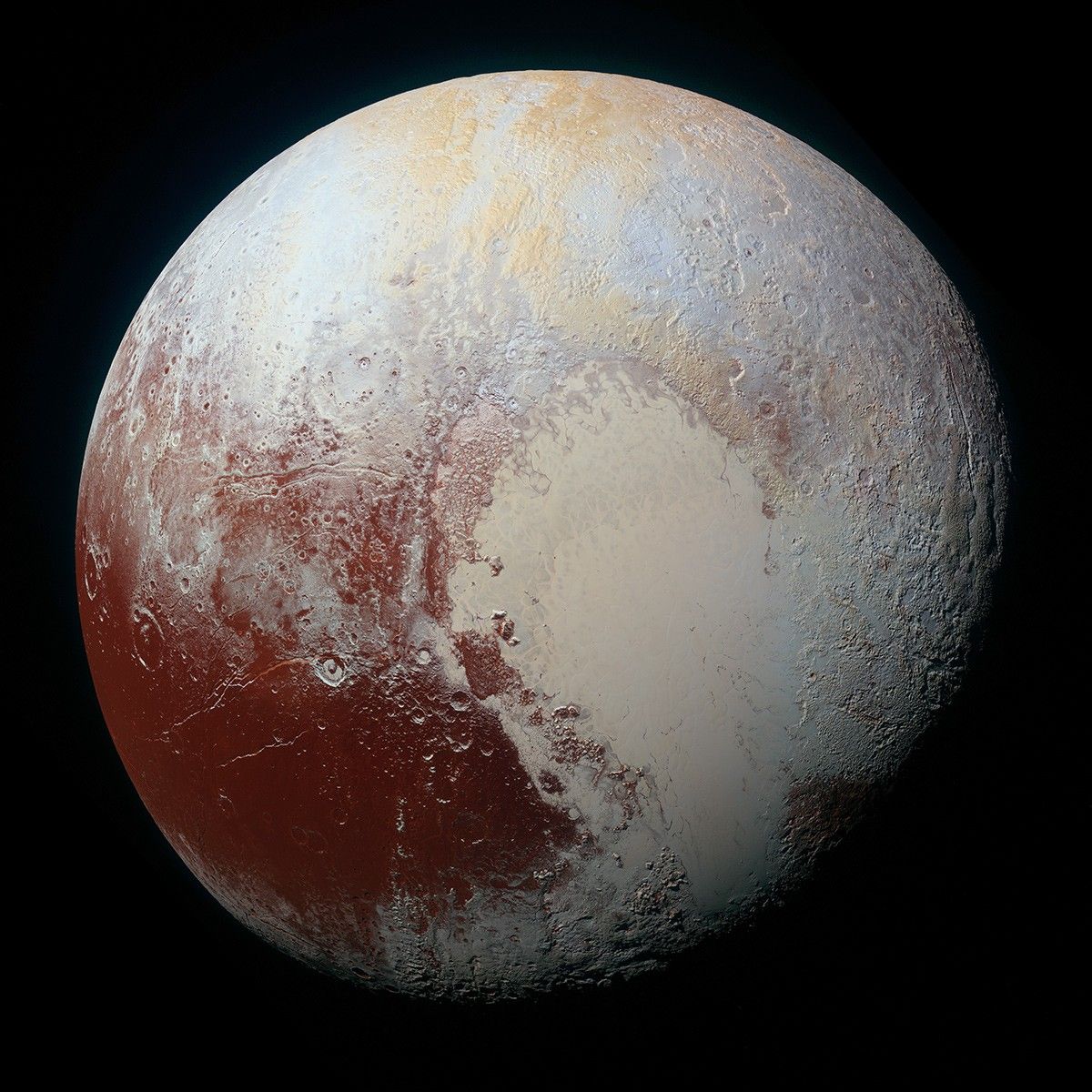
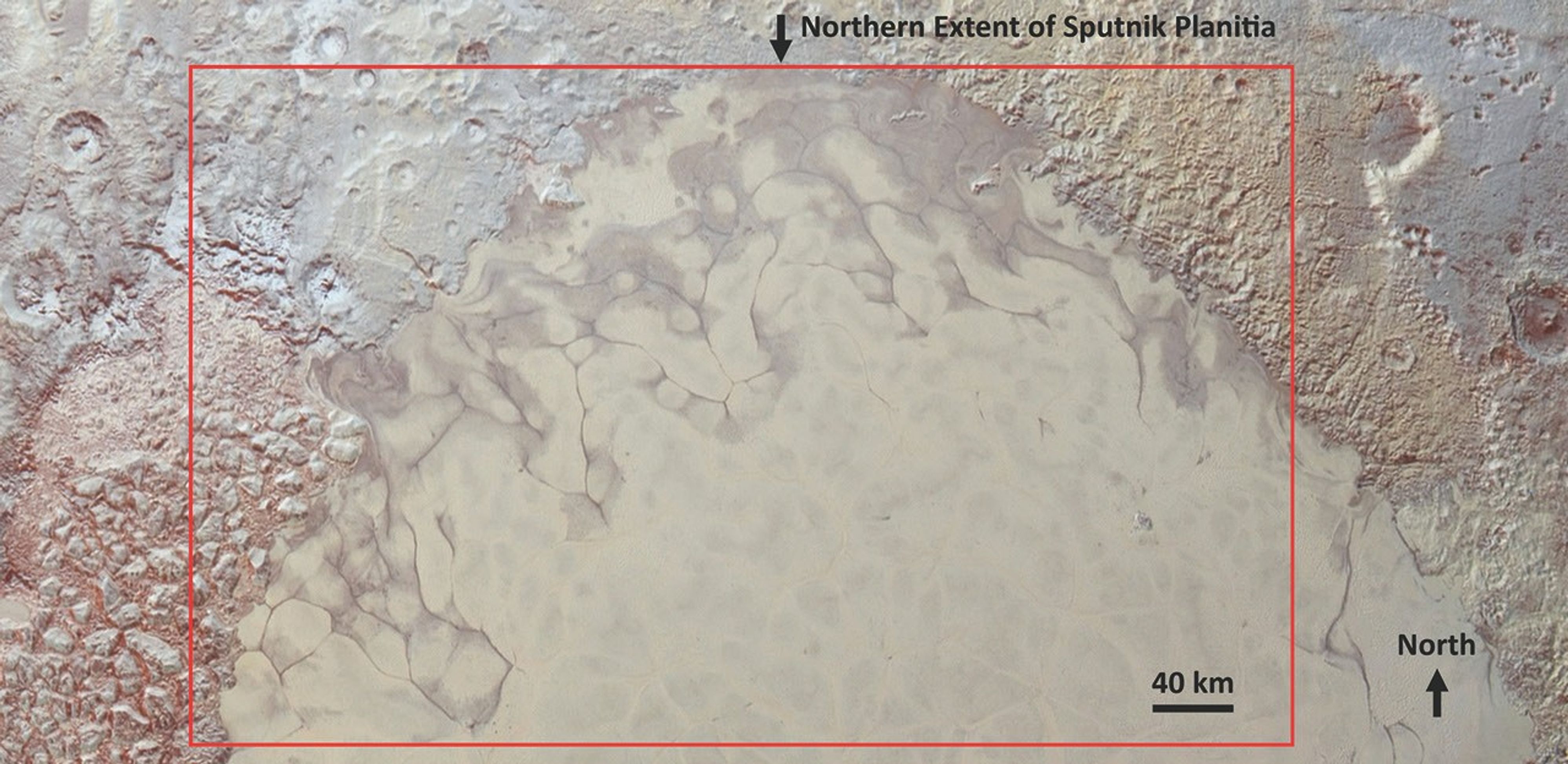
The Planetary Science Journal has published a study by the SouthWest Research Institute in Colorado of possible signs of liquid on Pluto’s surface which is over 200 degrees below zero under a thin nitrogen atmosphere with pressure about 100,000th that of Earth’s. Images of the large kilometres-deep heart-shaped nitrogen glacier known as Sputnik Planitia were examined in fine detail. It is suggested that as the region’s large convection cells of soft nitrogen ice rise and cool (a process thought to be driven by heat from the breakdown of radioactive elements in Pluto’s core), some liquid nitrogen from the deep glacial bed may seep upwards into fissures and reach the surface.
However, before this liquid can freeze it may be wetting the surface and leaving “thin, dark linear… and more diffuse features” around the edges of the glacier’s convection cells. The study compared Pluto with analogous liquid water processes and features seen in high-resolution satellite images of glaciers on Earth, especially in Greenland.
The behaviour of solid or semi-solid nitrogen at extremely low temperatures, and the forces that allow it to become or remain liquid are not well understood. Long considered frozen and inert before New Horizons’ arrival, Pluto continues to challenge and raise questions about ice worlds or moons in the outer solar system, such as Kuiper Belt object Eris and Neptune’s moon Triton.
Explore
Spring Equinox
Here in the southern hemisphere we are about to experience Spring Equinox (or Vernal Equinox from the Latin ver for spring-time, a period of new growth). This is when day and night are effectively the same length. This will occur on Wednesday 23rd and marks the beginning of spring in the southern hemisphere, and autumn in the northern hemisphere.
At the equator at an equinox the noon sun sits directly overhead and both hemispheres receive equal hours of daylight. However, away from the equator the sun’s path in the sky is midway between its high long summer arc and its low short winter one.
The main reason for the seasons lies in our planet’s titled axis of rotation which is 23.5 degrees with respect to its orbit around the sun. At an equinox neither hemisphere leans toward or away from the sun.
However, local day and night are not exactly equal at an equinox. Astronomical timings are based on how long the centre point of the Sun’s disc is above the horizon. A local day effectively starts when the ‘leading edge’ or limb of the Sun broaches the eastern horizon and ends when its ‘tailing edge’ or limb drops below the western horizon.
There is also a terrestrial effect as well. The Earth’s atmosphere refracts or bends light from the Sun so that at sunrise we get the first glimpse of the Sun before it physically crosses the local horizon. The reverse occurs at sunset when we see the Sun for a few minutes after it has already sunk below the western horizon.
Explore
Melbourne Sun times
| Date | Rise | Set | Day Length | Solar Noon* | |
| Tuesday 1st | 6:42am | 5:58pm | 11:16 hrs | 12:20pm | |
| Friday 11th | 6:27am | 6:07pm | 11:39 hrs | 12:16pm | |
| Monday 21st | 6:11am | 6:15pm | 12:03 hrs | 12:13pm | |
| Wednesday 30th | 5:57am | 6:23pm | 12:25 hrs | 12:10pm |
*When the sun is at its highest, crossing the meridian or local longitude.
Moon Phases
| Third Quarter | Friday | 4th |
| TNew Moon | Friday | 11th |
| First Quarte | Saturday | 19th |
| Full Moon | Saturday | 29th |
Moon Distance
Monday 7th is lunar perigee (nearest to Earth) at 368,259 km.
Saturday 19th is lunar apogee (furthest from Earth) at 404,221 km.
Visible Planets
Mercury has just undergone superior solar conjunction moving behind the Sun. It will become visible again later in the month from 6:40pm low in the west before setting by 7:40pm.
Venus is bright and easily seen this month (as the “evening star”) from 6:20pm before setting around 9:40pm. It will appear progressively lower in the west rising and setting a little later each evening.
Mars has reappeared after its solar conjunction. Early in the month it can be seen in the morning rising in the east from 5:40am before being lost in dawn light. By late September it will be rising around 3:20am.
Jupiter, after its solar conjunction, will rise in the east before dawn at 5am and be visible until almost sunrise. By late in the month it will rise from 4:30am.
Saturn is about to reach opposition (opposite side to Sun in our skies). It is visible as a morning planet from 9pm in the west after which is will move across the northern skies before fading in the west by 6am in dawn's light. It will appear a little earlier each night during the month.
Stars and Constellations
In the north
High in the north is Sagittarius (the archer centaur) with its bow and arrow forming the famous asterism The Teapot, the spout of which leads across the zenith to the curving tail of nearby Scorpius.
Lower in the north sits Aquila (the eagle) with Altair or Alpha Aquilae, the 12th brightest star at night. And quite low in the north is Lyre (the lyre) and its principal star Vega or Alpha Lyrae which is the 5th brightest star at night.
In the east
Directly east this month is a trio of adjacent constellations. In the centre is Aquarius, the water bearer while above is Capricornus (the goat), and to its left sits Pisces Austrinus (Southern Fish) with its principal star Formalhaut (Alpha Piscis Austrinus).
In the south
Low in the south-west can easily be seen two of the brightest stars in the night sky, Alpha and Beta Centauri. These are the two brightest stars in the constellation of Centaurus (the centaur) with Alpha Centauri also known as Rigel Kentaurus (foot of the centaur). Together these two stars are referred to as The Pointers as they lead directly to the unmistakable diamond shape of Crux or Southern Cross. Crux is the smallest of the traditional 88 constellations astronomer use and is an easy feature of the night sky to observe, even in city surroundings.
In the south-east is the 10th brightest star Achernar in the long constellation Eridanis (the river) that winds its way down to the horizon.
In the west
High in the west sits the curving tail, body and pincers of the scorpion, Scorpius. Within its body you should see red giant star Antares which will appear more orange than red in light polluted skies. In front of the Scorpion’s wide head and closer to the horizon sits Libra (the scales).
International Space Station
At a distance of about 400km the ISS completes an orbit every 90 minutes and appears as a bright object that moves slowly across the night sky. There will be many visible passes this month over Melbourne and Central Victoria. Here are some of the brightest and highest in elevation this month:
Morning
Tuesday 15th 5:37 to 5:44am North-West to-South-East
Friday 18th 4:51 to 4:55am West-South-West to South-East
There are no high and bright passes during evenings this month.
Heavens Above gives predictions for visible passes of space stations and major satellites, live sky views and 3D visualisations. Be sure to first enter your location under ‘Configuration’.
On this day
| 1st 1939 | Americans J Robert Oppenheimer and Hartland Snyder publish the first paper that describes the gravitational contraction of a star which later led to the modern concept of black holes. |
| 1st 1859 | Carrington Event, most powerful geomagnetic storm ever recorded. Now understood as a Coronal Mass Ejection (CME) from the Sun that hit Earth’s magnetosphere inducing strong northern auroras almost to the equator, and telegraph interference in Europe and North America with operators receiving electric shocks, poles sparking, and signals sent despite power cut off. |
| 1st 1979 | The Pioneer 11 (USA) made the first flyby of Saturn returning the first close-up images of the planet. It was the second probe to pass the asteroid belt and Jupiter and to reach solar escape velocity. Last routine contact was on 30 September 1995 and final data received was on November 1995. |
| 5th 1977 | The Voyager 1 (USA) is launched to explore the outer Solar System. After 42 years it continues sending data and is the most distant probe at 21.8 billion km (146 AU). It entered interstellar space in 2012 and its power supply may last until 2025. |
| 8th 2004 | Genesis (USA) probe crashes in Utah while returning samples of solar wind particles. Some collecting panels survived impact and were recovered giving successful scientific results. |
| 11th 1985 | The International Cometary Explorer or ICE (USA) became the first spacecraft to encounter a comet by flying through the dust tail of Comet Giacobini-Zinner. |
| 14th 1959 | The Luna 2 (USSR) was the first craft to fly to and impact another body, in this case the Moon. It released sodium gas to allow visible tracking, used radio for telemetry transmission, and crashed into Mare Imbrium (the Sea of Rains). |
| 17th 1976 | NASA unveils its concept for a Space Transportation System, a rocket launched and glider return orbiter known as the Space Shuttle. |
| 17th 1857 | The birth of Konstantin Tsiolkovsky, a pioneering Russian then Soviet teacher whose theoretical work on aerodynamics and rocketry influenced all who followed. He advocated spaceflight and believed humans would colonise the galaxy. |
| 18th 1977 | The Voyager 1 (USA) sends the first image of Earth and Moon together taken, from a distance of 11.6 million km while on its way to Jupiter. |
| 21st 1633 | The the Roman Catholic Inquisition begins its trial of Galileo for heresy in publishing and advocating a heliocentric or Sun-centred solar system contrary to church doctrine, dogma and scripture. |
| 23rd 1846 | Neptune, first predicted by Urbain Le Verrier (France), is discovered by Johanne Gottfried Galle (Germany) with John Couch Adams (UK) recognised for an independent discovery. |
| 27th 1905 | Albert Einstein published his paper containing the famous equation E=mc2 (energy equals mass multiplied by the speed of light squared), meaning a small amount of matter is equivalent to, or can be converted into, a great deal of energy. |