Upcoming events



Venus and its one-time moon?
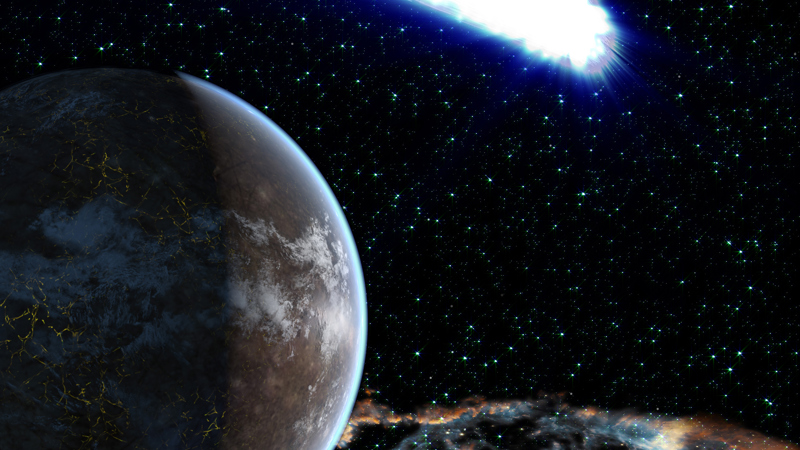
Our planetary neighbour Venus, so bright in the evening skies this month, is similar in size, mass and composition to the Earth. Our planet has a moon but why not Venus? There would have been no shortage of candidates in the inner solar system with numerous protoplanets colliding to become the ‘final four’ terrestrial planets - Mercury Venus, Earth and Mars. During this period Earth acquired a large moon. Could there once have been one for Venus?
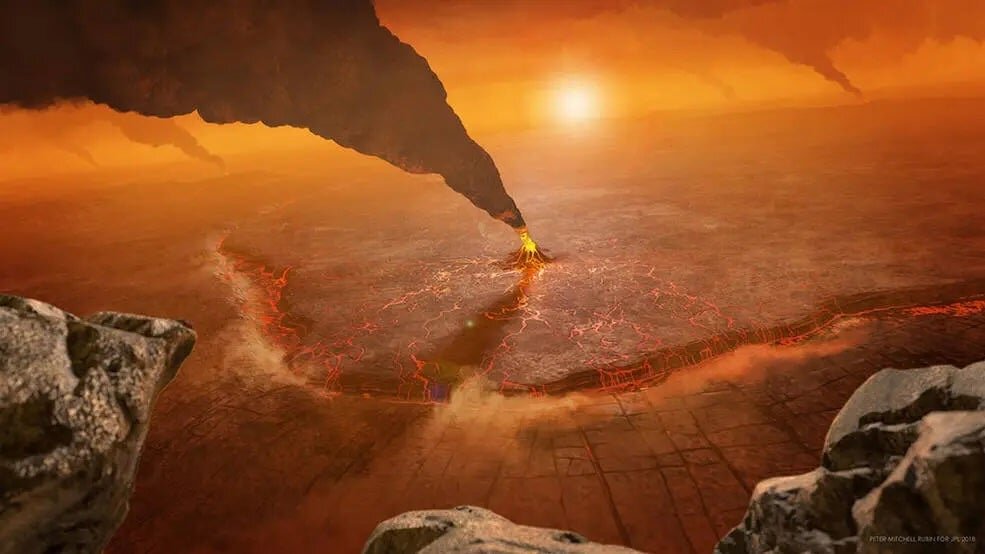
One theory has Venus capturing an object as a moon only to be destroyed by collision with yet another body. An alternative is that by chance Venus was simply unlucky in never gaining a long-lived moon in all the prevailing chaos. However, a new study suggests something different - “Tidal Demise”. Venus may have captured and held a moon for a time but Venus’ slow rotation caused the moon to move ever closer until eventually it crashed into the planet leaving it alone in space.
It goes like this… after Earth acquired a moon a small amount of the energy of our planet’s fast 24-hour spin is continually transferred to the Moon causing its orbital speed to rise and its distance to gradually increase by a few centimetres a year. Venus, however, has an extremely slow rotation of 243 days. Any moon would gain no extra orbital energy, gravity would dominate and draw the moon closer in its embrace. Once such a moon crossed the critical Roche limit tidal forces would overwhelm the moon’s internal integrity bringing on its disintegration and crash into the planet, perhaps leaving a temporary ring of debris. In simulations using different Venus rotation speeds and moon sizes, a new study suggests any moon would ultimately suffer that fate.
But why does Venus spin so slowly in the first place? An early collision with a large protoplanet at the right speed and angle may have dramatically slowed its rotation (and inverted its axis giving the planet its unique retrograde or reversed rotation in comparison to Earth). Any moon captured later would not survive in the long term. In a gradual death spiral it would be drawn in to destruction. A faster rotating Earth gets to keep its moon by gently nudging it away. Slower turning Venus can’t give such an energy boost to a moon and devours it.
The new study also concludes that in the ongoing search for planets beyond our solar system and their potential moons (that is, exoplanets and exomoons), any terrestrial ‘slow spinners’ orbiting in their system’s inner region are not expected to keep large moons.
Explore
- Venus ate its moon: How Earth’s ‘twin’ could have swallowed a rocky satellite
- Venus, backwards rotation and orbital period
Melbourne Sun times
| Date | Rise | Set | Day Length | Solar Noon* | |
| Wednesday 1st | 5:56am | 6:24pm | 12:27 hrs | 12:09pm | |
| Saturday 11th | 6:41am | 7:33pm | 12:51 hrs | 1:06pm | |
| Monday 21st | 6:27am | 7:43pm | 13:15 hrs | 1:04pm | |
| Saturday 31st | 6:14am | 7:53pm | 13:38 hrs | 1:03pm |
Australian Eastern Daylight Time (AEDT) begins on Sunday 4th at 2am when clocks move forward one hour. See What is Daylight Saving Time?
*When the sun is at its highest, crossing the meridian or local longitude.
Moon Phases
| Third Quarter | Saturday | 3rd |
| New Moon | Sunday | 11th |
| First Quarter | Monday | 19th |
| Full Moon | Monday | 20th |
Moon Distance
Saturday 17th is lunar apogee (furthest from Earth) at 406,643 km.
Thursday 29th is lunar perigee (nearest to Earth) at 364,407 km.
Planets
Mercury is now visible low in the west at dusk for two hours before setting.
Venus will soon move in front of the Sun for its inferior conjunction, but this month it can still be seen brightly in the west as the ‘evening star’ before setting two hours after sunset.
Mars is returning to our skies after its recent pass behind the Sun. It can be seen rising in the east in the early morning before fading from view in the dawn light.
Jupiter has also emerged from its passage behind the Sun, its solar conjunction. This bright Jovian planet is visible in the early morning in the east and will move across the north east until eclipsed by dawn’s light ahead of sunrise.
Saturn with its yellow hue continues to be visible in the east in the evening as darkness descends. It will move across the northern sky before setting before dawn the next morning.
Meteors
The Orionids appear from the 15th-29th but peak on the 21st-22nd with perhaps 30 meteors per hour from midnight until dawn. Centred on Orion near the red supergiant star Betelgeuse, they are typically very fast and bright entering the atmosphere at 66 km per second and vaporising 100 km above the surface leaving persistent trails. Dr Tanya Hill and Professor Jonti Horner explain the meteor shower in The Conversation.
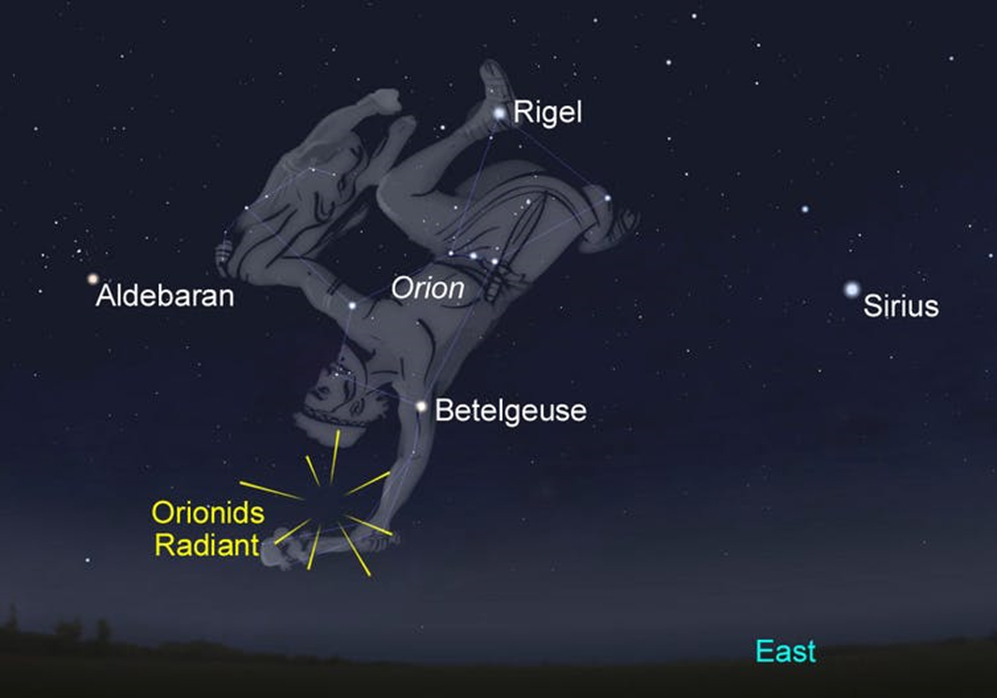
The Orionids shower was first recorded by the Chinese in 288 AD and is associated with Comet Halley. In 1705, Edmund Halley, after studying records of comets that seemed to re-occur and using Isaac Newton’s new laws of motion, calculated the comet’s orbit and predicted its return in 1758 (something he did not live to see). Every 75 years Comet Halley passes through the inner solar system leaving a trail of particles for Earth to pass through twice a year - the April/May Eta Aquarids and the October Orionids.
Explore
Stars and constellations
In the north
Visible this season are Aquila (the Eagle) and its principal star Altair (Alpha Aquilae) directly north.
In the west
Scorpius is now moving down to the west with the red-giant star Antares the middle of three stars that mark the scorpion’s body. High above following the scorpion is the asterism ‘the teapot’ which gives you the position of the bow and arrow held by the centaur Sagittarius. The centre of our Milky Way galaxy lies in that direction some 26,000 light years away.
In the east
Formalhaut in Piscis Austrinus (Southern Fish) is the bright evening star in the east this month. But as spring ends and we move towards summer we will progressively begin to see from the north-east to the south-east a rich collection of night sky objects:
- The beautiful Pleiades cluster (the Seven Sisters).
- Taurus the bull with red giant star
- The inverted Orion the hunter (with the right way up ‘Saucepan’ at its centre), and red supergiant
- Canis Major and the brightest night time star Sirius (also known as The Dog Star).
In the south
In a dark sky in the south-east are the isolated Large and Small Clouds of Magellan (our galaxy’s nearest neighbours) as well as the vast band of billions of stars and dark dust clouds that make up what we can see of our own galaxy, the Milky Way. In the evenings this month it runs in a broad arc from south to north. From our location in our disc-shaped galaxy we have an edge-on view along the plane of the galaxy where the density of stars is greatest. As you look away from the Milky Way to either side of the sky you see far fewer stars because in those directions you are looking through only a few thousand light years out into intergalactic space, to the north or to the south of the galactic plane.
Low in the south-west are the Pointers, Alpha and Beta Centauri, in the constellation of Centaurus (the other centaur in our night skies). Following the line of the two bright Pointers leads to the Crux (Southern Cross).
International Space Station
At a distance of about 400km the ISS completes an orbit every 90 minutes and appears as a bright point slowly moving across the night sky. Here are some of the brightest passes expected this month over Melbourne:
Morning
Sunday 4th 6:20 to 6:27am South-West to North-East
Monday 5th 5:33 to 5:39am South-West to East-North-East
Evening
Sunday 4th 6:20 to 6:27am South-West to North-East
Monday 5th 5:33 to 5:39am South-West to East-North-East
Heavens Above gives predictions for visible passes of space stations and major satellites, live sky views and 3D visualisations. Be sure to first enter your location under ‘Configuration’.
On this day
| 3rd 1942 | The first object to reach space, the experimental V2 (‘Vengeance’) rocket, was launched from Peenemünde, Germany in a brief flight over the Baltic. |
| 4th 1957 | The Sputnik (USSR) was launched to become the first artificial satellite. |
| 4th 2004 | The SpaceShipOne was launched as the first private spacecraft into space. |
| 5th 1923 | Edwin Hubble (USA) established that M31, the Andromeda Galaxy, is separate to our own Milky Way Galaxy. |
| 7th 1959 | The first photos of the moon’s far side are taken by Luna 3 (USSR). |
| 9th 1604 | A Type1A supernova 20,000 light years away in constellation Ophiucus is visible from Earth, and on 17th Johannes Kepler observes and publishes his account of the new star. It is the most recent supernova visible to the naked eye in our galaxy. |
| 10th 1967 | The United Nations’ Outer Space Treaty on the peaceful exploration and use of space was established. By now 109 nations are signatories and several other agreements and conventions have been created to cover space law. |
| 11th 1958 | The Pioneer 1 (USA), a battery- powered probe aiming for lunar orbit, fails to reach escape velocity and burns up. |
| 11th 1968 | The first crewed Apollo mission, Apollo 7 (USA), launched into Earth orbit in test of Saturn V rocket and Command and Service Module (CSM). |
| 12th 1964 | The USSR’s Voskhod 1 (‘Sunrise’) was the first spacecraft with a crew of more than one. In this case, three cosmonauts who orbited for 41 hours. |
| 13th 1773 | The Whirlpool Galaxy M51a, 31 million light years away in constellation of Canes Venatica, is discovered by astronomer Charles Messier. |
| 18th 1967 | The Venera 4 (USSR) is the first probe to analyse the atmosphere of another planet when it does so at Venus. |
| 19th 1910 | The birth of Subrahmanyan Chandrasekhar who had major insights into stellar evolution and black holes. |
| 24th 1998 | The Deep Space 1 (USA) probe was launched to test innovative technologies, including an ion engine, while visiting Asteroid Braille and Comet Borrelly. |
| 27th 1994 | The first sub-stellar object orbiting a star is found, a brown dwarf at Gliese 229. |
| 29th 1991 | The Galileo probe (USA) is the first to visit an asteroid, Gaspra 951, on its way to Jupiter. |
| 31st 2000 | The Expedition 1, first resident crew of the International Space Station, arrived by a Russian Soyuz craft for a 136 day stay lasting until March 2001. The three-person crew (one American and two Russians) made the station fully operational, hosted three visiting US Space Shuttles, and received two Russian Progress supply vehicles. |