Upcoming events


What Goes Up …
A recent research article has looked into the sun’s 11-year solar activity cycle which effects the number of sunspots, the strength of the solar wind of particles that stream into space, auroras on Earth, the dynamics of our atmosphere, and objects in orbit. A more active Sun will inject more energy into Earth’s upper atmosphere which in turn will expand causing more drag on satellites and space debris. The conclusion drawn was that this will affect the orbital decay and reentry of such objects, whether they be critical (and expensive) satellites or the vast number of pieces of space junk caused by human activity.
While that may not come as a surprise to the multi-billion-dollar space industry, at least to those who have being paying attention, the study adds rigour by comparing sun activity with orbital decay patterns. Over several sun cycles from 1986 to 2024, the authors saw a correlation between sunspots and the declining altitudes of a number of satellites.
This study of solar activity and its effect on our atmosphere adds valuable context to the European Space Agency’s 2025 report into the acceleration of space launches and the problem of an increasingly crowded Earth space environment and the rising risk of collision and orbital debris.
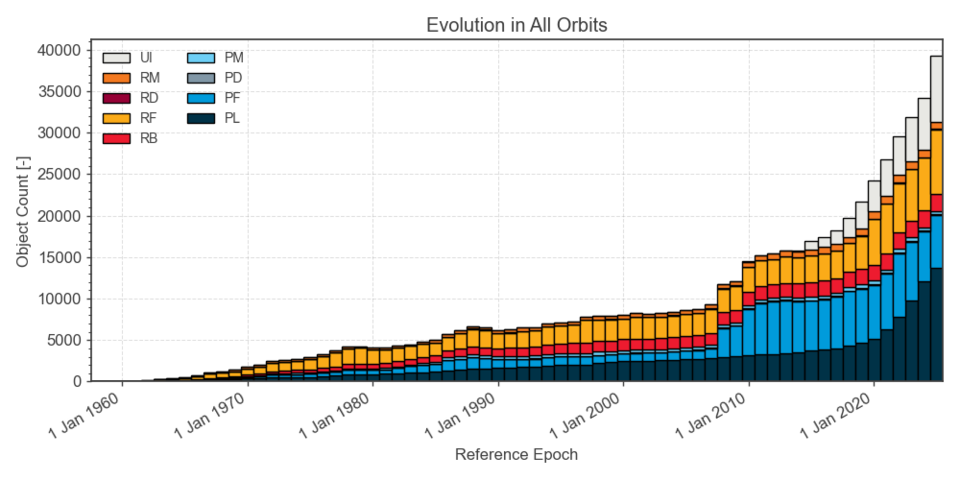
As the “Evolution in All Orbits” graph shows (with gross numbers at left and year range at bottom), orbiting objects of all sorts has steadily increased over the last 60 years, and especially dramatically in the last 15. The colours indicate the type of object: white for unidentified; orange, reds and yellow for rocket-related; and blues and grey for payload-related. ESA
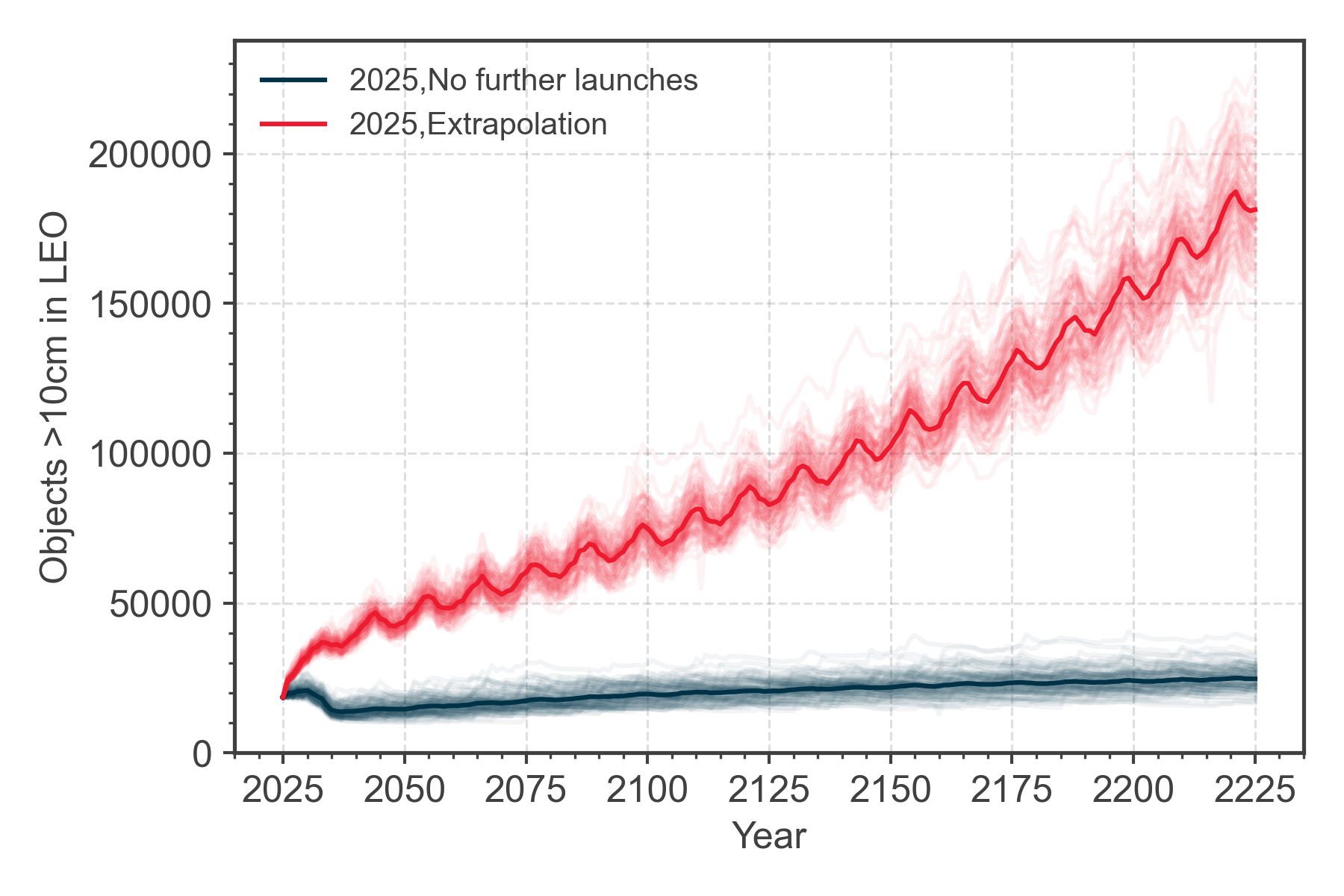
The second graph (with numbers at left and future years at bottom) shows two scenarios; an unrealistic end to launches shown by the largely grey flat line, and an alarming red extrapolation from current trends with a significant increase into the future. With the planned launching of tens of thousands of communication satellites, notably by Space X and Amazon, the future seems worrying if not bleak. ESA
Learn more at:
Explore more: ScienceNews - Space junk falls back to Earth faster as sunspot numbers climb
PhysOrg – Study shows how sunspots activity speeds up reentries
BOM Solar Cycle and Orbital Space Debris
ESA Space Environment Report 2025
Winter Solstice this month
The mid-year Solstices for 2026 fall on the 21st of this month. In the Southern Hemisphere is will be Winter Solstice and in the north Summer Solstice. For southern mid-latitudes the sun will rise and set at its most northerly points on the horizon. The Sun’s path across the sky will be the both the shortest and the lowest of the year. We will experience daylight of only 9.5hrs, and the sun’s rays will be at their shallowest angle of the year providing the least energy per square metre.
Museums Victoria Reasons for the Seasons
Melbourne Sun times
| Date | Rise | Set | Day Length | Solar Noon* | |
| Monday 1st | 7:26am | 5:09pm | 9:43 hrs | 12:17pm | |
| Thursday 11th | 7:32am | 5:07pm | 9:35 hrs | 12:19pm | |
| Sunday 21st | 7:35am | 5:08pm | 9:32 hrs | 12:21pm | |
| Tuesday 30th | 7:36am | 5:11pm | 9:34 hrs | 12:23pm |
*When the sun is at its highest, crossing the meridian or local longitude.
Moon Phases
| Third Quarter | Monday | 8th |
| New Moon | Monday | 15th |
| First Quarter | Monday | 22nd |
| Full Moon | Tuesday | 30th |
Moon Distance
Monday 15th is lunar perigee (nearest to Earth) at 357,198 km.
Monday 15th is lunar apogee (furthest from Earth) at 406,366 km.
Planets
Mercury is not visible this month as is about to pass behind the Sun for its solar conjunction.
Venus as the ‘evening star’ can be seen from 5: 30am in the north west before setting by 7pm.
Mars, after its solar conjunction, is a pre-dawn object seen in the east from 4:50am before fading by 6:40am.
Jupiter has now passed its solar conjunction and is visible this month at dusk around 5:23pm in the north-east and will set by 8:00pm.
Saturn can be seen rising in the north-east from 2:20am and will fade in dawn’s light.
Meteors
There are two minor meteor showers this month. The Arietid Meteor Shower (in the constellation of Aries) occurs through to June 24 but peaks on June 11th. From Melbourne the shower is likely best seen just before dawn. Although low in number (less than 10 per hour) they can often be spectacular and bright with many displaying a yellow/orange colour.
The Bootid Meteor Shower (in the constellation of Bootes) appears late in June and into early July. The best time to see meteors is after midnight with no moon in the night sky.
Learn more at:
EarthSky Arietid Meteor Shower
In-The-Sky Bootid Meteor Shower
Stars and constellations
In the west
Although Orion has disappeared below the western horizon but his two dogs Canis Major with the star Sirius (low in the west) and Canis Minor with the star Procyon (low in the north-west) are still both in our skies.
In the north
Leo the lion is still visible in the north-west with the bright star Regulus. Look for a large hook of stars, or inverted question mark, to locate his curving mane and shoulders.
In the east
Scorpius is in the south-east this month with the red-giant star Antares as the middle of three stars that form the scorpion’s body. During winter the centaur-archer Sagittarius suits below the scorpion with its bow and arrow (the famous ‘Tea Pot’ asterism).
In the south
High in the south-east is Crux or The Southern Cross with the Pointers (Alpha and Beta Centauri) lower down. In darker skies the two neighbouring galaxies, the Large and Small Clouds of Magellan, can be seen as small isolated patches in the south-west. From our southern latitude they are easily seen every night.
In dark locations the broad band of the Milky Way’s billions of stars and numerous interstellar dust clouds stretches across the sky from horizon to horizon. While some foreground stars in our local region of the galaxy can be seen, the dark dust clouds obscure our view further into the galaxy since our eyes and optical telescopes ‘see’ in only the visible part of the spectrum.
International Space Station
ISS orbits every 90 minutes at an average distance of 400 km appearing like a bright star moving slowly across the night sky. Here are some of the brightest passes expected this month over Melbourne:
Morning
Monday 1st 6:39am-6:46am South-West to North-East
Tuesday 2nd 5:53am-5:58am South-South-West to East-North-East
Evening
Saturday 13th 6:35pm-6:39pm North-West to South-East
Monday 29th 6:42pm-6:45pm South-West to South-South-East
Heavens Above gives predictions for visible passes of space stations and major satellites, live sky views and 3D visualisations. Be sure first to enter your location under ‘Configuration’.
On this day
| 1st 2002 | The Czech Republic becomes the first country to ban light pollution. |
| 2nd 1966 | The Surveyor 1 (USA) lands on Moon as first probe to land on another body. |
| 3rd 1965 | Ed White takes America’s first spacewalk as part of Gemini IV. |
| 6th 1971 | The Soyuz 11 (USSR) carries the first people to a space station (Salyut 1). |
| 7th 1879 | Joan Voute proves with parallax that dwarf star Proxima Centauri is the same distance as Alpha Centauri binary. |
| 8th 2004 | A Transit of Venus is observed, the first in 122 years. |
| 9th 1986 | The Rogers report on Space Shuttle Challenger explosion reveals solid rocket booster fault and serious management and safety problems with US program. |
| 10th 2003 | The launch of Mars Exploration Rover Spirit (USA) which lands in 2004 and exceeds expectations operating to 2010. |
| 13th 1983 | The Pioneer 10 (USA) becomes the first spacecraft to travel beyond the planets of the Solar System. |
| 13th 2010 | Hyabusa (Japan) craft returns the first asteroid samples to Earth. |
| 14th 1962 | European Space Research Organisation (ESRO) begins, later to be part of European Space Agency (ESA). |
| 15th 763 BCE | Assyrians record a total solar eclipse which has helped in dating other events in Mesopotamian history. |
| 16th 1911 | A meteorite weighing 772g strikes a barn in rural Wisconsin (USA). |
| 16th 1963 | Valentina V. Tereshkova (USSR) is the first woman in space in Vostok 6, the first civilian into space, and the only woman to undertake a solo space flight. |
| 17th 1969 | The Venera 6 (USSR) descends into Venus’ dense atmosphere sending data before being crushed by rising pressure. |
| 18th 1983 | Sally Ride is first American woman in space aboard Shuttle Challenger. |
| 20th 1990 | Asteroid Eureka found as part of the Trojans asteroid group orbiting at Mars’ L5 Lagrange point. |
| 21st 2004 | The SpaceShipOne (USA) launched as first privately-funded human space flight. |
| 21st 2006 | Pluto’s small moons Nyx and Hydra are named. |
| 22nd 1633 | Galileo recants his sun-centred solar system model under threat of torture by the Catholic Inquisition. |
| 22nd 1978 | Dr James W. Christy (USA) discovers Pluto’s large moon Charon. |
| 24th 1883 | Discoverer of cosmic rays, Victor Francis Hess, is born. |
| 24th 1915 | The birth of Fred Hoyle, who explained the creation of elements in stars, promoted the steady state universe, and coined the pejorative term ‘big bang’ for the rival model of the universe’s creation. |
| 29th 1818 | Angelo Secchi born, one of the first astronomers to believe the Sun is a star. |
| 29th 1995 | The Space Shuttle Atlantis (USA) – first docking at Russia’s Mir Space Station. |
| 30th 1908 | A meteor several metres in size explodes over Tunguska (Russia) destroying 2,200 km2 of forest in a multi-megaton blast. |
| 30th 1971 | The Soyuz 11 (USSR) was the only mission to visit the first space station Salut 1 (USSR) after which its crew of three became the only humans known to have died in space when their cabin depressurised prior to re-entry. |