Upcoming events




Planetary milestone moment
Last month Earth experienced Winter Solstice in the southern hemisphere and Summer Solstice in the north. This month our planet passes through another of its annual milestone moments. On July 6th it will be aphelion, Earth’s furthest point from the Sun in the year.
On an elliptical orbit Earth will sit 5 million km more distant than its closest point to the Sun which is perihelion in January. It might seem reasonable to assume Earth’s changing distance from the Sun influences the seasons, but the change from aphelion (152.1 million km in July) to perihelion (147.1 million km in December) has a negligible effect. The main factor that brings on the seasons is Earth’s tilted axis of rotation which makes each hemisphere alternate between leaning towards the Sun in summer or then leaning away in winter.
Explore more at:
timeanddate Perihelion and Aphelion
Melbourne Sun times
| Date | Rise | Set | Day Length | Solar Noon* | |
| Wednesday 1st | 7:36am | 5:11pm | 9:34 hrs | 12:23pm | |
| Saturday 11th | 7:34am | 5:16pm | 9:42 hrs | 12:25pm | |
| Tuesday 21st | 7:29am | 5:23pm | 9:54 hrs | 12:26pm | |
| Friday 31st | 7:21am | 5:31pm | 10:10 hrs | 12:26pm |
*When the sun is at its highest, crossing the meridian or local longitude.
Moon Phases
| Third Quarter | Wednesday | 8th |
| New Moon | Tuesday | 14th |
| First Quarter | Tuesday | 21st |
| Full Moon | Friday | 30th |
Moon Distance
Monday 13th is lunar perigee (nearest to Earth) at 359,114 km.
Sunday 26th is lunar apogee (furthest from Earth) at 405,548 km.
Visible Planets
Mercury is not visible during its Inferior Solar Conjunction as it passes in front of the Sun.
Venus continues in our skies from 5:30pm in the northwest before setting by 8:30pm. Often referred to as the Evening Star, it will look like the first star of the night. It is the brightest object of the night, second only to the Moon.
Mars returns again to our night after its passage behind the Sun (its Solar Conjunction). It will be visible rising around 4:30am before being lost in the early dawn early light.
Jupiter, after being in our night skies for some months, has begun its pass behind the Sun (Solar Conjunction) and is visible.
Saturn is again visible after its Solar Conjunction. It will rise in the east from 1:10am after which it will move across the northern sky before fading by 7am in the dawn light. During the month it can be seen a little earlier each night.
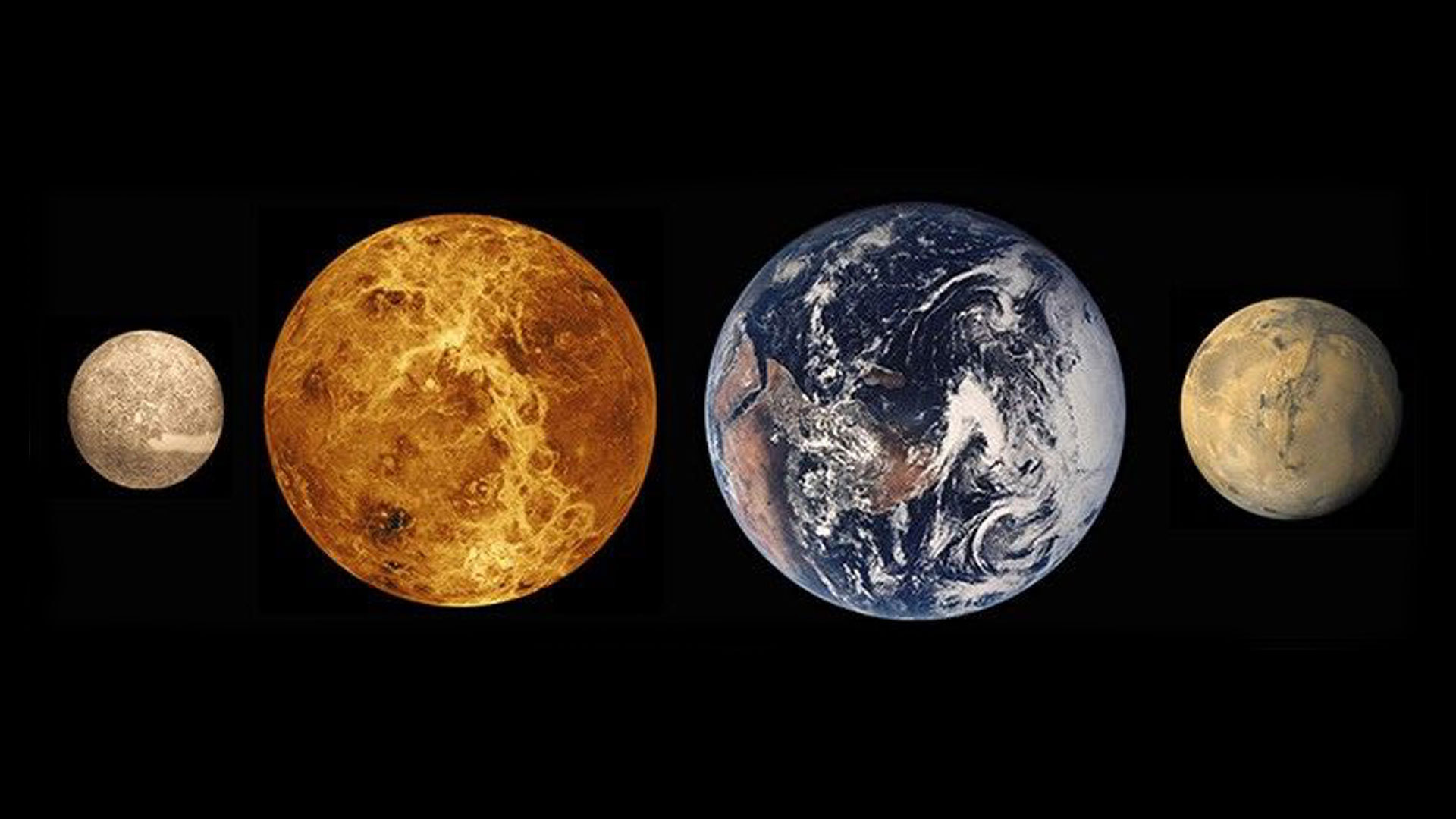
Relative sizes of the inner terrestrial planets in order from the Sun: Mercury, Venus, Earth and Mars. The surface of Venus, obscured in visible light by a thick carbon dioxide atmosphere, is revealed in radar imaging by the Magellan Orbiter of the early 1990s. Mercury with no effective atmosphere, Earth with a largely nitrogen-oxygen atmosphere, and Mars with a thin carbon dioxide atmosphere, are seen in visible light. Image NASA
Learn more at:
NASA The Solar System
Meteors
There are no strong meteor showers in July but on the 27th-30th the Southern Delta Aquariids could be seen high in the north a few hours before dawn in the constellation of Aqaurius, the water bearer, radiating from near Skat (Delta Auquarii), the fourth brightest star in that constellation.
See
NASA Southern Delta Aquariids
Earthsky Detla Aquariid Meteor Shower
Stars and constellations
In the west
Canis Major (and Sirius, brightest of the night time stars) is much lower this month in the west, while Orion the Hunter has now completely disappeared below the western horizon.
In the north
Canis Major (and Sirius, brightest of the night time stars) is much lower this month in the west, while Orion the Hunter has now completely disappeared below the western horizon.
In the east
Scorpius rises much higher in the south-east with the red-giant star Antares easily seen even from areas with city lights. Below and now fully revealed is the centaur-archer Sagittarius whose bow and arrow forms the famous asterism the Tea Pot. Beyond Sagittarius lies the centre of the galaxy with the supermassive black hole Sagittarius A* (Sag A* for short) imaged in 2019 by the Event Horizon Telescope Collaboration with results released in 2022.
See:
Astronomy Australia: First direct evidence of supermassive black hole
ESO: EHT Meet the black hole at the centre of our galaxy
In the south
The Southern Cross or Crux is high up directly south and, to the left, are the Pointers (Alpha and Beta Centauri which mark the front hooves of Centaurus, the other celestial centaur in our winter skies.
The billions of distant stars and numerous dark dust clouds of the Milky Way form a broad band across the evening sky from east to west which gradually ‘wheels’ around the sky as Earth rotates on its axis. From our southern perspective we enjoy a superb view of the galaxy quite different to most northern hemisphere locations.
In the south-west are the irregular neighbouring galaxies, the Large and Small Clouds of Magellan. These nearby companions to the Milky Way are not visible from mid to high latitudes of the northern hemisphere.
Also visible are the bright stars Canopus in the south-west and Achernar closer to the horizon in the south.
International Space Station
ISS orbits every 90 minutes at an average distance of 400 km appearing like a bright star moving slowly across the night sky. Here are some of the brightest passes expected this month over Melbourne and Central Victoria:
Evening
Wednesday 1st 6:50pm-6:55pm West-South-West to North-East
Thursday 2nd 6:22pm-6:09pm South-West to North-East
Morning
Tuesday 14th 6:45am-6:51am West-North-West to South-East
Wednesday 15th 5:58am-6:03am North-North-West to South-East
Heavens Above gives predictions for visible passes of space stations and major satellites, live sky views and 3D visualisations. Be sure to first enter your location under ‘Configuration’.
On this day
| 1st 1770 | The closest pass to Earth of any known comet: Comet Lexell at 2.2 million km (roughly 5.5 times the moon’s distance). |
| 24th 1054 | Chinese and other astronomers witness the supernova explosion that produced the Crab Nebula 6500 light years away. |
| 4th 2005 | The Deep Impact probe (USA) crashes into Comet Tempel 1 to analyse its composition. |
| 4th 1868 | The birth of Henrietta Swan Leavitt who established the luminosity-period relationship of Cepheid variable stars allowing Edwin Hubble to show ‘nebulae’ were other galaxies beyond our own. |
| 4th 1643 | The birth of Isaac Newton famous for studies in optics, the reflecting telescope, laws of gravitation and motion, and co-creator of calculus. |
| 5th 1687 | Isaac Newton’s Mathematical Principles of Natural Philosophy is published laying the groundwork for much of modern science. |
| 7th 1959 | Venus’ diameter is determined and its atmosphere analysed by its occultation of the star Regulus in Leo. |
| 8th 2011 | The space shuttle Atlantis (USA) is launched on the final mission for the shuttle program. |
| 10th 1962 | The first communications satellite Telstar (USA) is launched as an experiment in trans-Atlantic communication. |
| 11th 1979 | The Skylab 1 (USA) is destroyed during re-entry over Western Australia and scatters debris over a wide area. |
| 14th 1965 | The Mariner 4 (USA) makes the first controlled flyby of Mars and returned the first close-up images of the planet. |
| 15th 1975 | The Apollo-Soyuz Test Project mission occurs. An American Apollo module with three astronauts (launched with the last Saturn rocket) and a Soviet Soyuz craft with two cosmonauts rendezvous and dock in Earth orbit. |
| 16th 1746 | The birth of Giuseppe Piazzi, discoverer of the dwarf planet Ceres in the asteroid belt. |
| 16th 1969 | The Apollo 11 (USA) launches to moon for the first lunar landing 5 days later. |
| 16th 1994 | Jupiter is struck by over twenty fragments of Comet Shoemaker-Levy 9 with Earth-based telescopes and the Hubble Space Telescope observing the unique event. |
| 20th 1969 | The Apollo 11 (USA) Moon landing when Lunar Excursion Module ‘Eagle’ touched down in the Sea of Tranquility. |
| 21st 1969 | The first humans set foot on another world. At 12:39pm AEST Neil Armstrong becomes the first person to step onto the Moon and is followed 20 minutes later by Buzz Aldrin, while the third Apollo 11 astronaut, Michael Collins, remains in the Command Service Module ‘Columbia’ in lunar orbit. Armstrong and Aldrin are on the moon for 21hrs 36min. |
| 22nd 1784 | The first use of parallax and hence calculation of the distance to a star by Friedrich Bessel. |
| 23rd 1995 | Alan Hale and Thomas Bopp discover comet now named after them. |
| 23rd 1928 | Vera Rubin born – famous for analysing rotation rates of galaxies. |
| 24th 1969 | The first lunar landing mission, Apollo 11, ends with Command Module splashdown in the Pacific Ocean. |
| 30th 1971 | The first Lunar Rover used on the moon in Apollo 15 Mission. |
| 29th 2005 | Dwarf planets, Eris and Makemake, are announced leading to Pluto becoming a dwarf planet as well. |