Upcoming events




Our crowded corner of space
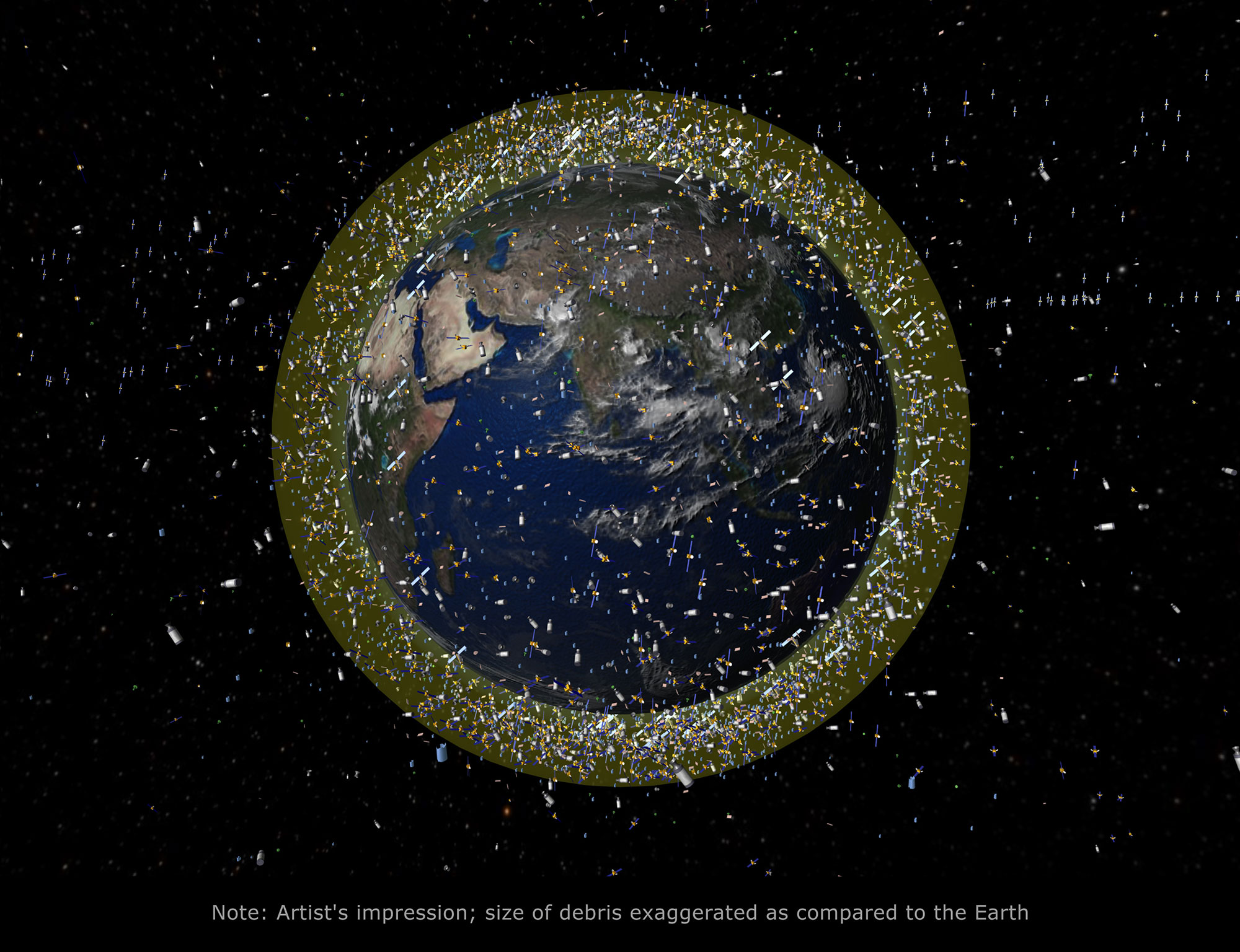
We know Earth is surrounded by thousands of active and inactive satellites, and tens of thousands of pieces of orbital debris (aka 'space junk'), but the accelerated growth in satellites providing global communications and internet coverage, especially in Low Earth Orbit (LEO), raises serious and worrying issues for astronomy.
Now that SpaceX has placed over 10,000 satellites in orbit, we may wonder what is Earth’s safe orbital ‘carrying capacity’. Over 20 corporations have launched communications satellites into Low Earth Orbit (LEO). Some have also been placed into Medium Earth Orbit (MEO), such as GPS systems at 20,000km, and geostationary satellites in High Earth Orbit (HEO) at 36,000km. In terms of the number of current satellites, by far the majority are from SpaceX Starlink, followed by lesser numbers by OneWeb (UK), Amazon Leo, SpaceX Starshield and Xingwang (China).
SpaceX has approval from US regulators for around 42,000 more LEO satellites. While plans from others, such as ESpace, seem more like business hopes or politicking, the overall trend across the sector is accelerating with more parties entering the market. And with the growth of terrestrial data centres, some corporations intend on satisfying that rising demand by creating space-based orbiting data centres. SpaceX’s own ambition is to launch perhaps a million satellites into LEO.
Once ‘constellation’ referred only to star patterns but now it increasingly covers fleets of satellites in Earth orbit. Other problems are rising as well. LEO satellites do not last forever and those that inevitably leave orbit and burn up on re-entry are said, on average, to leave a residue of around 30kg of aluminium oxide in the upper atmosphere raising questions of this being an “uncontrolled chemical experiment”. And while amateur and professional astronomers wrestle with worsening terrestrial light pollution, compounding their problems they now regularly report image pollution from satellites that detract from sensitive telescope observations.
It is not just in optical astronomy either. A disturbing pattern is emerging for radio astronomy. In one example, researchers using Australia's Square Kilometre Array SKA-Low facility in Western Australia, have reported up to 30% of their data was effected by electromagnetic interference from SpaceX satellites in frequencies that should otherwise be free from such radio pollution.
Explore:
Starlink - dynamic 3D orbit display
What's up in space
SpaceX now has more than 10,000 Starlink satellites in orbit
10,000 Starlink satellites orbiting Earth … and counting
A million new SpaceX satellites will destroy the night sky — for everyone on Earth
Melbourne Sun times1
| Date | Rise | Set | Day Length | Solar noon2 | |
| Wednesday 1st | 7:33am | 7:13pm | 11:40 hrs | 1:24pm | |
| Saturday 11th | 6:42am | 5:59pm | 11:16 hrs | 12:21pm | |
| Tuesday 21st | 6:51am | 5:45pm | 10:53 hrs | 12:18pm | |
| Thursday 30th | 6:59am | 5:34pm | 10:34 hrs | 12:17pm |
1 Daylight Savings time ends 3am, Sunday 5 April, with clocks turned back 1 hour.
2 When the sun is at its highest, crossing the meridian or local longitude.
Moon Phases
| Full Moon | Thursday | 2nd |
| Third Quarter | Friday | 10th |
| New Moon | Friday | 17th |
| First Quarter | Friday | 24th |
Moon Distance
Tuesday 7th is lunar apogee (furthest from Earth) at 404,970 km.
Sunday 19th is lunar perigee (nearest to Earth) at 361,633 km.
Planets
Mercury is visible early in the month in the eastern sky from around 4:20am before fading by sunrise. It will appear a little earlier each morning before it finally is lost to view as it moves behind then Sun.
Venus will become visible again by the 18th as it emerges from the Sun when it will be in the north-west from around 6pm before setting by 7pm.0am.
Mars will return to our skies later this month after its passage behind the Sun. On the 18th the Red Planet will be in the east before dawn from 5am and then fade by sunrise.
Jupiter will be visible in the north from 6:15pm early in the month before setting in the west around 11pm. During the month it will rise and set a little earlier each night.
Saturn will become visible again by the 20th in the eastern early morning skies from around 5am before being lost in the dawn light.
Meteors
April’s main shower, The Lyrids, is centred near the bright star Vega low in the north at 3am. It is active from 16th to 25th peaking on the 22nd to 23rd. Better placed is the Pi-Puppids associated with Comet Grigg-Skjellerup which peaks on 24th centred low in the south-west near Canopus in Carina.
Stars and constellations
In the South
The Southern Cross can be found on its side in the south-east with the Two Pointers below. To the right of the Cross, in the south-western sky, is the star Canopus, the second brightest star in the night sky. Low in the south is Achernar, the head of the river Eridanus. Achernar never sets in Melbourne and is called a circumpolar star as it moves through an apparent circle around the South Celestial Pole as Earth rotates on its axis, half the circle during the night when visible and the other half during daytime.
In the North to South-West
If a dark location you can see the Large and Small Clouds of Magellan, two small neighbouring galaxies to our own Milky Way. They appear as irregular fuzzy patches isolated from the broad band of stars that runs across the sky which is our edge-on view of own galaxy.
In less light-polluted skies you can also see in the Milky Way several dark regions that are vast clouds of dust. Whilst we may see a few foreground stars, the dark areas behind obscure our view of more distant stars of the galaxy.
In the West
Orion, the hunter, is in the west lying almost on his side with the red-giant star Betelgeuse as one of his shoulders. The three bright stars that form an obvious line are Alnitak, Alnilam and Mintaka. They mark his belt and also conveniently the base of the local ‘Saucepan’ asterism. The handle of the saucepan is Orion’s scabbard which hangs from his belt. Continuing the belt stars above and a little to the right we reach Sirius, the brightest star in the night sky and principal star in Canis Major (greater or larger dog) which is one of Orion’s hunting dogs. Below Sirius in the north-west is Procyon which marks the position of his lesser or smaller dog Canis Minor.
Below Orion and drawing closer to the horizon during the month is the Hyades, an open group of stars that form a sideways wedge or V. This is the triangular head of Taurus, the bull, with his ‘angry eye’ as the red-giant star Aldebaran on the corner.
In the North
In the north but upside down from our southern hemisphere perspective is Leo, the lion. This constellation is easily recognised by the hook shape (or inverted backwards question mark) of stars that forms the mane on the lion’s head and shoulders.
To the left of Leo and close together are the two bright stars Castor and Pollux, the principal stars in the constellation of Gemini, the twins which appears upside down as well from southern latitudes.
In the east
Later this month and into May the spectacular constellation of Scorpius will begin its return to our evening skies. This is one of the largest constellations and when it appears low in the east you can easily identify to the left its long curving tail leading to its body containing the red-giant star Antares marking its heart, and to the right its pincers reaching out.
International Space Station
ISS orbits every 90 minutes at an average distance of 400 km appearing like a bright star moving slowly across the night sky. Here are some of the brightest passes expected this month over Melbourne and Central Victoria:
Morning
Friday 3rd 6:57am to 7:04am, South-West to North-East.
Saturday 4th 6:11am to 6:16am, South-South-East to East-North-East.
Evening
Saturday 11th 7:33pm to 7:37pm, North-West to South-South-East
Sunday 12th 6:46pm to 6:52pm, North-North-West to East-South-East
Thursday 30th 7:00pm to 7:04pm, South-West to North-East
Heavens Above gives predictions for visible passes of space stations and major satellites, live sky views and 3D visualisations. Be sure first to enter your location under ‘Configuration’.
On this day
| 1st 1948 | Alpha, Bethe and Gamow publish their famous paper on the ‘hot Big Bang’. |
| 2nd 1845 | Fizeau and Foucault take the first photograph of the Sun. |
| 3rd 1966 | The Luna 10 (USSR) became the first spacecraft to orbit the Moon. |
| 6th 1973 | The Pioneer 11 (USA) probe launched to Jupiter and Saturn. |
| 8th 1732 | The birth of David Rittenhouse who determined Earth-Sun distance of 150 million km. |
| 9th 1959 | NASA’s first cohort of astronauts, “the Mercury 7”, are announced. |
| 11th 1905 | Einstein’s ‘Special Theory of Relativity’ is published. |
| 11th 1970 | The Apollo13 (USA) was launched on its ill-fated mission. |
| 12th 1633 | Galileo’s trial by the Catholic Inquisition, on the question of a sun-centred solar system, begins in Rome. |
| 12th 1961 | The Yuri Gagarin (USSR) became the first human in space orbiting Earth for 108 minutes in Vostok 1. |
| 12th 1981 | The Columbia (USA) was the first space shuttle to be launched. |
| 14th 1629 | The birth of Christiaan Huygens who explained Saturn’s rings and discovered its largest moon Titan. |
| 16th 1495 | The birth of Petrus Apianus who established that cometary tails at all times point away from the Sun. |
| 18th 1971 | The Salyut 1 (USSR), the first space station, was launched. |
| 19th 1975 | First Indian satellite, Aryabhata, is launched. |
| 21st 1990 | The Hubble Space Telescope (HST) was launched on the space shuttle Discovery. |
| 23rd 1992 | COBE satellite reveals microwave temperature variation across universe. |
| 27th 2002 | Final telemetry received from probe Pioneer 10 (USA). |
| 28th 1900 | The birth of Dutch astronomer Jan Oort whose name is given to a vast cloud of icy objects thought to orbit the sun well beyond the Kuiper Belt. |
| 28th 2001 | American Dennis Tito became first space tourist paying the Russian Space Agency $US20 million to travel on a Soyuz craft to the ISS for an 8-day journey. |
| 30th 1006 | The brightest supernova ever recorded is seen in the constellation of Lupus. |