Get to know the planets that make up our Solar System
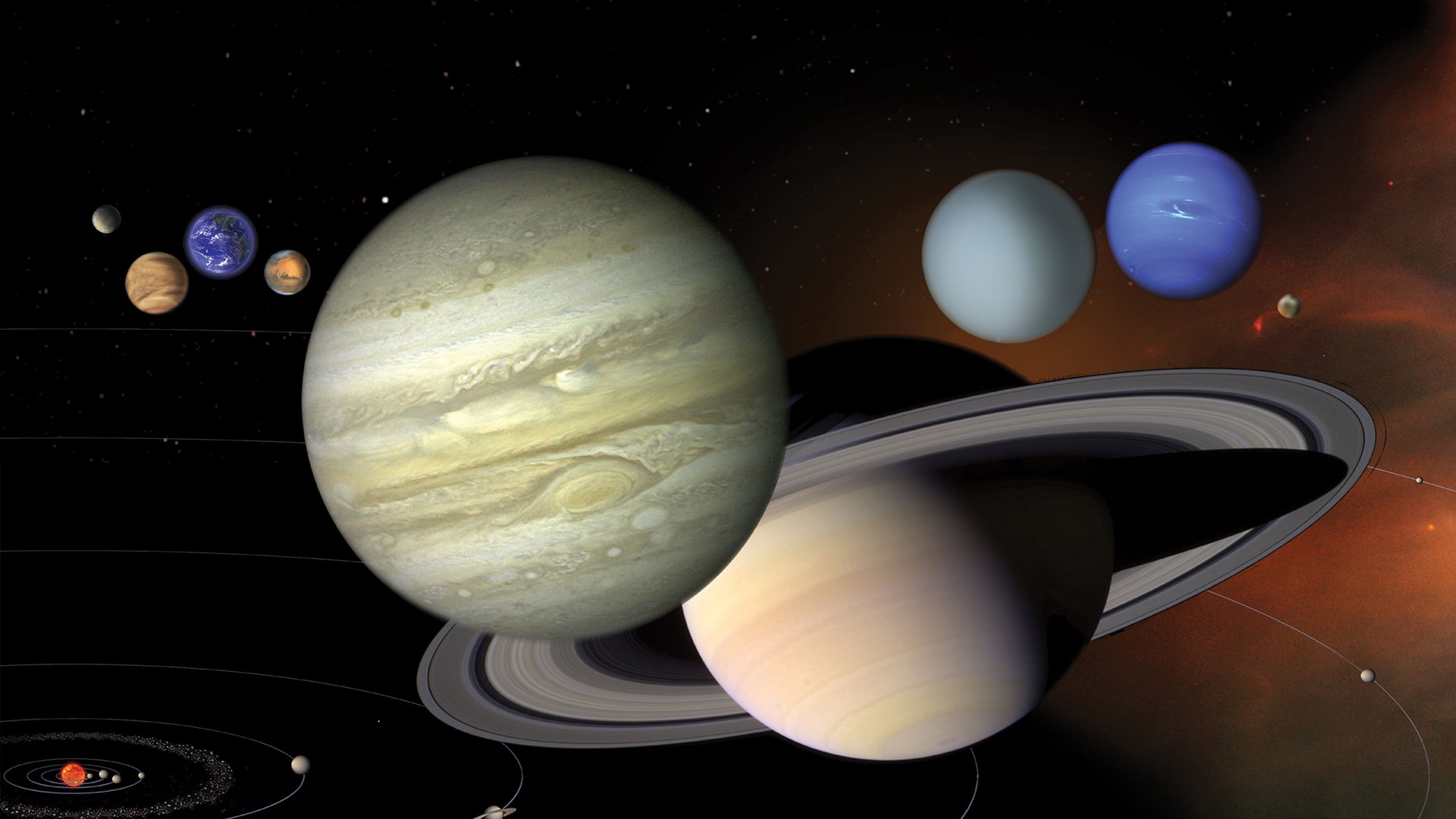
Evidence suggests that the Solar System formed almost five billion years ago.
It started from a spinning cloud of gas and dust. The centre of the cloud began to collapse, forming the Sun. Collisions of the surrounding material formed the eight planets. The inner (rocky or terrestrial) planets are Mercury, Venus, Earth and Mars. The outer planets (or gas giants) are Jupiter, Saturn, Uranus and Neptune.
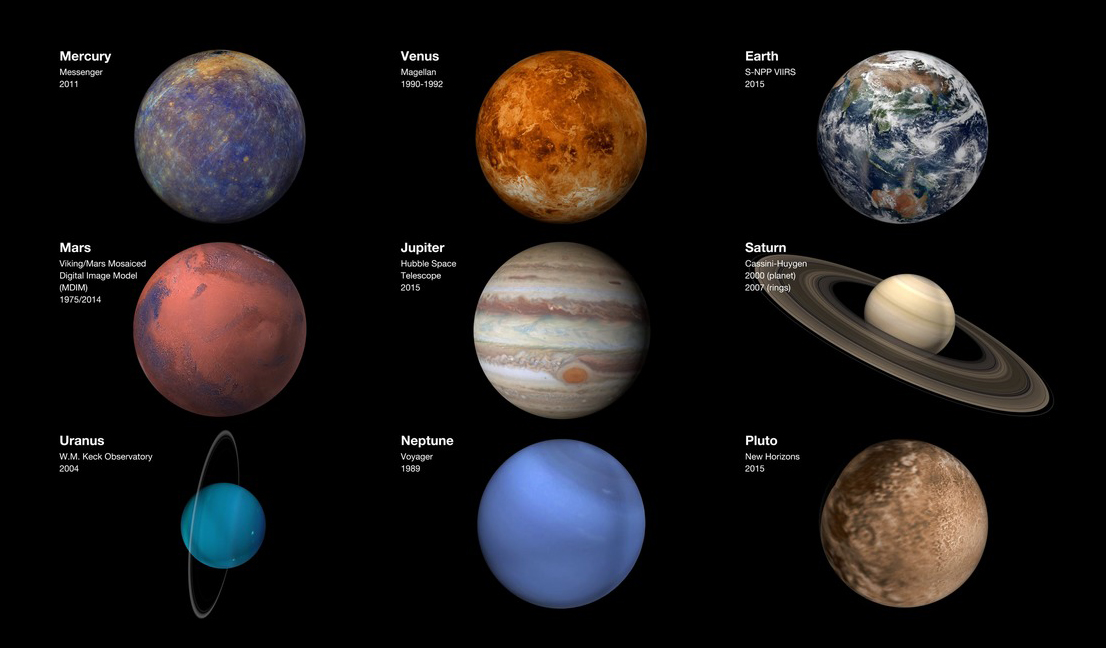
Mercury
- Mercury has no atmosphere, is heavily cratered, grey and rocky.
- One day on Mercury is about two Mercury years long! So it has whizzed around the Sun twice before its day is up!
Venus
- Venus is often called the ‘morning star’ or ‘evening star’ because it shines so brightly in our night sky. This is because its thick atmosphere of clouds bounces lots of sunlight back to Earth.
- The average temperature on Venus is 480oC. That is so hot, even lead would melt!
Earth
- Liquid water is vital to life on Earth and Earth is the only planet in the Solar System with liquid water on its surface - it covers nearly three quarters of the globe!
- The Moon is Earth’s only natural satellite. It causes our tides and slows down the daily rotation of our planet.
Mars
- Mars is known as the ‘red planet’ as it is covered in iron oxide (rust).
- Mars has the largest volcano in the Solar System, Olympus Mons. It is three times higher than Mt Everest.
Jupiter
- Jupiter is the largest planet in the Solar System. Nearly 1,400 Earth’s could fit inside it!
- The Great Red Spot on Jupiter is a giant storm, which has been raging for over 300 years.
Saturn
- Saturn’s magnificent rings are actually spinning chunks of rock and ice. Some of these rocks are as big as houses!
- If you could build a bathtub big enough to fit the planets, Saturn is the only planet that would float!
Uranus
- This planet rotates on its side! Uranus was probably knocked off its axis by a planet-sized object early in the Solar System’s history.
- Uranus is a blue-green colour because of the methane in its atmosphere.
Neptune
- Conditions on Neptune are just right for making diamonds. The high-pressure atmosphere of methane means that diamonds can rain from the sky.
- Neptune has the fastest winds in the Solar System. They reach 2,000 kilometres per hour!
The problem with Pluto
First discovered in 1930, Pluto has always been considered the odd-ball of the Solar System. It is much smaller than the planets of our Solar System, and is even smaller than our Moon! Pluto does not orbit the Sun on the same plane as the eight planets, instead its orbit takes it above and below the planets.
The debate over Pluto’s planetary status began when astronomers discovered more objects beyond the orbit of Neptune. These objects are called “Trans-Neptunian Objects” or TNOs.
In 2005, Eris was discovered (formerly nicknamed Xena or 2003 UB313). Eris is a TNO that is further from the Sun than Pluto and it is even larger than Pluto! Its discovery gave rise to the question: should Eris become our tenth planet or should Pluto be demoted?
To make this decision, the International Astronomical Union (IAU) realised it was time to officially define the term “planet”. The new definition states that a planet is an object in the Solar System that:
- orbits the Sun
- is large enough to be round
- and has cleared the neighbourhood around its orbit.
It is this last criterion that Pluto does not meet. Pluto is found within the Kuiper Belt, a ring of objects (much like the Asteroid Belt) that lies beyond Neptune. So there are countless other objects present around Pluto’s orbit. But what is Pluto, if it is not a “planet”?
A new category of planets was subsequently created by the IAU, known as “dwarf planets”. These objects are round and orbit the Sun, but have not cleared the area around their orbit of other objects. Currently, five dwarf planets have been named: Pluto, Eris, Makemake, Haumea and Ceres; the largest asteroid found in the Asteroid Belt (which is located between Mars and Jupiter).
It is expected that other objects will soon be classified as dwarf planets. Some of the potential candidates are: Vesta and Pallas, situated in the Asteroid Belt; and Varuna, Quaoar, Orcus, Ixion and Sedna, which are TNOs.