Exhibition resource
Suitable for: Years 5 to 10
Learning area: Science
Topics: Earth science, Dinosaurs, Climate change
Expand students knowledge about the evolution of life with this in-depth resource.
The 600 Million Years: Victoria Evolves Gallery Guide contains extensive science content covering the evolution of life on Earth, beginning with multicellular life forms. The information, images and videos connected to the 600 Million Years exhibition can be used to support a unit on evolution, fossils and geology.
In this activity students will
- Read about the amazing fossil record of South Australia.
- See fossil evidence for the evolution of life, from earliest multicellular life forms to the creatures of today.
- Watch videos about fossil discovery, evolution and mass extinction.
- See how living things changed throughout geological time periods.
Suggested questions to engage students
- What can fossils tell us about how living things evolve over time?
- How do the structural features of these fossils give us information about how these animals survived in their environment?
- How do new fossil discoveries change our understanding of the past?
About the resource
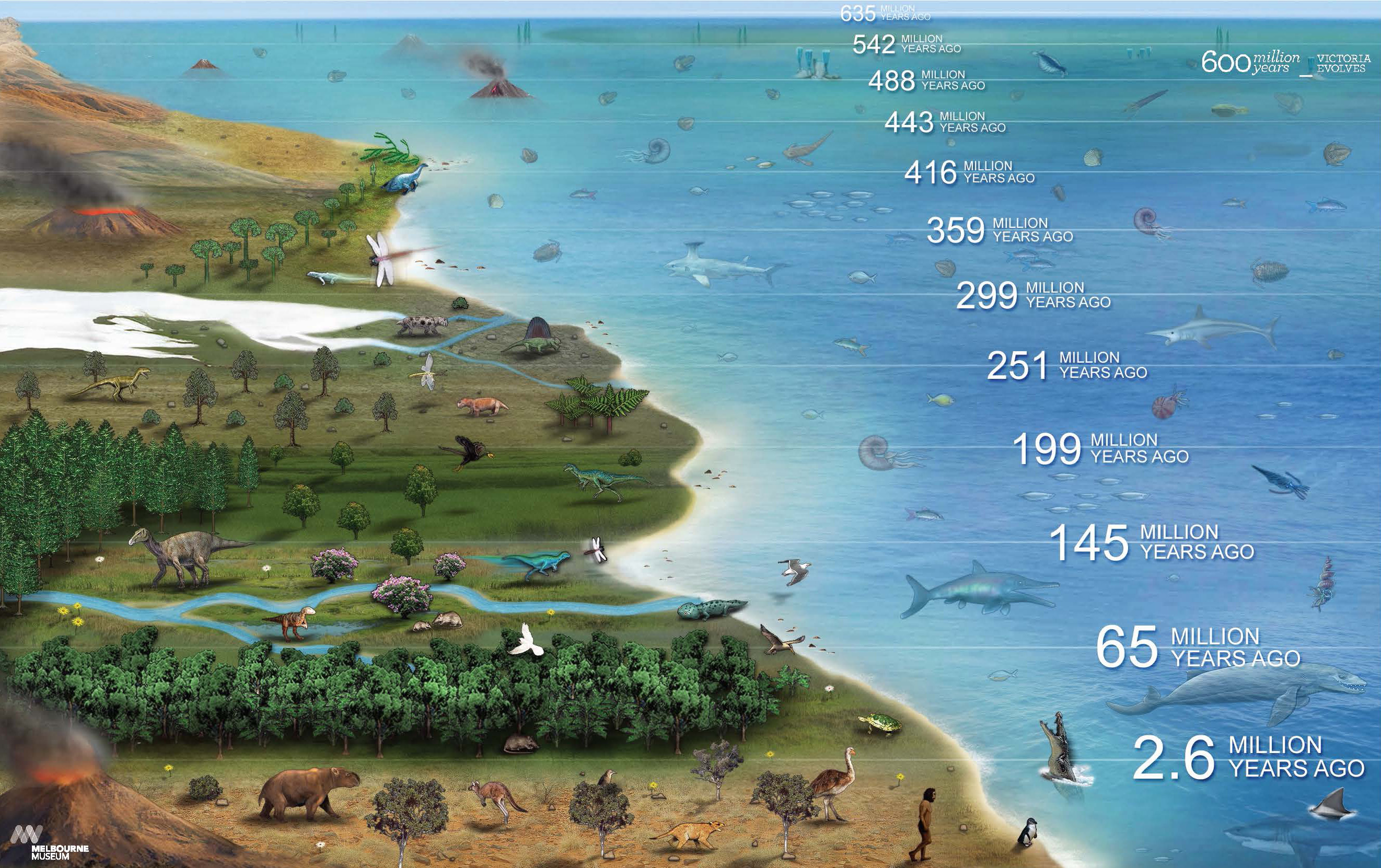
The 600 Million Years: Victoria Evolves Gallery Guide details how life has evolved and changed over time, and how the fossil record provides the evidence for this change overtime.
Beginning around 600 million years ago, with the Ediacaran fossil record, found in the Flinders Ranges, South Australia, these fossils capture a pivotal evolutionary moment: the rise of complex multicellular life and the origins of animals, immediately before the rapid diversification of life in the Cambrian.
The resource then details each geological period, and showcases fossils from the museum’s collection, which highlight significant moments in evolution such as when fish evolved to land living animals, the rise of dinosaurs and the evolution of birds, and the evolution of whales.
This resource can be used pre- or post- excursion, or as a stand alone resource for classroom research.
What to do
Have students access the resource:
Assign students to watch one video each. Have them respond to the following questions:
-
What fossils were discussed in the video?
-
What kind of fossils did you see in the video? Were they trackways, footprints, fossil bones, fossil leaves, or something else?
-
What did these fossils tell you about:
-
- How living things change over time (evolution)?
- Changes in the environment?
-
Is the animal or plant fossil still something that is alive today?
-
What was the most fascinating fact in the video you watched?
Victorian Curriculum Links
Science: Levels 5 and 6
Biological sciences
- organisms have evolved over time, as seen in fossils and scientific records; the structural features and behaviours of living organisms enable them to thrive in their environments (VC2S6U02)
Science: Levels 7 and 8
Nature and development of science
- scientific knowledge, including models and theories, can change because of new evidence (VC2S8H01)
Earth and space sciences
- Earth is a dynamic planet as demonstrated by tectonic activity, including the formation of geological features at divergent, convergent and transform plate boundaries; the theory of plate tectonics is supported by scientific evidence (VC2S8U10)
Science: Levels 9 and 10
Nature and development of science
- scientific knowledge is contestable and is validated and refined over time through expanding scientific methods, replication, publication, peer review and consensus (VC2S10H01)
Biological sciences
- the theory of evolution by natural selection includes the processes of variation, isolation and adaptation and is supported by evidence including the fossil record, biogeography and comparative embryology; the theory explains past and present biodiversity and demonstrates how all organisms have some degree of relatedness to each other (VC2S10U05)


Sign-up to Museum Teachers
Subscribe and get special offers, teacher news and free entry to all museums.