Museums Victoria Research Institute has today published the second volume of PRISM, an annual online, open access humanities journal. PRISM engages, investigates, and challenges the stories and ideas associated with museum collections and the human histories that contribute to them.
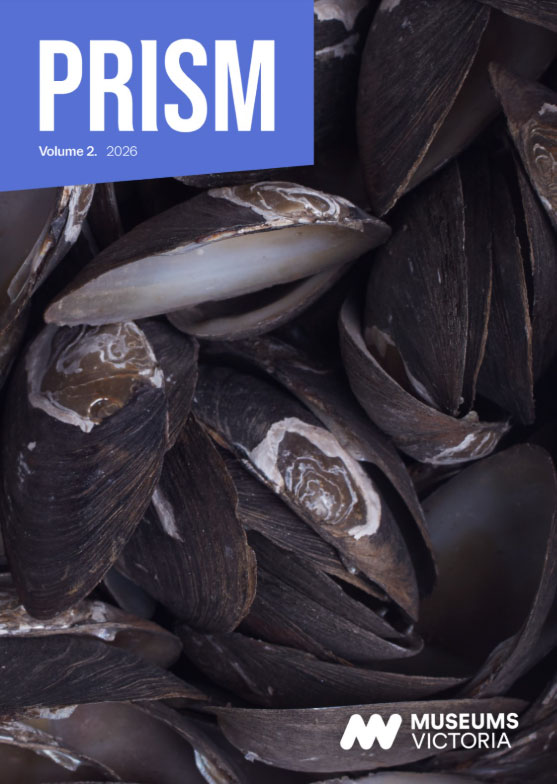
Volume two explores the humanities through both regional and international lenses, with research spanning Melbourne, the Mallee and the Murray River, and extending as far as Norway, Germany, Tonga and Hawai‘i.
Contributions span the GLAM sector — Galleries, Libraries, Archives, and Museums —with Museum collections, collection managers, curators, artists, and academics featuring heavily in this volume, providing insight into the core work of the Museums Victoria Research Institute. This includes hazardous collection management, collaborative research with First Peoples communities, and cutting-edge research that informs exhibition development.
Building on the success of Memoirs of Museums Victoria, the long-running, peer-reviewed science journal that has published original research in zoology, palaeontology, and the natural sciences since 1906, the second volume of PRISM continues to extend the Institute’s publishing program into the humanities. Together, PRISM and Memoirs capture the full spectrum of research at the Museums Victoria Research Institute.
Side by side, these journals showcase the Institute’s leadership in interdisciplinary, museum-based scholarship and its commitment to sharing knowledge that connects science, history, culture and community.
“Through the stories preserved in our collections, PRISM encourages curiosity, inspires fresh thinking and connects people with new knowledge,” said Dr Jane Melville, Director, Museums Victoria Research Institute.
“This journal celebrates interdisciplinary research and demonstrates how museums contribute to a richer understanding of our collective past, who we are today and the futures we can imagine.”
Articles featured in the second volume of PRISM:
- Berlin’s Australian Archive – Millu Wudungi Brendan Kennedy, Aunty Glenda Nicholls, Rebecca Carland and Dr Anja Schwarz detail the multi-year international provenance project that connected Murray River communities with their cultural belongings held in archival collections in Berlin.
- Blandowski goes bush! – Tim Stranks presents a new narrative account of William Blandowski’s lower Murray expedition in 1856–1857, including detail of collaboration between Blandowski’s expedition team and First Peoples communities along the Murray River.
- Towards a counter-museum – Dr Rory Hyde reflects on student concepts for architectural reimagining of museum spaces.
- A story of repatriation – Veisinia Tonga explores the nuance of the Tongan concept of ‘tapu’ through the repatriation of Tongan ancestral remains from a Hawaiian museum.
- The evolution of objects – Dr Daniel Haumschild and Dr Simon Holloway trace the journey of a WWII deportation notice from the Łódź ghetto to the Melbourne Holocaust Museum, examining its changing nature through time.
- Silver Death – Nicholas Crotty recounts how the discovery of a small – potentially toxic – piece of off-white cardboard led him down a path of detailed provenance research and skilful hazardous collection management.
- Foundations of Our Wondrous Planet – Kate Phillips explores the values and concepts that underpin Museums Victoria’s landmark biodiversity exhibit, including techniques for presenting natural sciences and First Peoples’ perspectives in concert.
PRISM is available online and free to access, providing a platform that bridges research disciplines, communities and knowledge systems.
Read the second volume of PRISM here: PRISM Volume 2 | Collections & research | Museums Victoria
About Museums Victoria Research Institute
Established in 2022, the Museums Victoria Research Institute mobilises world-class collections and scientific expertise to address today’s most urgent and complex global challenges.
From climate change and biodiversity loss to migration, inequality and conflict, the Museums Victoria Research Institute utilises more than 170 years of museum-based research to better understand our rapidly changing world. The Institute redefines how research can inform and inspire change - connecting science, culture and community to turn knowledge into action. Its work not only deepens public understanding but also helps shape a sustainable and equitable future through research.
Media and Communications Team
Museums Victoria [email protected] 0466 622 621