VCE Systems Engineering involves the design, production, operation, evaluation and iteration of integrated systems.
The study equips students for a diverse range of engineering fields such as manufacturing, transportation, automation, control technologies, mechanisms and mechatronics, electrotechnology, robotics, pneumatics, hydraulics, and energy management.
Students use innovative systems thinking and problem-solving skills throughout the systems engineering process. They test and verify that their systems are well-built and integrated, evaluate how well the completed system meets the intended goals, and reflect on the systems engineering process to create a satisfactory design outcome.
The selected works are excellent examples of design strategies and production processes employed by VCE students.
Pete Chalikouras
St Michael's Grammar School, St Kilda East
Boon Wurrung Bunurong Country
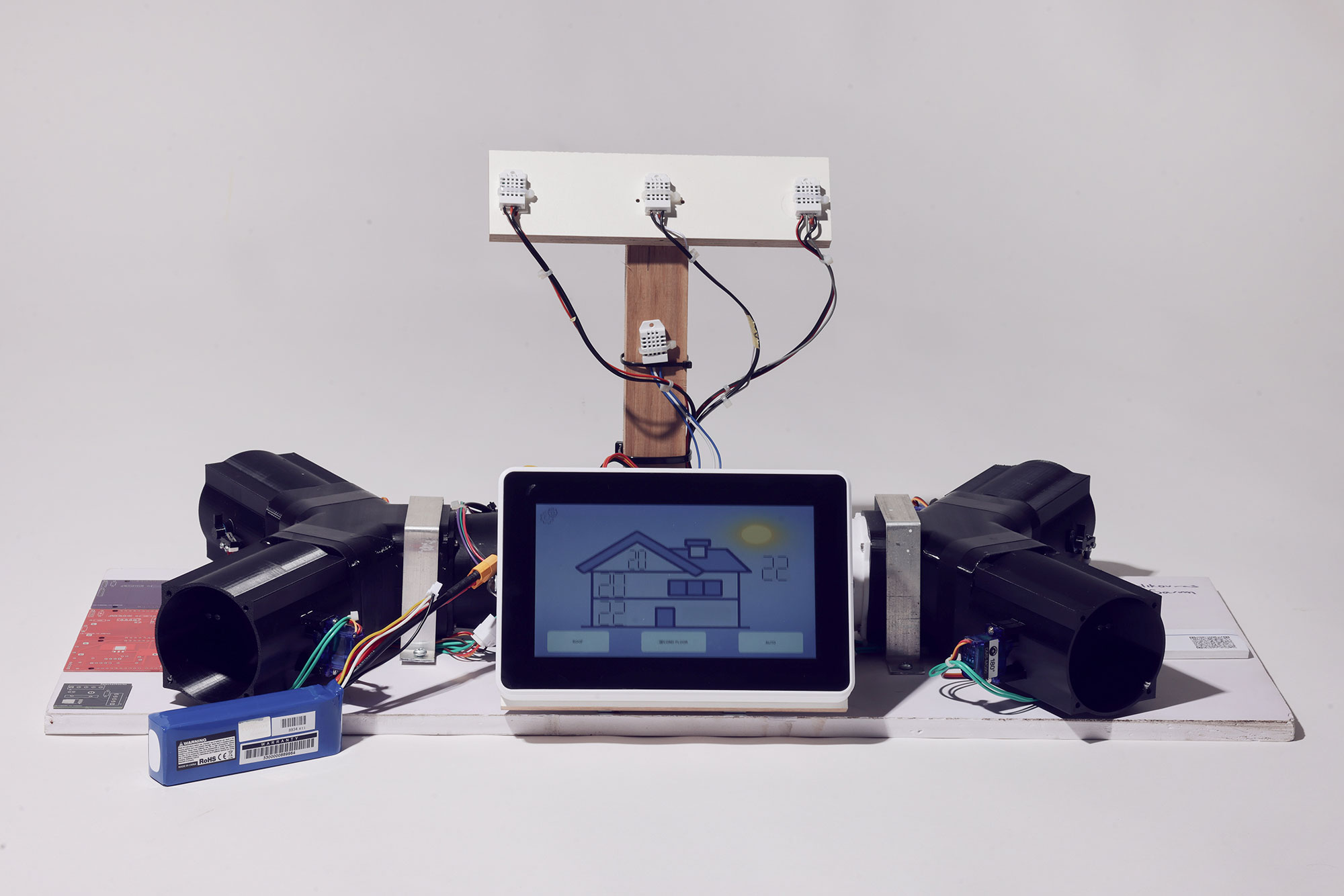
Intelligent home climate control and ventilation
Arduino Mega, custom-printed circuit board (PCB), San Ace 80, touchscreen, servo motors, Mass air flow (MAF) sensor, DHT22 temp sensors, Polyethylene Terephthalate Glycol (PETG) filament
My system is an intelligent climate control system controlled by a 7-inch OLED touchscreen display that automatically manages airflow and temperature across multiple zones using four temperature sensors: roof, house, outside and auxiliary. The system employs servo-controlled valves to direct air through strategic intake and exhaust paths, while a variable speed fan circulates air based on real-time conditions. The system aims to improve the efficiency of house cooling.
Madeleine Ching
Girton Grammar School, Bendigo
Dja Dja Wurrung Country
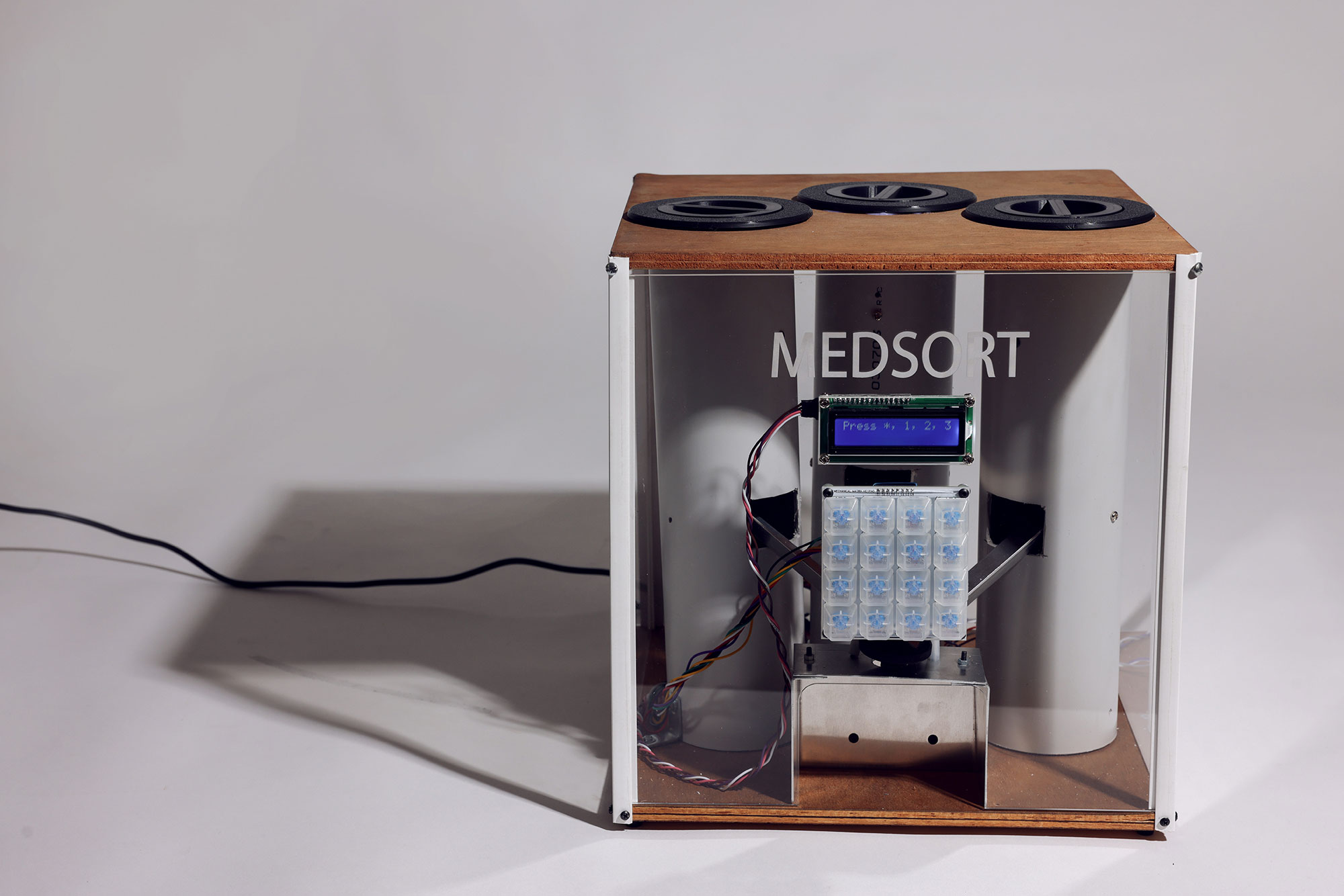
Medsort
Arduino Nano, servo motors, 1602 LCD display, 4x4 Keypad matrix, 10mm Plywood, 3mm Polymethyl methacrylate (PMMA), Polylactic Acid (PLA) 3D-printed components, Piezo buzzer, real-time clock (RTC) module
I have developed Medsort to be a system which sorts and dispenses pills. It is designed for use by the elderly and those with dementia to minimise the chance of medication administration errors, while reducing the burden of care for caretakers. Controlled by an Arduino Nano, Medsort interprets user-inputted variables, dispensing quantities of different medications at specific times. Tracks deliver the pills to a collection area for the user. Overall, the system prioritises accuracy and efficiency in its function.
Charlie Cowled
Kardinia International College, Bell Post Hill
Wadawurrung Country
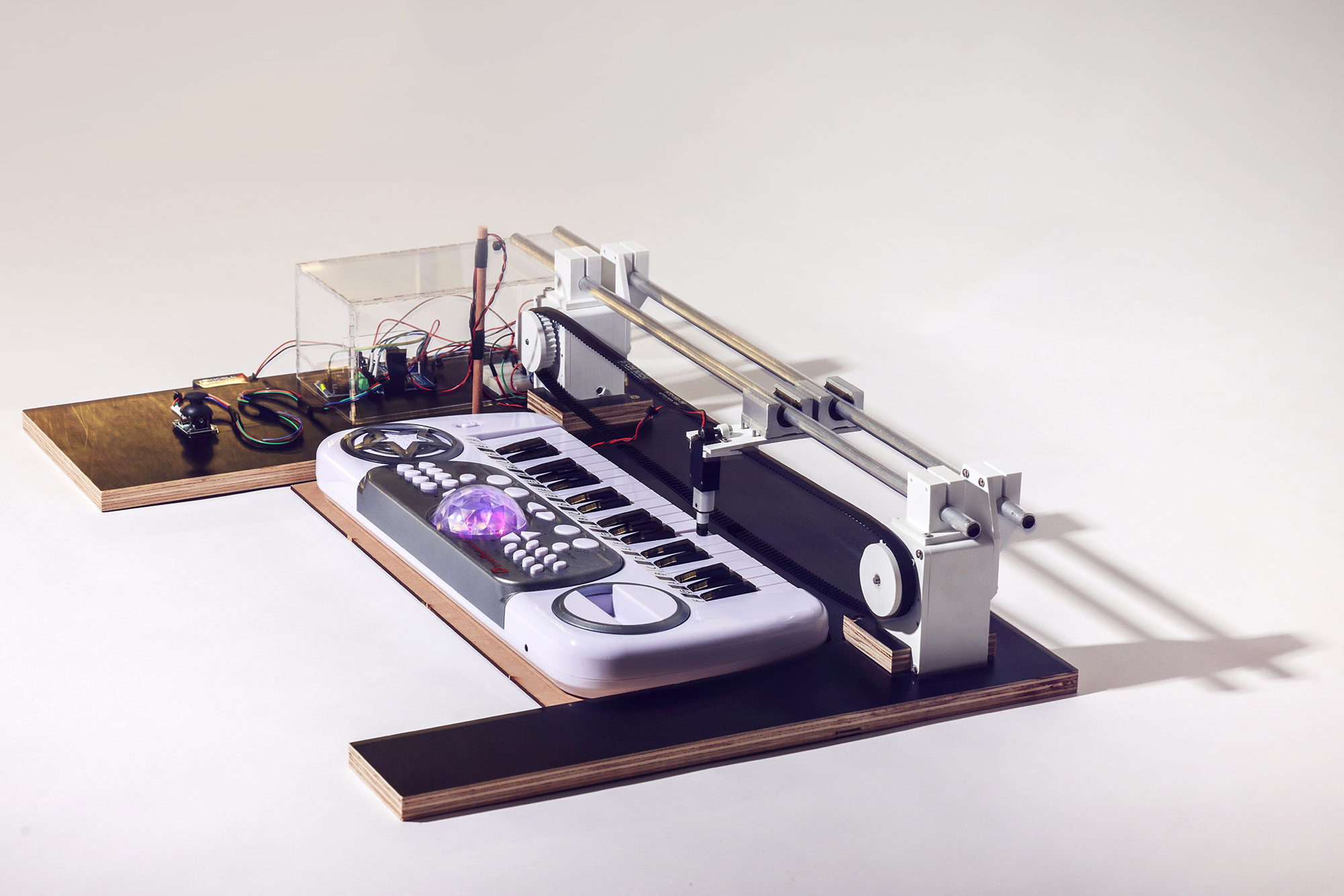
The Key-Assist
Arduino Uno, NEMA stepper motors, actuator, gears, 9V battery, power bank, A4988 motor driver, Polylactic Acid (PLA), 3D-printed modular components, saw-cut wooden components, rubber belt drive, linear bearings, ball bearings
The Key-Assist is a robotic key-pressing system that enables people with motor disabilities to play electronic keyboards. Users can program song sequences for automatic playback or use a joystick and button controls for manual positioning and key pressing. By constructing a physical medium for musical interaction, the Key-Assist illustrates how modern haptic control and assistive robotics can redefine accessibility in creative industries.
Max Drake
Kardinia International College, Bell Post Hill
Wadawurrung Country
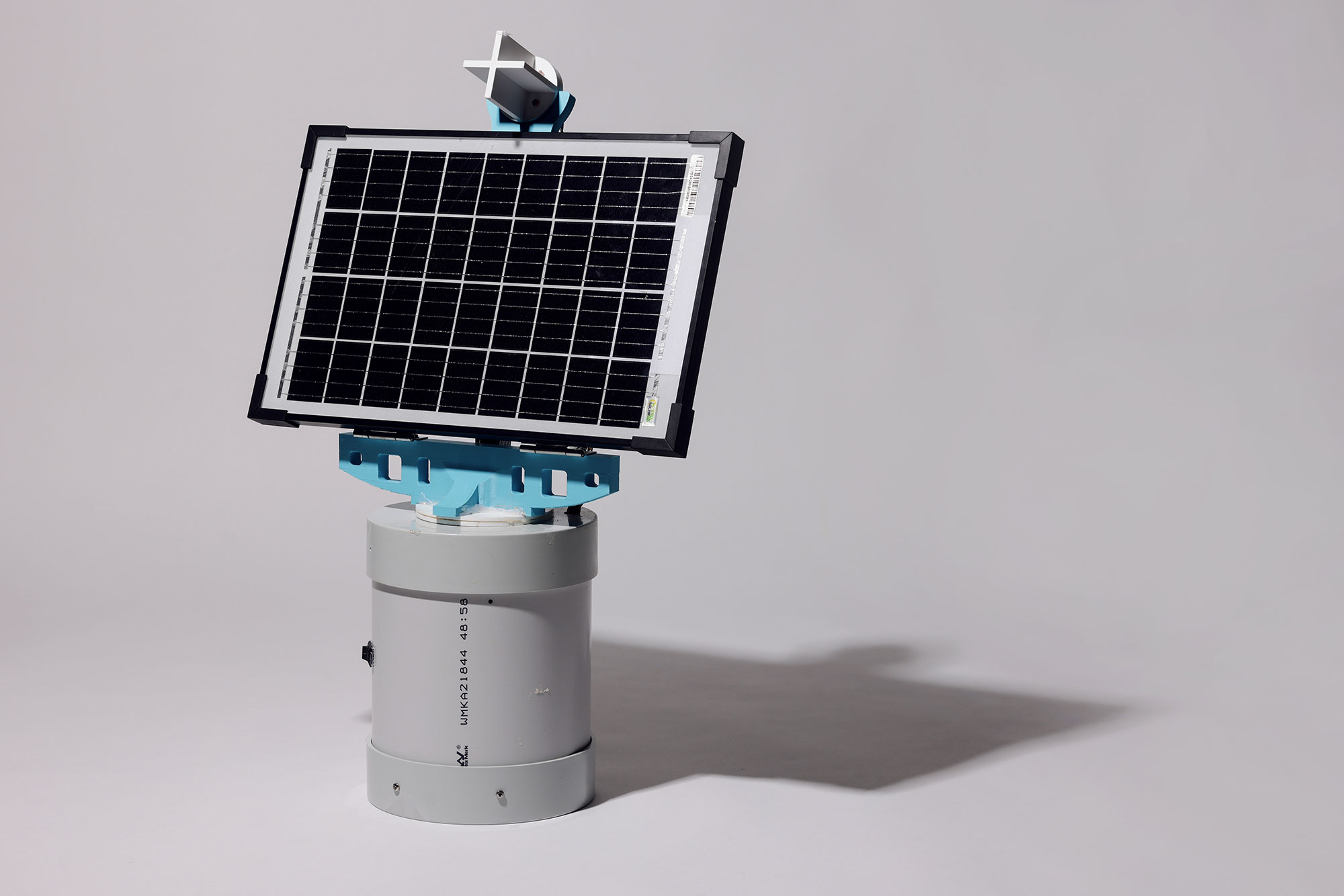
Dual-Axis Solar Tracking System
10W Monocrystalline solar panel (12V), Arduino Uno, linear actuator, Nema-17 stepper motor, L293D motor driver, L298N motor driver, 7ah SLA battery, solar charge controller, toggle switch, light-dependent resistor (LDR) sensors
I have created a dual-axis solar tracking system that keeps a solar panel aligned with the sun throughout the day. Four LDR sensors are arranged around a cross divider, which shades them from indirect light. The Arduino Uno compares the sensor readings and controls the stepper motor and linear actuator through the motor drivers. The system is designed to maximise the panel's energy output, which charges a detachable SLA battery.
Jet Edwards-Perry
Girton Grammar School, Bendigo
Dja Dja Wurrung Country
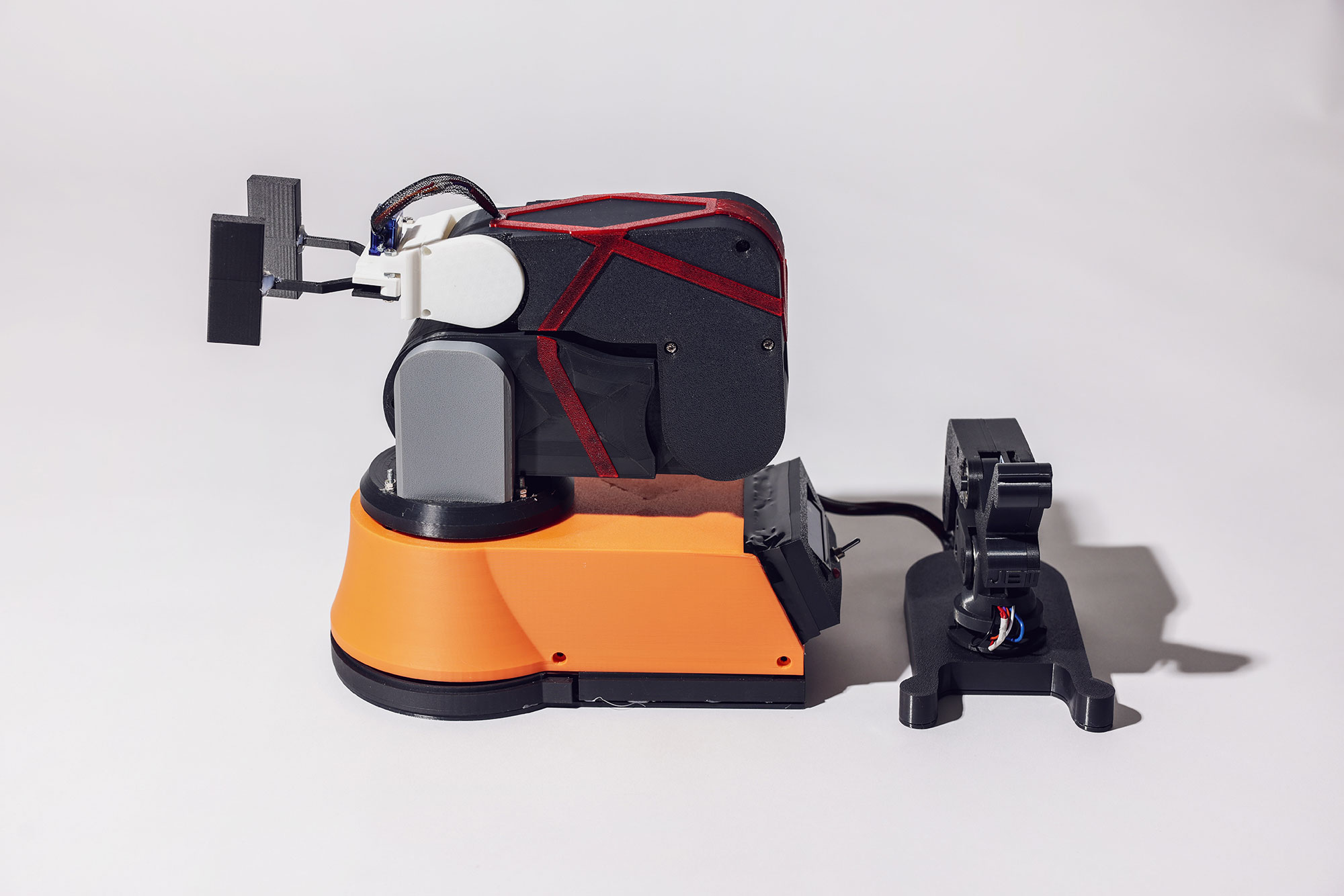
Dual-Control Robotic Arm System
Servo motors, stepper motors, Arduino UNO microcontrollers, magnetic rotary encoders, metal nuts and bolts, Lazy Susan, bearings, SPST push switch, threaded inserts, 3D-printed spur gears, custom PCB, Polylactic Acid (PLA)
My project is a four-joint robotic arm that mirrors a scaled-down controller arm in real time. Magnetic rotary encoders track each joint’s movement and send data through a wired link to dual Arduinos that coordinate stepper and servo motor control. Fully 3D-printed in Polylactic Acid (PLA), the system demonstrates intuitive 1:1 human-to-robot motion transfer. Created as a proof-of-concept for remote and assistive robotic systems, it showcases how accessible materials can support emerging human-machine interface technology.
Liam Holmes
St Helena Secondary College, Eltham North
Wurundjeri Woi Wurrung Country
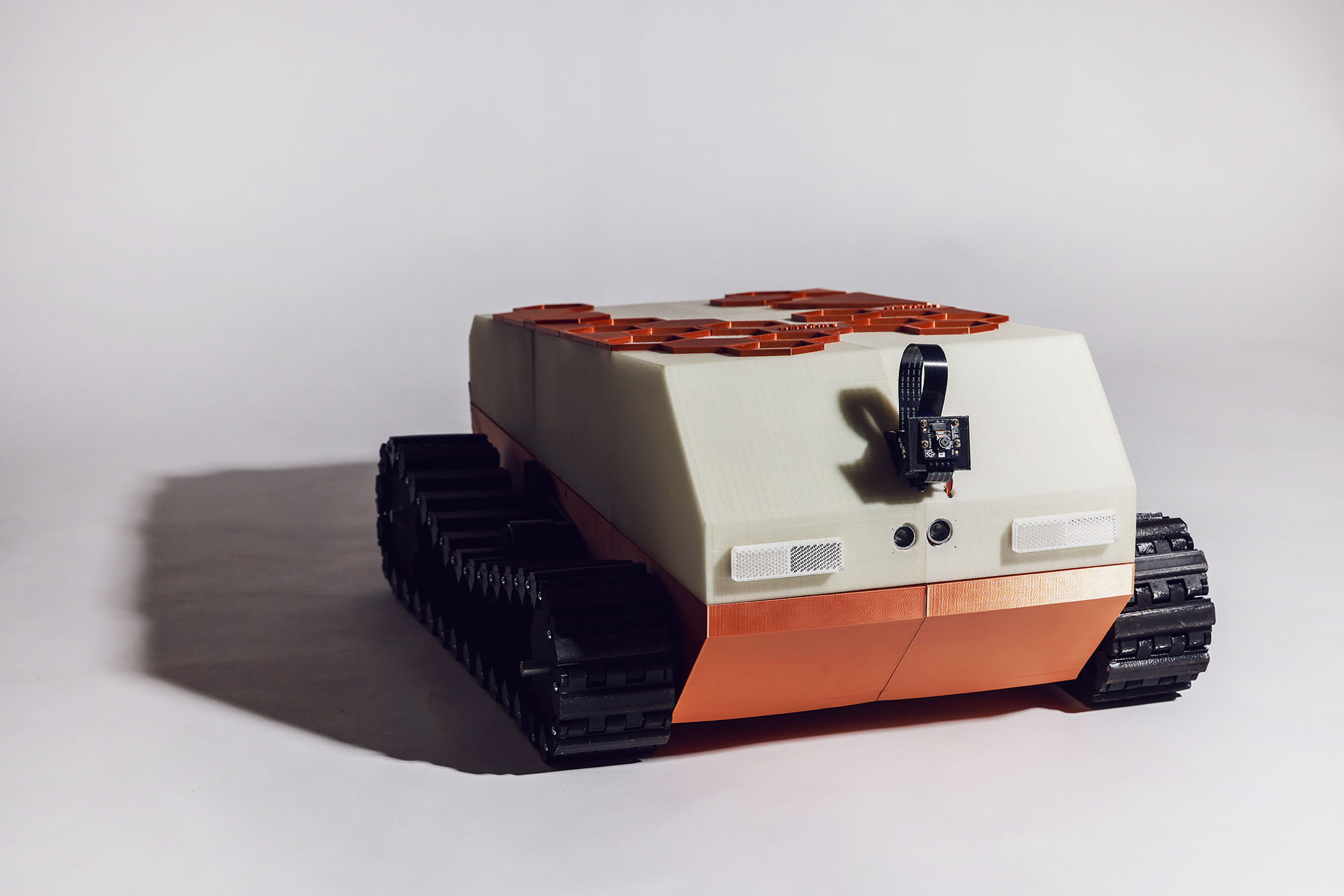
Reforestation Rover
Polylactic Acid (PLA) components, Lithium-Ion batteries, Raspberry Pi, NoIR Camera, ultrasonic range sensor, 36GP-3530 motors, servos, motor driver boards, GPS Receiver, TP-Link MR6500V Router, DC to DC buck converters, Archimedes screw
I developed the Reforestation Rover as an affordable alternative to existing industrial, agricultural seed-planting robotics, addressing the issue of deforestation in low socio-economic areas. Allowing for global remote control, the rover employs 5 electromechanical subsystems while drilling holes, planting and covering seeds. The drill lowers, contacting microswitches, signalling the Raspberry Pi to raise the drill and rotate an Archimedes screw, releasing the seeds. The soil-mover lowers while driving forwards, covering the seed with a fine layer of soil.
Lachlan Jaensch
Bacchus Marsh Grammar School, Maddingley
Wadawurrung Country
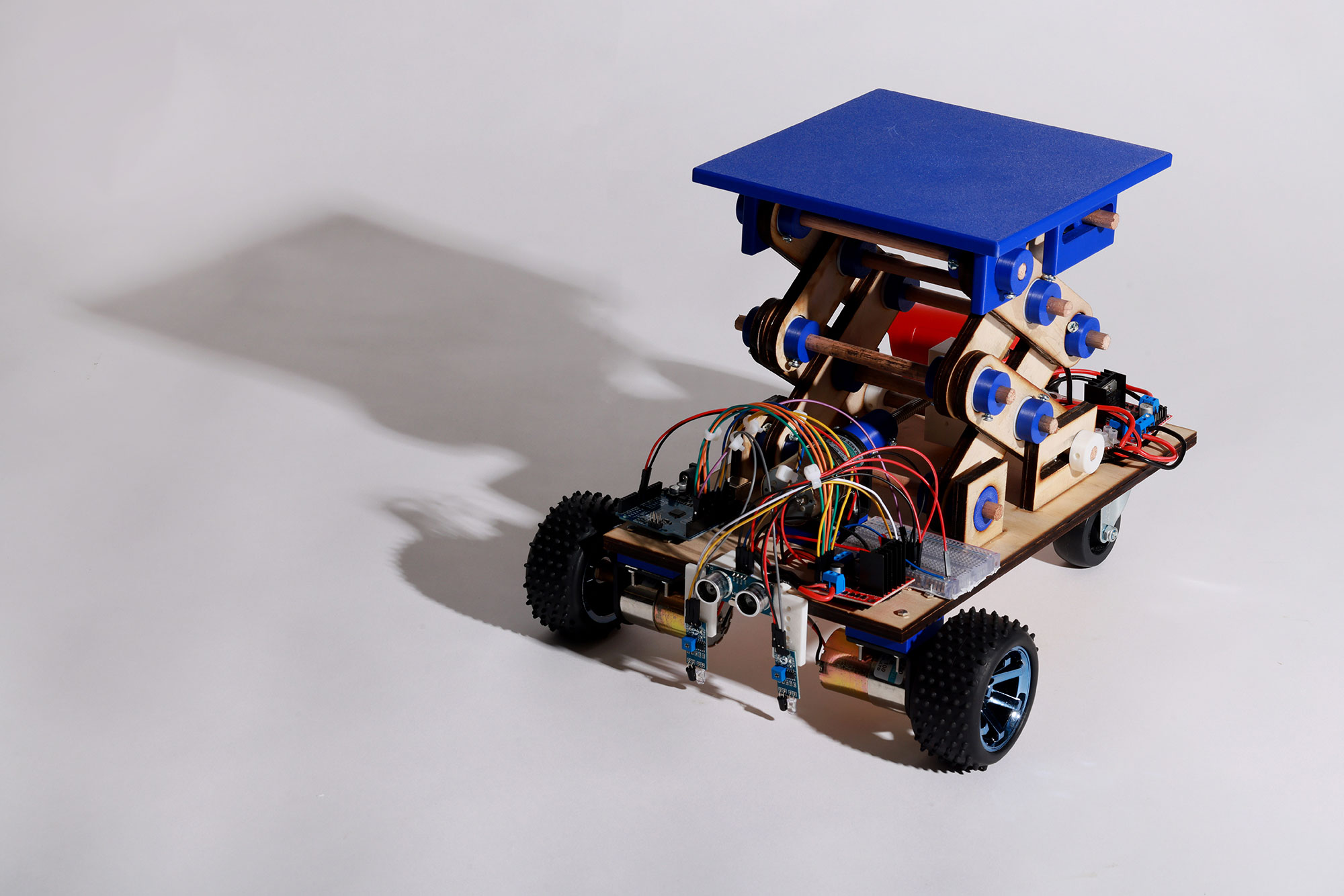
Autonomous Shelf Lifting Robot
DC motors, wheels, ultrasonic sensors, Infrared (IR) sensors, lead screw, Arduino Uno, lithium-ion battery, Polyethylene Terephthalate Glycol (PETG) 3D-printed components, laser-cut plywood components
I have designed a scaled-down, shelf-lifting robot that can autonomously move shelves around a warehouse setting. It does this through using two IR sensors to follow a black line on a contrasting white surface, and utilises an ultrasonic sensor for obstacle avoidance. When it reaches the end of the line, it spins a motor attached to a lead screw to raise the scissor lift mechanism up, lifting the object. It then follows the line back and lowers the object at the end of the line.
Alexander Larocca
Parade College, Bundoora
Wurundjeri Woi Wurrung Country
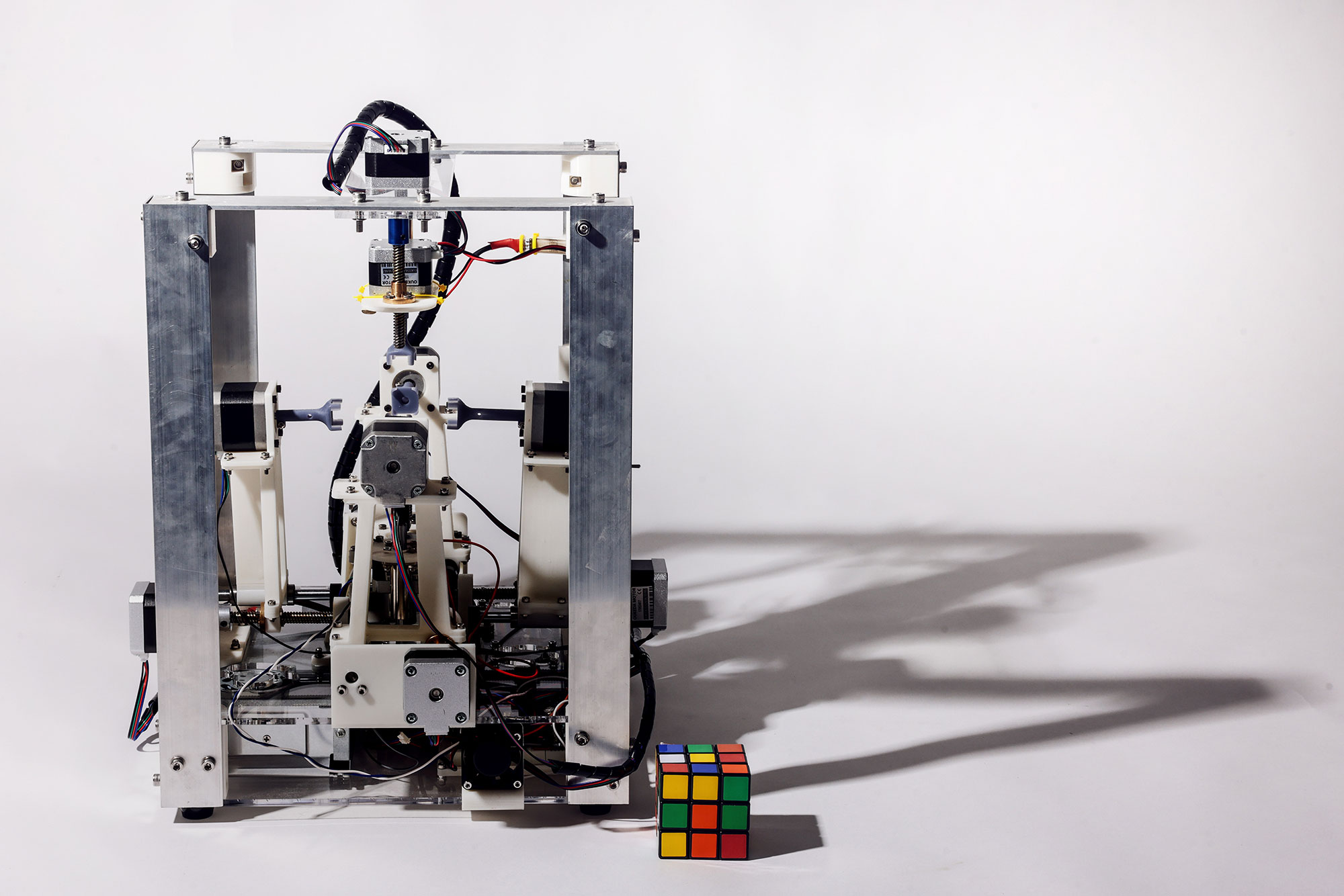
Rubik’s Cube Solver
Raspberry Pi 4B 4Gb, Raspberry Pi Camera Module 3, A4988 stepper motor drivers, NEMA17 stepper motors, breadboards, laser-cut acrylic, Polylactic Acid (PLA) 3D-printed parts, aluminium angles, T8 lead screws, guide rail
I have designed an autonomous Rubik’s Cube solving robot that uses an LDR to detect when a Rubik’s Cube is placed inside. The cube is automatically rotated to photograph all six sides for analysis with computer vision. Once analysed, the cube state is passed onto the Kociemba-solving algorithm to compute a series of solutions. The cube is engaged from all six sides to execute the solution set precisely using stepper motors, disengaging automatically to await another scramble.
Xavier Phillips
Viewbank College, Viewbank
Wurundjeri Woi Wurrung Country
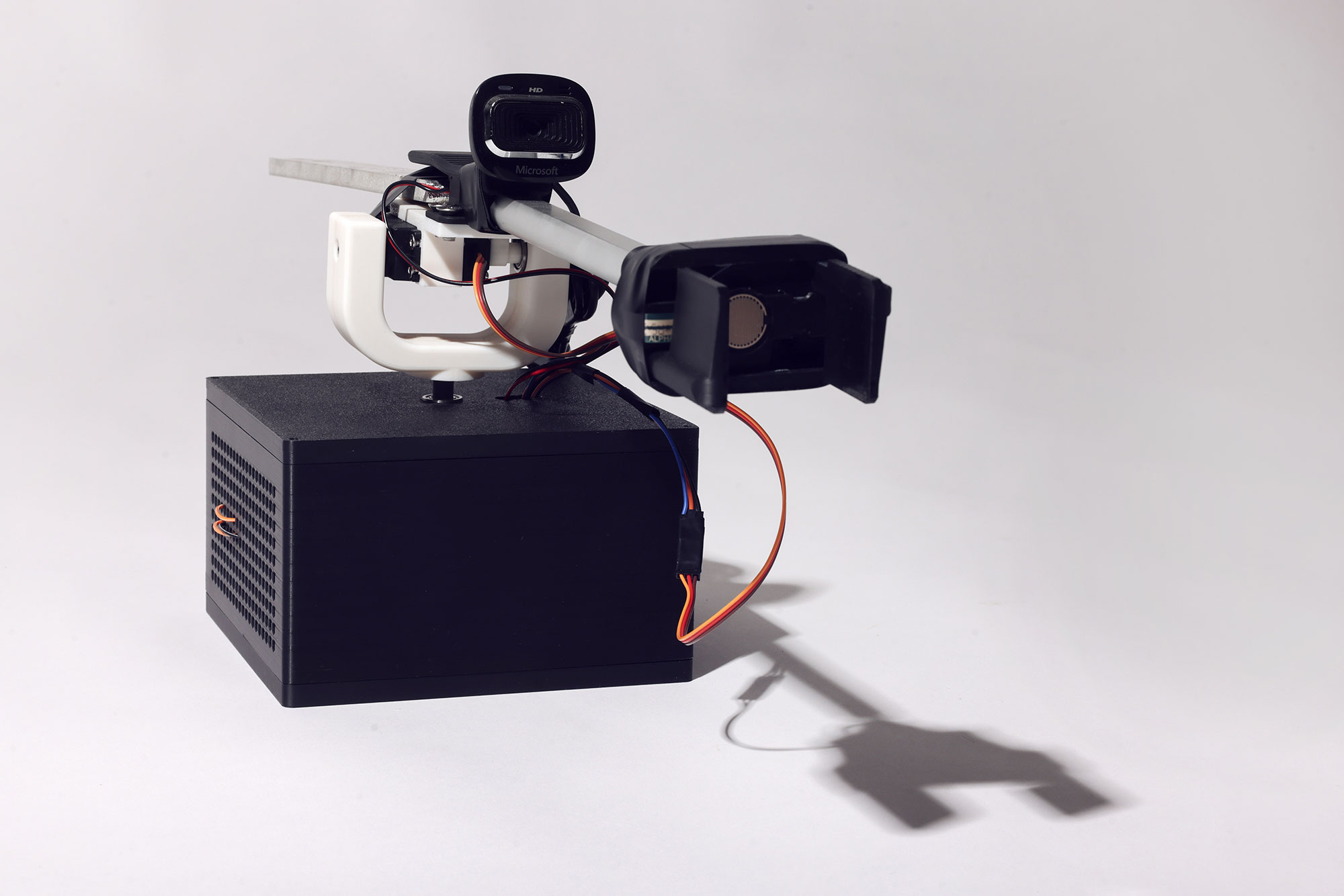
AutoBerryPicker
Raspberry Pi 3, Arduino Uno, L298N motor controller, 1080p webcam, MG996R and SG90 servo motors, DC linear actuator, Lithium-ion battery, 3D-printed components, ball bearings, aluminium counterweight
To address the issues of unethical labour and food wastage in agriculture, I designed and produced a robotic arm that uses optical detection to autonomously harvest strawberries. A computer running a custom Python program identifies ripe strawberries in the camera feed, while an Arduino controls the arm's movement and gripper to navigate to strawberries and remove them from their stems. The harvested strawberries are then deposited in a designated storage area for collection.
Rodney Tang
Bacchus Marsh Grammar School, Maddingley
Wadawurrung Country
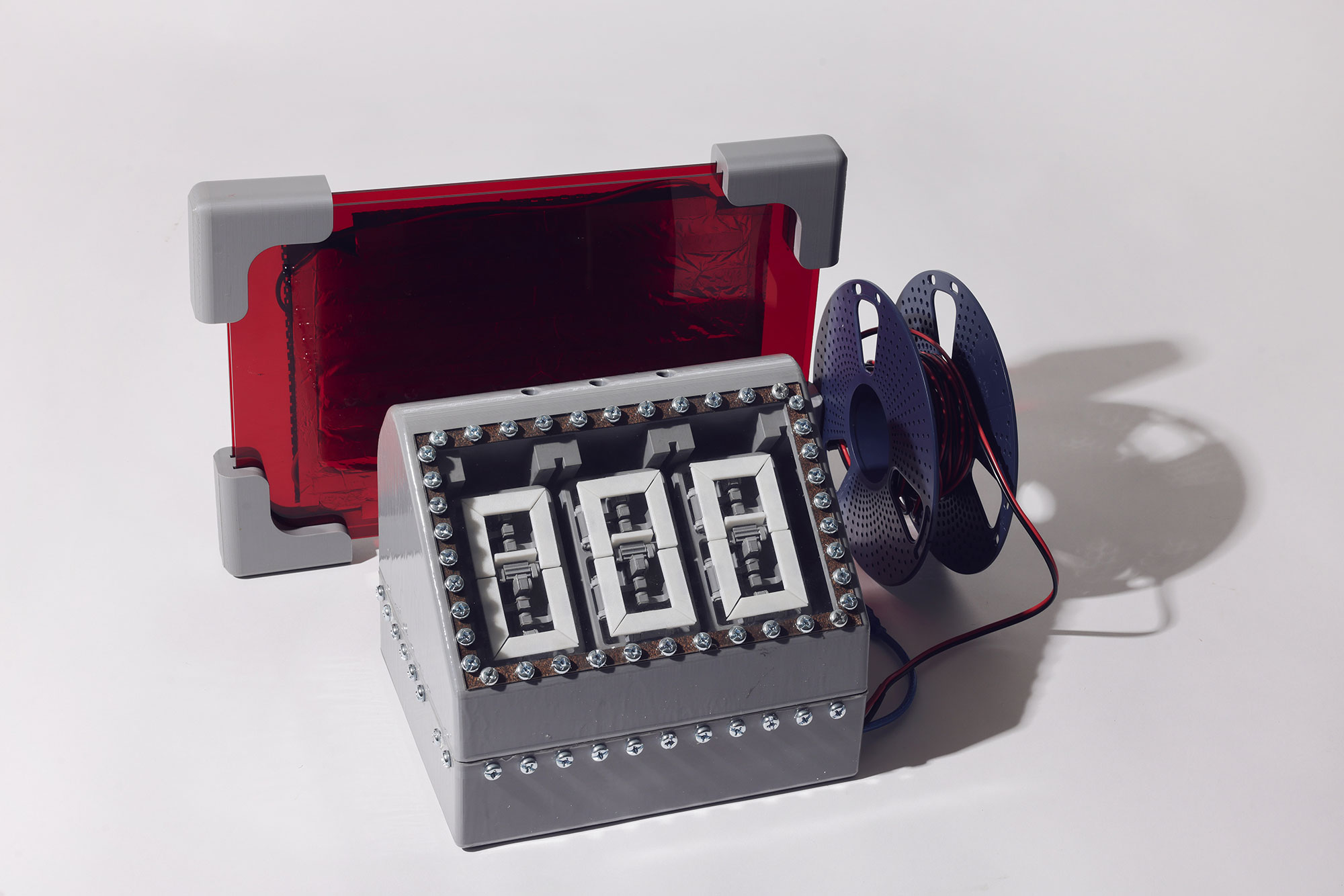
Swimming Lap Counter and Touchpad
Arduino Uno, AA battery, battery holder, MG995 servo motor, servo shield, Polylactic Acid (PLA) filament, epoxy resin, clear acrylic sheet, cork gasket, M6x10MM screw, barrel connector female, barrel connector male, door mat
In competitive long-distance swimming, swimmers rely on lap counters that are kept out of the water, making them hard to see and manage. This underwater lap counter addresses this issue by remaining submerged for clear visibility, updating automatically when activated by a custom touchpad, removing the need for input from human officials. Many modern swimming technologies, such as touchpads, are costly and inaccessible for use in smaller pools. This touchpad concept demonstrates how essential equipment could be made more affordable without sacrificing accuracy and performance.