Student activity
Suitable for: Years K to 6
Learning area: Science
Topics: Energy & forces, Space
Students create their own projector to explore the constellations we can see in the night sky.
This activity has been designed to support students to develop their understanding of how light travels, and their familiarity with common constellations in our night sky.
In this activity students will
- Make a constellation projector using a cup
- Explore how light travels in straight lines
Suggested questions to engage students
- Are some cup constellations brighter than others? Why/ why not?
- Does light travel in straight lines?
- Why do different constellations appear at different times of the year?
- Can you make your constellations appear brighter? How?
What to do
Students will need the following items:
- Paper, polystyrene or plastic drinking cup
- Skewer
- A strong torch
- Pencils or crayons (optional)
- Constellation design sheet
To begin, download and print out the constellation design sheet.
- constellations-in-a-cup.pdf| 27.66 KB .pdf file
Students will need to select one of the constellation designs and glue it face up onto the inside bottom of the cup. If you stick the design to the outside of the cup, the constellations will be back to front.
Next, use the skewer to make small holes where the dots are. Make larger holes in the positions where there are larger dots.
Finally, students will need a room where you can close the curtains and turn off the lights. Alternatively, find a dark region within the room, and simply hold the cup closer to a wall.
Put the torch into the cup and turn it on. The constellation should appear as dots of light. For best results, adjust the distance between the cup and the wall.
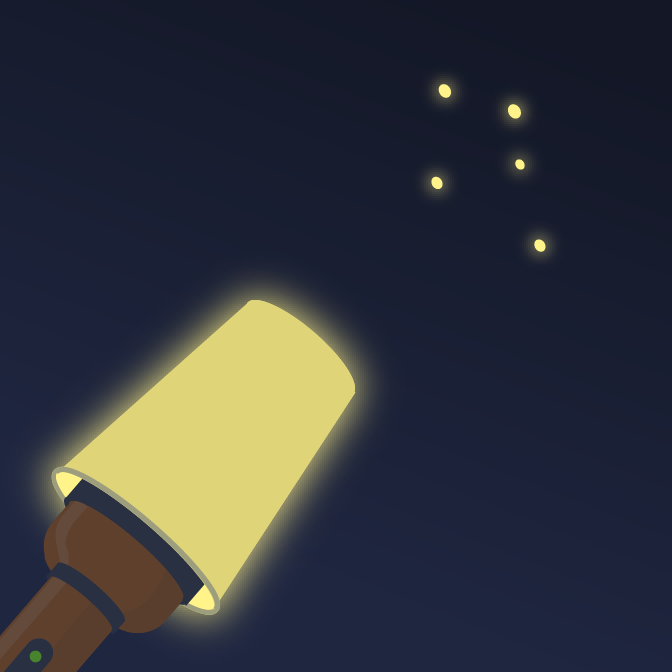
(Optional) Students may also decorate their cup with pencils and crayons.
Extension questions
Ask students to compare two different cup constellations.
- Can you see a difference in the clarity of two different constellations? Why do you think this is?
- Find a friend who made the same constellation as you. What similarities and differences can you see? What factors are at play here?

Due to the Earth’s orbit around the Sun, the constellations seen in the night sky change throughout the year. The constellation of Orion can be seen during summer evenings and the constellation of Scorpius is in the sky during winter evenings.
We can’t see these constellations and other stars during the day because our closest star, the sun is so bright. Ask students to try turning on the light on to see how the constellations look.
Victorian Curriculum Links
Science: Levels Foundation to Level 2
Science as a Human Endeavour
- scientific knowledge is based on observations of the natural world using the senses, and scientific tools and instruments (VC2S2H01)
Science understanding
- Earth is one of 8 planets in our solar system; observing the sky reveals patterns in the changing positions of the Sun, Moon, planets and stars (VC2S2U08)
Science inquiry
- observations are made using the senses and recorded, including informal measurements, using digital tools as appropriate (VC2S2I03)
Science: Levels 3 and 4
Science inquiry
scientific investigations to answer questions or test predictions can be planned and conducted using provided scaffolds, including identifying the attributes of fair tests, and considering the safe use of materials and equipment (VC2S4I02)
Science: Levels 5 and 6
Science knowledge
- light can be produced from many sources; light travels in a straight path, can form shadows, and can be absorbed, transmitted, reflected or refracted by objects (VC2S6U08)
Victorian Early Years Learning and Development Framework (VEYLDF)
- Children are confident and involved learners
- Children develop dispositions for learning such as curiosity, cooperation, confidence, creativity, commitment enthusiasm, persistence, imagination and reflexivity
- Children develop a range of skills and processes such as problem solving, inquiry, experimentation, hypothesising, researching and investigating
- Children are effective communicators
- Children express ideas and make meaning using a range of media


Sign-up to Museum Teachers
Subscribe and get special offers, teacher news and free entry to all museums.