Student activity
Suitable for: Years F to 4
Learning area: Science
Topics: Energy & forces, Electricity
Students create a sound detector and test various materials to observe how sound travels through the air.
This activity has been designed to support students to develop their understanding of how sound travels in waves, which we can feel in the form of vibrations. Students will watch a video and create a sound maker using cling film, a bowl and a rubber band. They will test the effectiveness of different materials, posing their own hypotheses throughout the experiment.
In this activity students will
- Watch a video showing how they can ‘see sound’.
- Make a sound detector using commonly found materials.
- Explore how energy changes from sound to movement.
- Develop an understanding of how our ears hear.
- Collect data by conducting a ‘fair test’.
Suggested questions to engage students
- Can you make your sprinkles dance?
- What differences do you observe when comparing the effect of high pitched to low pitched sounds?
- In this experiment, what are you keeping the same?
- In this experiment, what are you changing?
- In this experiment, what are you measuring?
What to do
Ask students to explain how we hear sound. Record their ideas either as a class brainstorm or through individual writing or diagrams.
Next, watch the video for instructions on how to make a sound detector.
Equipment
To carry out the “seeing sound” experiment students will need:
- some cling wrap
- a bowl
- an elastic band or tape
- hundreds and thousands (or sprinkles)
- sugar or salt.
Instructions for students
- Take a piece of cling wrap and stretch it over the bowl. Make sure it’s nice and tight. Use an elastic band or some tape to make sure it’s secure.
- Add sprinkles on top of the cling wrap. Put a finger gently in the middle of the cling wrap to stop sprinkles going everywhere as they settle on the surface.
- Move your mouth close to the bowl and hum. Can you see anything?
- Try humming deeper, or higher pitched, louder, and softer. Can you make your sprinkles dance?
- Keep experimenting: try testing different sized and shaped materials, or even try putting the bowl in front of a speaker or musical instrument!
Discuss with students
Sound waves are created through a movement called vibration – something moving backwards and forwards. When molecules of air vibrate, they bump into other nearby air molecules, passing the vibration through the air to our ears, which we detect as sound.
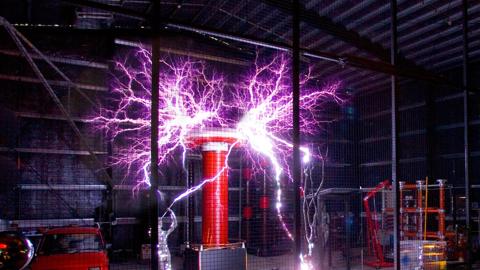
With the singing tesla coils shown in the video, the vibration is caused by the air heating up from the lightning. With your student experiment, the vibrations you make with your voice move through the air and cause the cling wrap to vibrate, and this makes sprinkles jump around!
Review students initial brainstorm about sound and ask how their ideas have changed over the course of this experiment.
Victorian Curriculum Links
Science: Levels Foundation to Level 2
Science understanding
- sound can make materials vibrate and vibrating materials can make sound; different actions can be used to produce sounds of varying pitch and volume (VC2S2U12)
Science inquiry
- experiences can be used as a basis for posing questions to explore observed patterns and relationships, and to make predictions (VC2S2I01)
Science: Levels 3 and 4
Science inquiry
- observations can be used as a basis for posing questions to identify patterns and relationships, and to predict the outcomes of investigations (VC2S4I01)
Science as a human endeavour
- scientific knowledge, skills and data can be used by people to explain how they will meet a need or solve a problem (VC2S4H02)


Sign-up to Museum Teachers
Subscribe and get special offers, teacher news and free entry to all museums.