The State election will be held on Saturday 28 November 2026. During the caretaker period (starting 6 pm on Tuesday 3 November) content will only be added to this website in line with the caretaker conventions.

Key details
Date/Time:
Thursday 26 November, 4:30pm to 6pm
(Followed by the optional Discover the Night Sky presentation from 6:30pm to 7:30pm)
Location:
Scienceworks
Cost:
$30 Museum Teachers
$40 for non Museum Teachers
Overview
Your students are star…dust! We’ll help you show them just how bright they shine! (Because they literally are made of chemical elements forged in the stars).
Don't miss this professional learning session focused on teaching Earth and space science curriculum content.
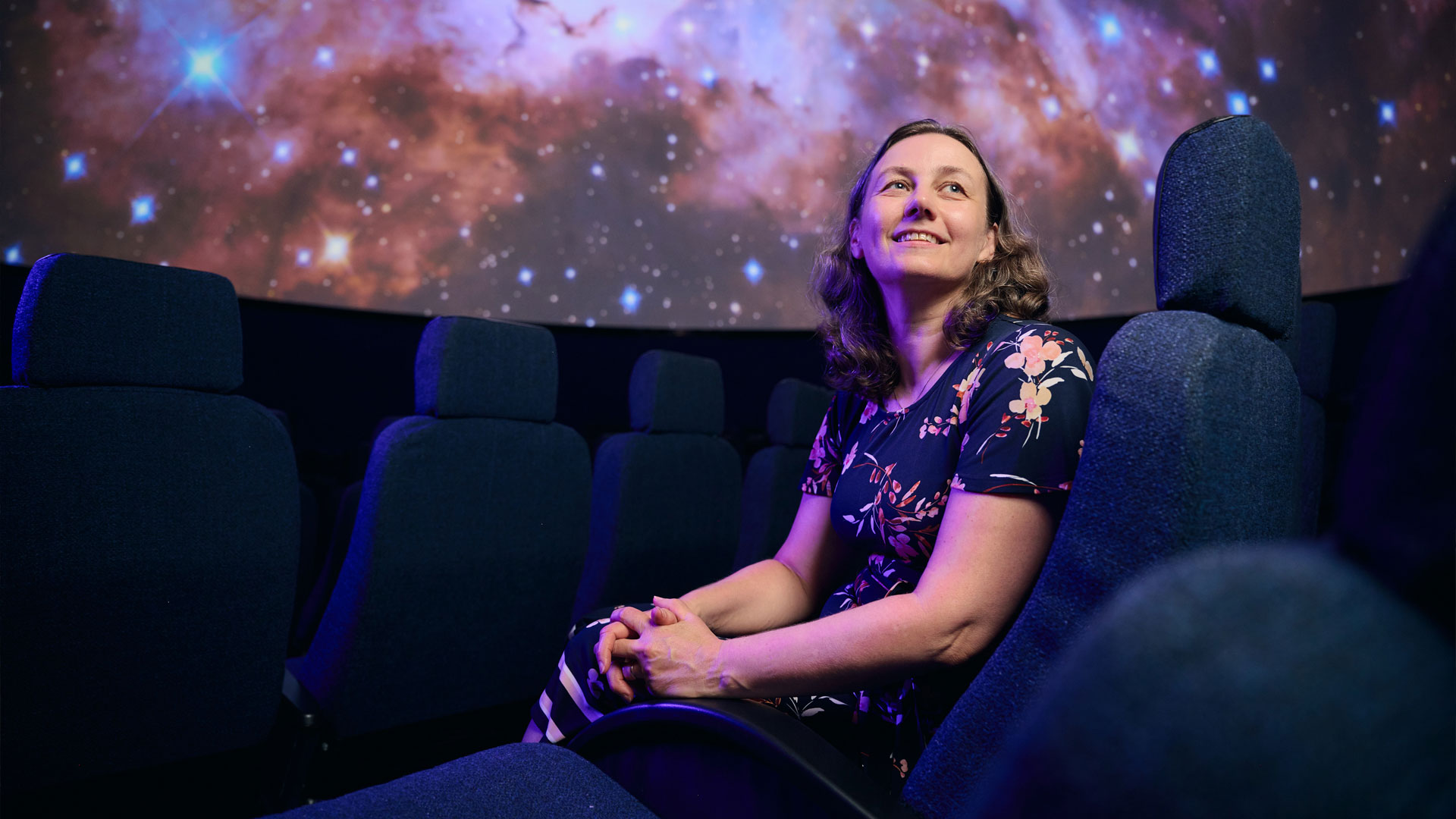
Learn how you can teach current astronomy with special guest, astrophysicist Dr Sara Webb from Swinburne University of Technology. Dr Webb will be sharing her work developing innovative AI tools to better understand our universe. Together with our in-house astronomer Dr Tanya Hill, they'll be able to answer almost any astronomy question you may have... unless perhaps no one knows the answer yet!
This professional learning session includes
A Planetarium show presented by Dr Tanya Hill that highlights what to see in the night sky, a fly through Saturn’s rings, and travelling to galaxies beyond the Milky Way.
Learn from astrophysicist Dr Sara Webb about the tools she uses to better understand the biggest unknown in astronomy: the nature of Dark Energy.
How to teach students about space curriculum content and astronomy, with hands-on activities to take back to your classroom.
An opportunity to discuss your astronomy questions with astronomer Dr Tanya Hill (Museums Victoria) and astrophysicist Dr Sara Webb (Swinburne University of Technology).
A complimentary ticket to attend the Discover the Night Sky event
Teachers will be provided
With useful space science teaching demonstrations for the classroom.
A greater understanding of current astronomy to share with students.
Other Key information
The program is scheduled to finish at 6pm. At this time, doors to the Planetarium Foyer will open for the Discover the Night Sky event.
All professional learning attendees will receive a complimentary ticket to attend the 6:30pm to7:30pm show in the Melbourne Planetarium. You are welcome to network with other participants in the break before the show begins.
If you would prefer to stay for the 8pm to 9pm show instead, please indicate this at time of booking.
AITSL Standards
2.1 - Content and teaching strategies of the teaching area
6.2 - Engage in professional learning and improve practice
6.3 - Engage with colleagues and improve practice
7.4 - Engage with professional teaching networks and broader communities
Curriculum links
Earth is part of a system of planets orbiting around a star (the Sun) (VCSSU078)
Predictable phenomena on Earth, including seasons and eclipses, are caused by the relative positions of the Sun, Earth and the Moon (VCSSU099)
The Universe contains features including galaxies, stars and solar systems; the Big Bang theory can be used to explain the origin of the Universe (VCSSU129)

Sign-up to Museum Teachers
Join Museum Teachers for free general entry to all our Museums, discounts and to keep up to date with professional learning opportunities.