Being cold-blooded animals it is unsurprising that turtles are not well represented in cool-to-temperate southern Australia.
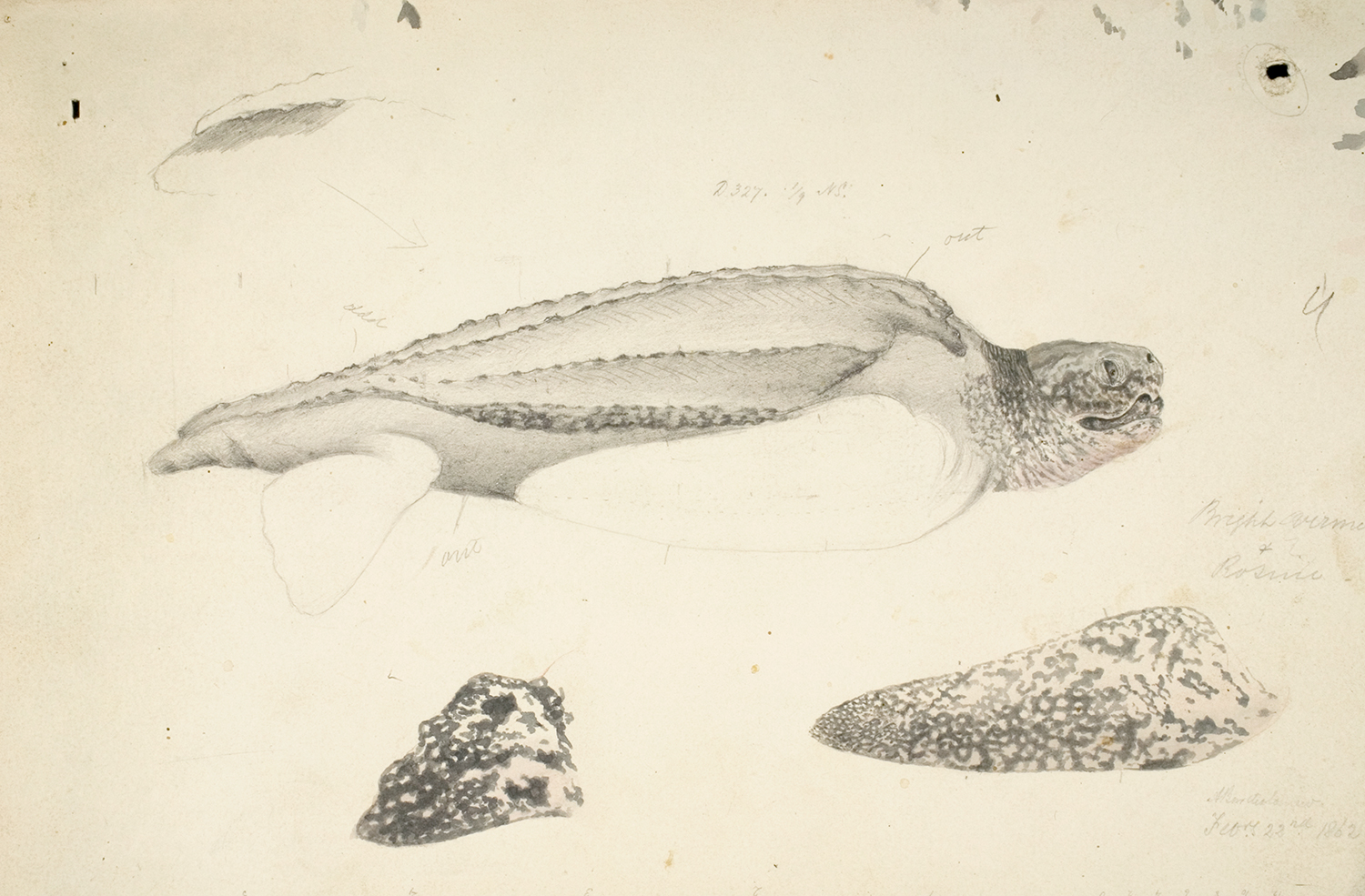
The Leathery Turtle is the only marine turtle that resides in the world's temperate seas. The animal depicted in the Prodromus was caught off Portland and brought to the lab for identification by Frederick McCoy.
Once known as tortoises, two of the species described in the Prodromus are more accurately defined as 'freshwater turtles'.
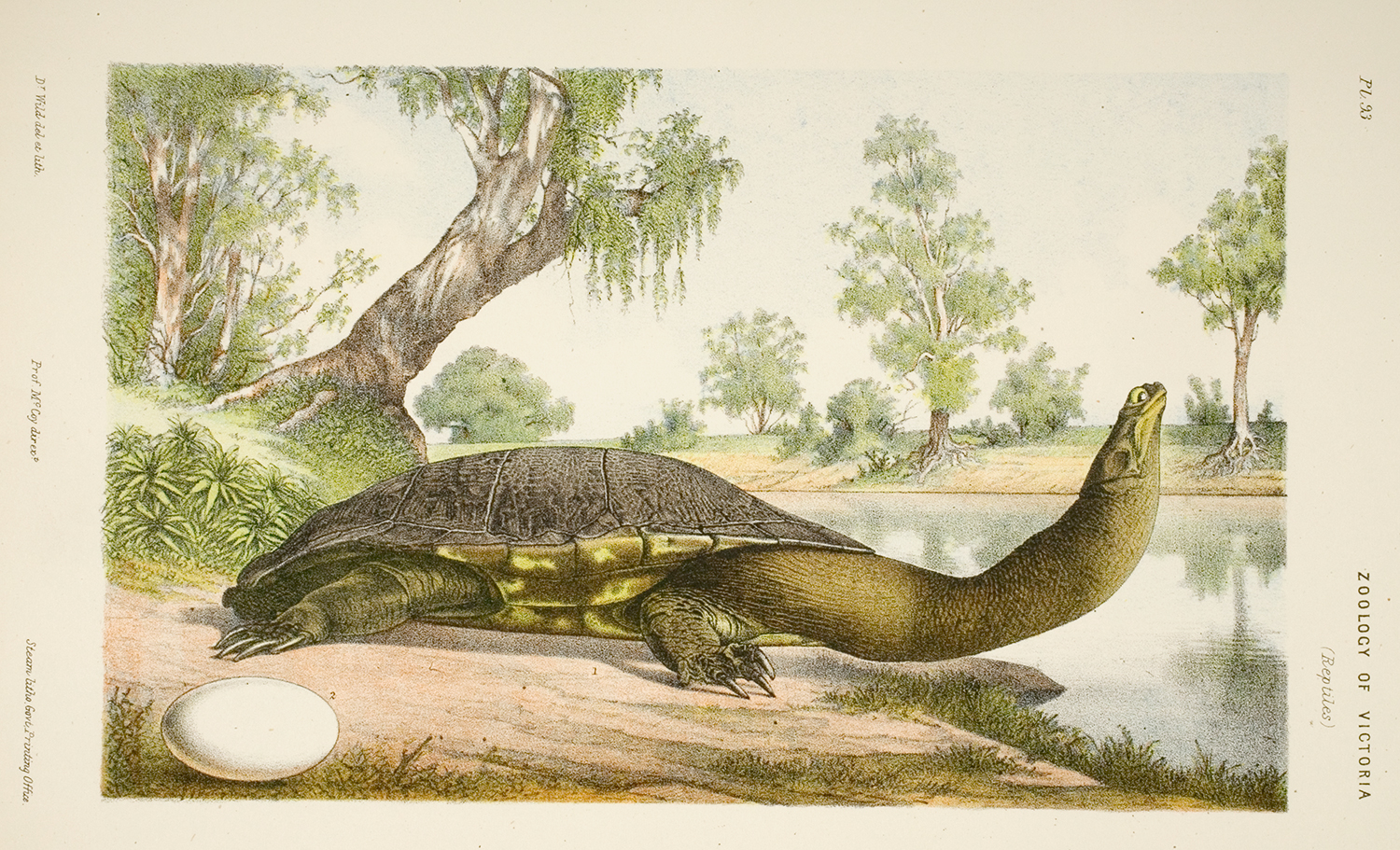
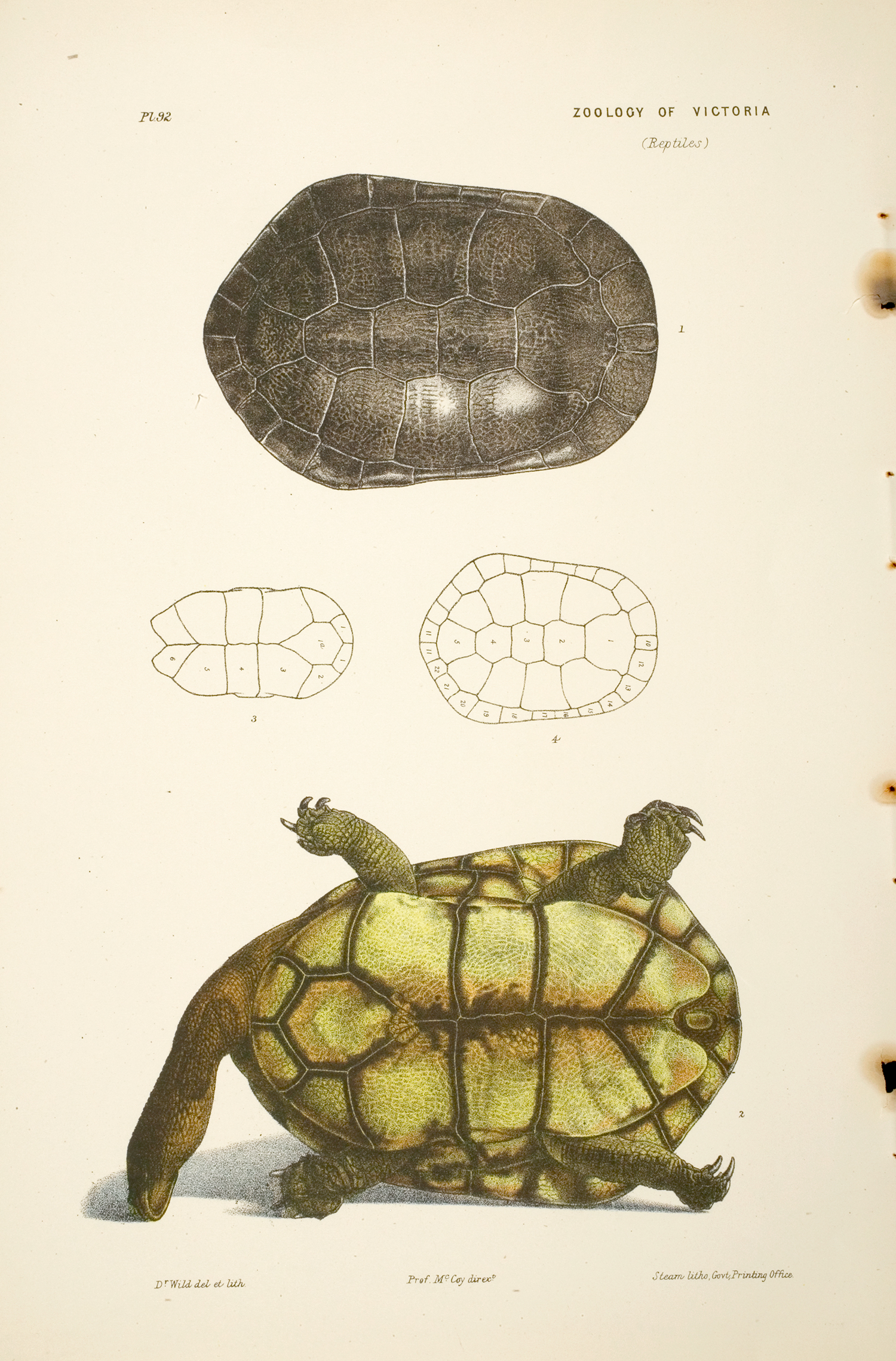
The Snake-necked Turtle lives in swamps, slow moving rivers and lagoons across much of Victoria. John James Wild depicted the species, neck extended, in an idealised Murray River habitat. His image of the animal's carapace reveals a mastery of colour lithography used to create an almost photo-realist effect, despite being achieved by purely mechanical means.
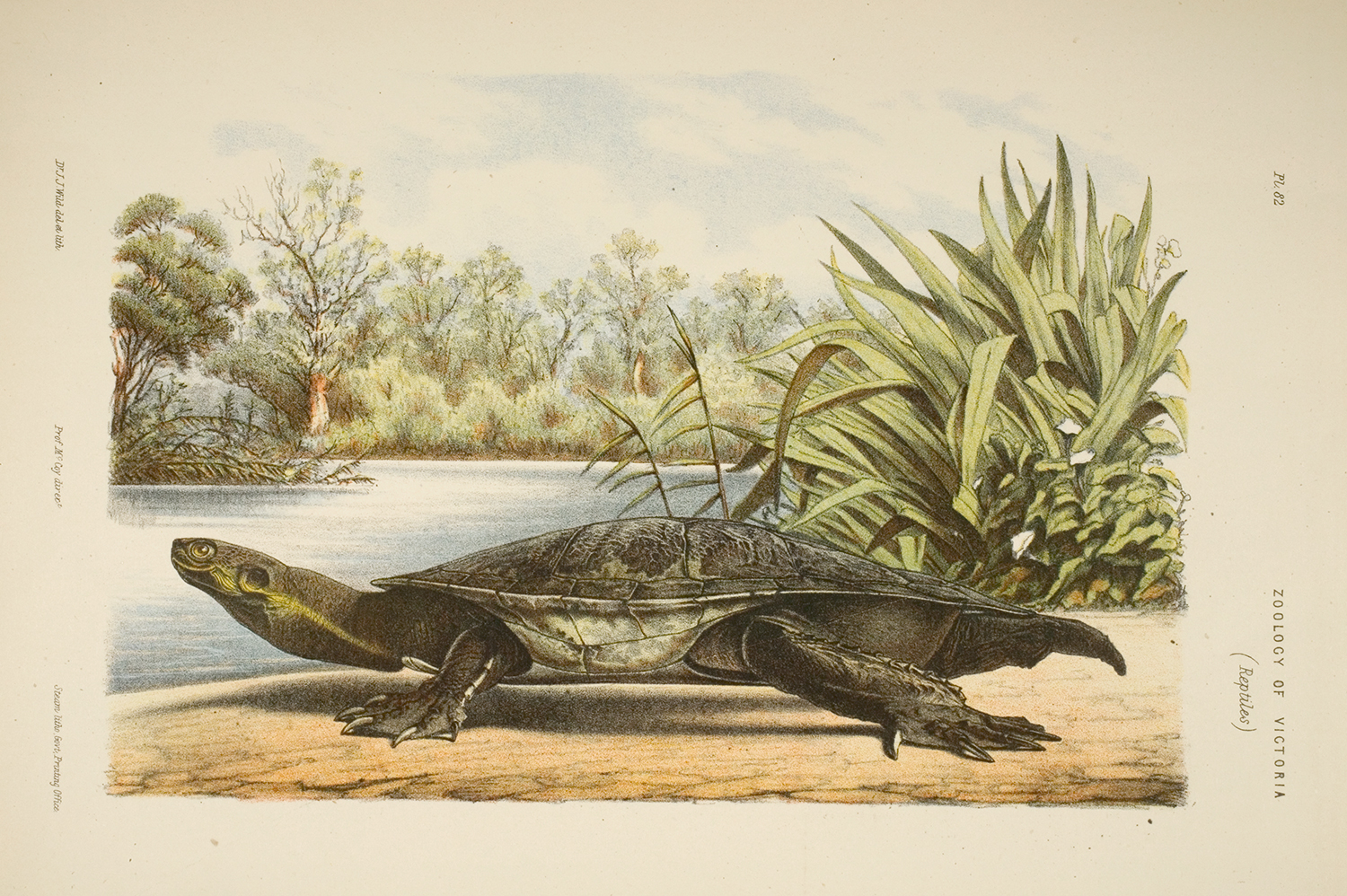
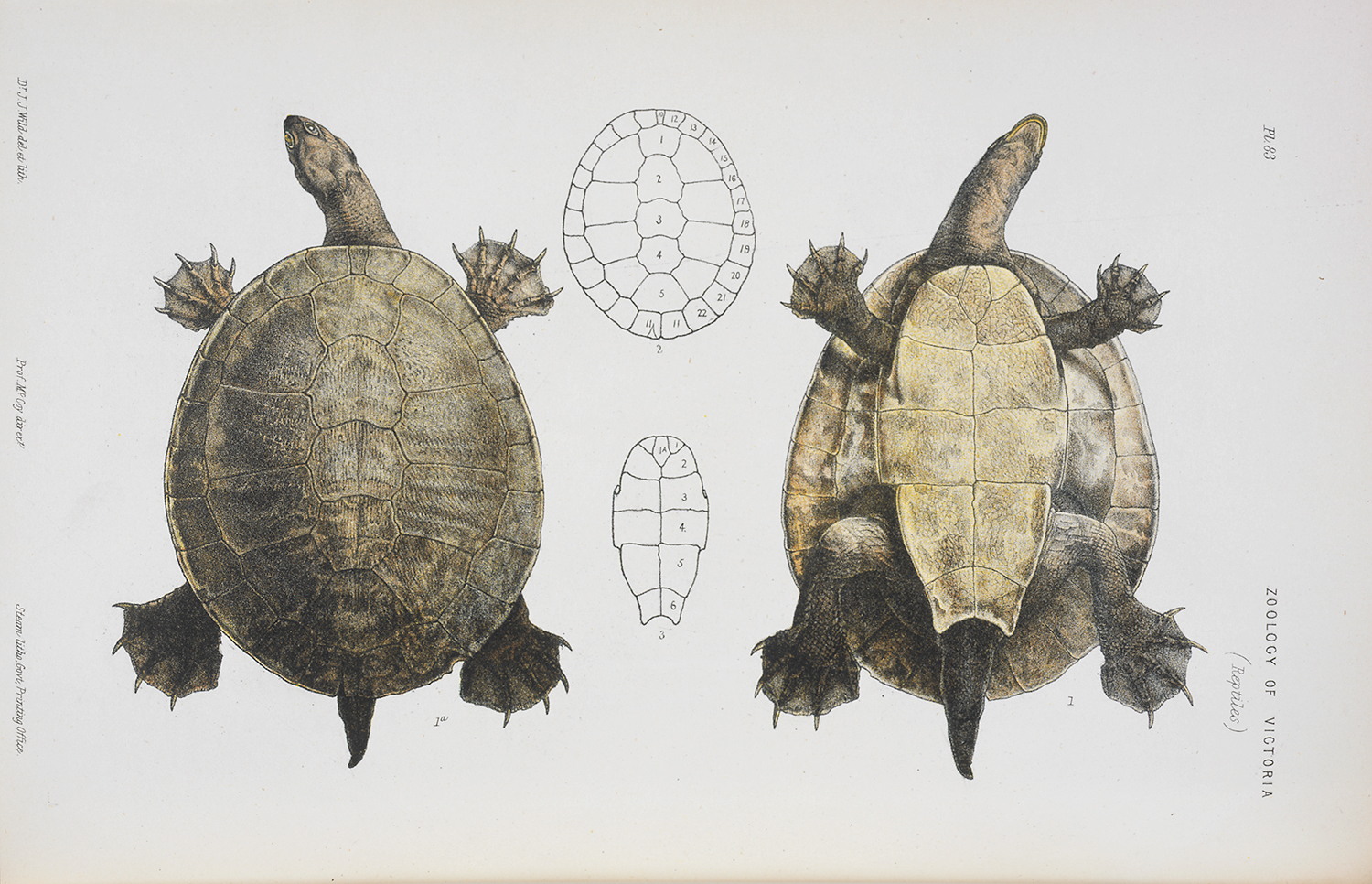
Wild also produced a similarly realistic depiction of the Macquarie Turtle, an animal restricted in Victoria to the Murray River drainage systems.
Discover more turtles
Long-necked Tortoise
Chelodina longicollis
Public Domain (Licensed as Public Domain Mark 1.0)
Plates 92-93. Long-necked Tortoise, Chelodina longicollis
This handsome Tortoise is as common in the rivers of Southern Gippsland as the Chelemys Macquaria is in the Murray and its tributaries; and although it also inhabits the more northern Australian rivers, the Chelemys has not yet been found in those flowing south. Although the yellow upturned sides of the carapace are usually marked with square brown patches on the edges of the plates, and those below have usually broad brown edges, some rare examples have the brown so extended as almost to obliterate the usual, yellow ground colour. The detailed measurements I have given show how the individual plates, as well as the general outline of carapace and plastron, vary; in none of my specimens do the anterior edges of the 2nd and 11th marginal plates coincide with sutures of the costal plates, as mentioned in Dr. Gray's examples. There are certainly no barbels under the chin of this tortoise.
Public Domain (Licensed as Public Domain Mark 1.0)
Luth
Dermochelys coriacea
Plate 101. The Luth, or Leathery Turtle, Sphargis coriacea (now known as the luth, Dermochelys coriacea) found in Portland
Public Domain (Licensed as Public Domain Mark 1.0)
Of all living Chelonians the Luth is the largest, some recorded being 9 feet long; our specimen, from the size and the distinct tuberculation of the dorsal ridges, is only half grown; but there are no traces of the fine ridges on the sternum said to be found in the very young.
The species above is the only one I have known to have occurred on the shores of the colony. It was captured in 1862 at Portland.
Short-necked Tortoise
Emydura macquarii
Public Domain (Licensed as Public Domain Mark 1.0)
Plates 82-83. The Murray Tortoise, Chelymys macquaria (now known as the Short-necked Tortoise, Emydura macquarii) found at the Goulburn River
Although popularly called the Murray Turtle by the colonists, the structure of the feet is that proper to the walking Tortoises, and not the exclusively swimming paddles of the true Turtles.
Very common in the River Murray and its branches, the Darling, Goulburn, &c., from which a great number of specimens of various ages and sizes are in the Museum. It is not found in the rivers flowing south into the sea on the Victorian coast. The specimen figured is one of average size from the Goulburn.
Although so common, no recognisable figure has been published before.
Public Domain (Licensed as Public Domain Mark 1.0)