Pennatulacea, or sea pens, are an order of marine invertebrate in the same class of animals as anemones and corals. Like their relatives, sea pens are colony animals comprised of polyps.
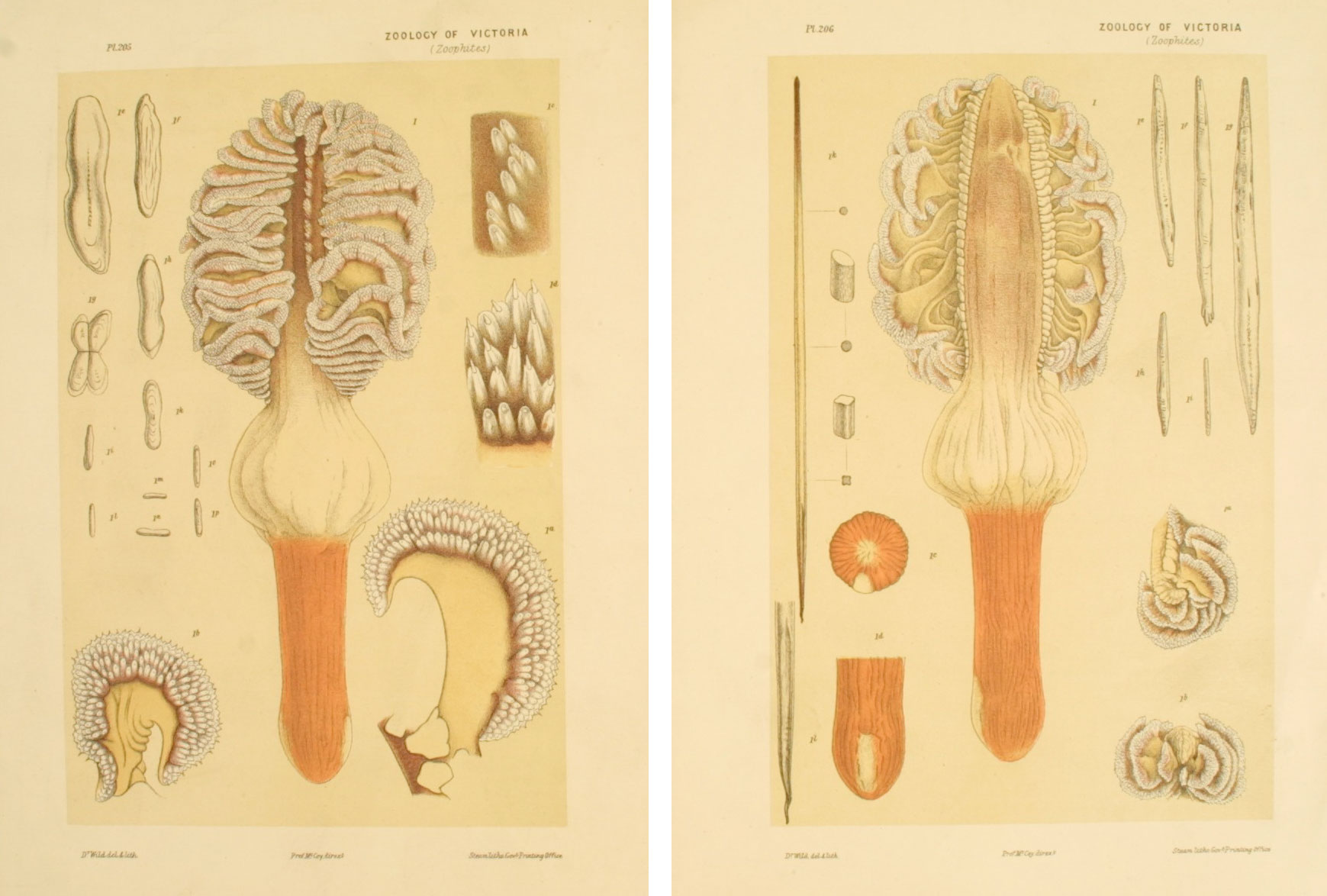
Sea pens live in places swept by currents, within protected bays and gulfs as well as in deeper waters off open coasts.
The stalk of a sea pen remains buried in sediment while the feather-like array of polyps are arranged in rows above, for food collection and for pumping water. These sometimes luminesce when touched.
Only one sea pen was illustrated for the Zoology of Victoria, Sarcoptilus grandis. The largest and most common species in waters off southern Australia, this particular specimen was found by Frederick McCoy, washed up after a southerly storm. The Museum retains this specimen in the collection with a label that notes that it was illustrated by Dr J.J. Wild.
Wild's analytic approach was ideally suited to the description of the sea pen, carefully illustrating the (relatively fresh) specimen from both sides. Wild also provided details of the feeding and syphoning polyps. Sponge expert Arthur Dendy later drew the calcareous spicules which give support to the animal.