The unique attributes of Australia's marsupials and monotremes would have fascinated McCoy's curious mind, but he was working in the shadow of John Gould, the brilliant naturalist and entrepreneur, as well as other European authorities.
Gould had visited Australia from 1838 to 1840, collecting specimens which would later comprise his great folio productions, A Monograph of the Macropodidae (1841-42) and The Mammals of Australia (1845-63). By this time he had illustrated every terrestrial and arboreal species from Australia then known to science.
McCoy's opportunity for a significant new contribution to the scientific literature of living species came in 1867, when two small possums from the Bass River in South Gippsland were brought to him for identification. He named the new species in honor of John Leadbeater, the taxidermist who prepared these and many other specimens for exhibition at the National Museum. Leadbeater's Possum was the only arboreal mammal in the Prodromus of the Zoology of Victoria.
The Prodromus also included three species of marine mammals. The Australian Fur Seal was unique in receiving two entries, the first based on a young animal located near Punt Road by artist Ludwig Becker. The second was created following one of McCoy's rare field trips, when he traveled to Philip Island to observe the species and collect a representative male, female and juvenile.
The other mammals illustrated were the Leopard Seal, an occasional vagrant from Antarctic waters, and the Common Dolphin, a species with worldwide distribution in temperate water.
Australian Fur Seal
Arctocephalus pusillus doriferus
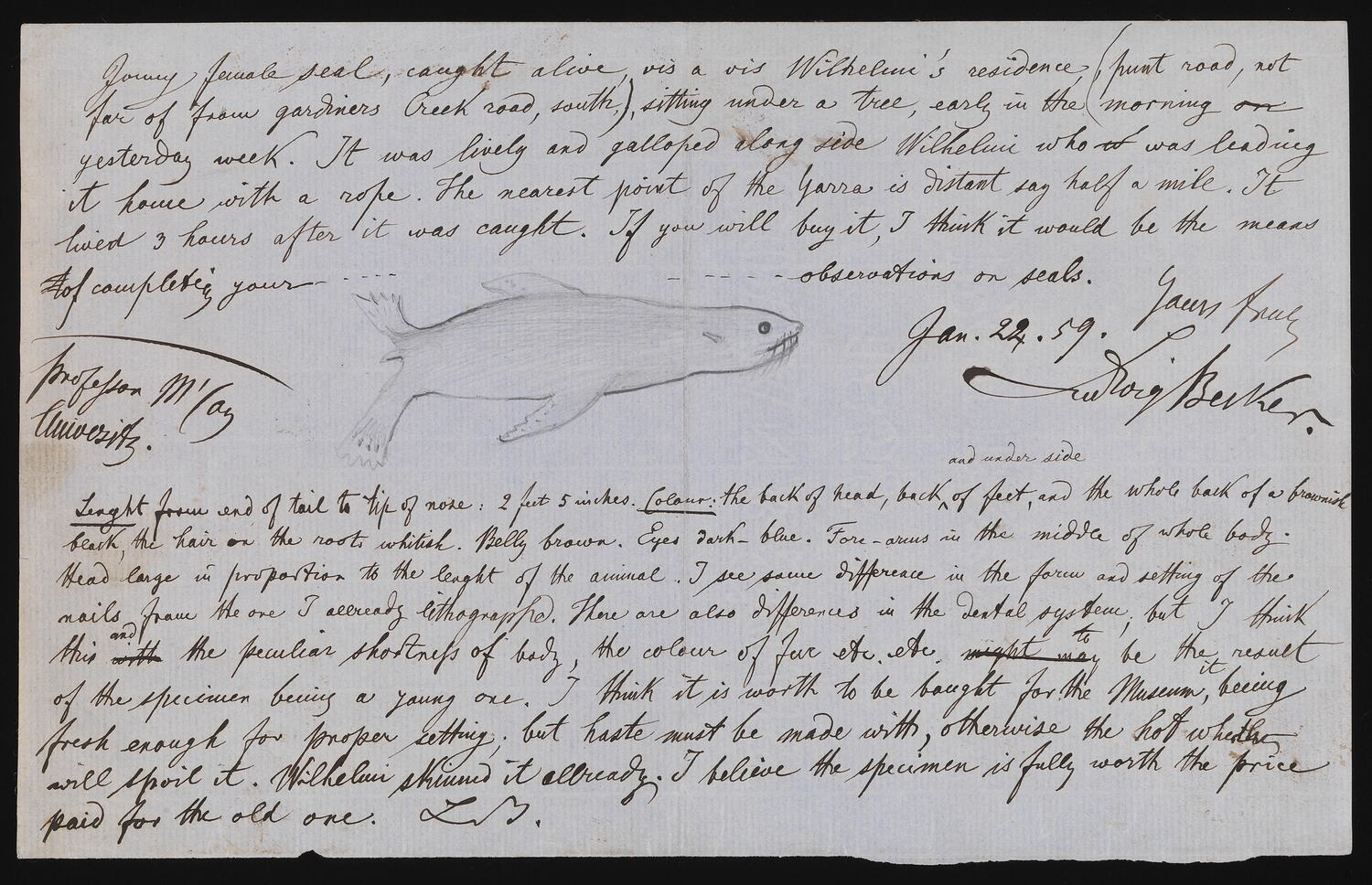
Plate 31. Australian Sea-Bear or Fur-Seal, Euotaria cinerea (now known as Australian Fur Seal, Arctocephalus pusillus doriferus). All the specimens described were killed at the Heads, Near Queenscliff.
The Hon. David Moore has kindly furnished me with a great deal of valuable information respecting the old trade at Sydney in the Fur-Seals of this species. The males he mentions were more valuable than the others; these were entered in the invoices under the trade term of "Wigs," the females entered as "Klapmatches," and the young as "Pups." The trade, he informs me, has now entirely ceased in New South Wales, Victoria, and South Australia, partly from the animals being scared away by the traffic of a multitude of steamers and other vessels, and partly of the greater scarcity of labour no longer leaving it profitable to pay a sufficiently numerous crew of a vessel to man the several boats required. Colonel Champ also informs me that five-and-twenty years ago he used to see several of the islands between the Tasmanian and Victoria shores covered with numbers of the Fur-Seals, of which it is rare circumstances to see a single individual now in the localities where they were so common formerly.
I subjoin in foot-note an amusing notice of one of the young specimens now in the Museum, written by the late clever observer and artist, Ludwig Becker*.
* "Professor McCoy. University 24th January 1859.- Young female Seal, caught alive, vis-a vis Wilhelmi's residence (Punt road, not far off from Gardner's Creek road, south) sitting under a tree in the morning yesterday week; it was lively and galloped alongside Wilhelmi, who was leading it home with a rope. The nearest point of the Yarra is distant say half-a-mile. It lived three hours after it was caught. If you will buy it, I think it would be the means of completing your observations on Seals. - Yours truly, (signed) Ludwig Becker.
"Length from end of tail to tip of nose, 2 feet 5 inches. Color: the back of the head, back and under side of feet, and the whole back, of a brownish-black; the hair on the roots whitish; belly brown; eyes dark-blue. Forearms in the middle of whole body. Head large in proportion to the length of the animal. I see some differences on the form and setting of the nails from the one I already lithographed. There are also differences in the dental system; but I think this and the peculiar shortness of body, the color of the fur, &c., &c., to be the result of the specimen being a young one. I think it is worth to be bought for the Museum, it being fresh enough for proper setting; but haste must be made with, otherwise the hot weather will spoil it. Wilhelmi skinned it already. I believe the specimen is fully worth the price paid for the old one.-L.B."

Public Domain (Licensed as Public Domain Mark 1.0)
Plate 71. The Australian Sea-Bear or Fur Seal, Euotaria cinerea (now known as the Australian Fur-Seal, Arctocephalus pusillus doriferus) found in Phillip Island
Thinking it desirable to visit the actual locality in Western Port Bay, where the French voyagers with Quoy and Gaimard originally found the type specimen of this species, still in the Paris Museum, I last year went out in a small steamer from Phillip Island to the smaller island on which these Seals abound in the breeding season. The coast is so rocky, and the surf so dangerous that it is only on rare occasional days that a landing can be safely made, and on this occasion is was quite impossible to do so. On looking with a good binocular, one could soon make out that the greater number of what looked like brown bare, rounded rocks over the surface of the island were really Seals. On the steam whistle being blown they all started up, and, with the precise action of a flock of crowded sheep driven by a dog, they awkwardly galloped in a confused cluster, jumping up on those in front in their hurry to get down to the sea, into which most of them plunged; a few old large males alone standing their ground, well raised up on their bent fin-like legs, as in our plate, with their broad breast to the foe, and head raised, threateningly showing their teeth, and erecting the hair of the neck angrily, like a short mane. After a little while, scores of the females and younger males came swimming out to our little vessel to look at us, raising their kind, intelligent, good-humored, dog-like heads, with beautiful large, brown, soft eyes, looking like large Retriever Dogs with the pleased and friendly expression they wear when approaching their masters.
Making an arrangement with an old sealer living on Phillip Island, and greatly aided by Mounted Constable George Ardill, stationed on duty there, I ultimately got for the Melbourne Museum the fine old male, the adult female, and the young one, figured on our present plate in the attitudes of life when on land, as noted at the time, and now represented by Dr. Wild (the accomplished artist, formerly of the Challenger Expedition) from the preserved specimens set up with every attention to accuracy of form and position of the parts. These additional lithographs of this species, not figured by Mr. Gould, and which will soon become extinct on our shores, were desirable because our former figure, in Plate 31 (Decade IV), was of an unusually grey specimen, and only gave the position of the limbs and body when swimming, which differs little from others Seals; while the attitudes assumed on land, shown in the present plate, are peculiar to the Seals having external ears.
The task of procuring the required specimens was by no means an easy one, for not only is it difficult to land, even in the calmest weather, but if a boat approached the island by day the Seals would take to the water, and not return so long as the men were to be seen. It was therefore determined to land on the first calm evening, and bring blankets and food for the night, to be passed in some of the caves found there, so that, as the Seals came back at night to rest, the sealers might quietly emerge before daybreak, and, selecting an adult old male and female, make sure of them with heavy rifles used for the purpose, and take chance of catching a young one in the confusion. This was at last successful, and I was enabled to get accurate drawings of the diverse profiles of the male and female, and of all the soft parts while yet in the flesh.
During the breeding season the roaring of the old males may be heard half a mile off, high above the thunders of the surf, and they show great courage and ferocity in defending the females and young when attacked by man. The young are very easily tamed, and one was going about the kitchen of the hotel at the time of my visit like a rather lame dog, following the housekeeper everywhere with affectionate pertinacity, and playing with a young kangaroo and some other tame animals about the house with all the fun of a kitten or young puppy. It would come when called like a dog, and obviously liked to have its head stroked with the hand.
Having told my friends, Trooper Ardill and the sealer, Ross, that I should like to have their observations on the creature in writing for publication, the former furnished me with the following interesting account, which I give in his own words, conveying Ross's observations and his own:-
Cowes Police Station, 12th March 1880.
In reply to your enquiries relative to the Seals which frequent the Seal Rocks off Phillip Island:-The Seals come to the rocks about 1st October. The time of bringing forth the pups is between 10th November and 10th December. They do not commence to breed until they are three years old. The male (or bull) during the pupping season will ascend the rocks and stop for one or two months without food, and is extremely attentive to the female (or cow) and pups. When the females fight and quarrel he restores order. The bull is very fat in the beginning of the season and yields from five to ten gallons of oil, and in three weeks after will hardly yield one gallon, the yield of course depending on the age and size of the bull. The cows are seldom killed, as they have very little fat. It is against the rule of sealers to kill a cow or the pups.
They live on fish of various kinds. I have found the backbones of fish 2 feet in length. The ear leather-jackets, parrot fish, squid, &c. I found one backbone 2 feet 4 inches; it may have been a barracuta or pike; I don't think it was a shark. I have found a few joints of a shark's backbone.
The bull is very furious at pupping season, and when disturbed will go into the water and return in a few minutes. Out of season they go to sea in the morning and return at night. When fighting they strike each other like the boar; their teeth are about 1½ inches long, and cut terribly. I have seen cuts from 1 to 10 inches in length.
The usual color is a yellowish-brown, although some have been seen that were spotted, and some a beautiful grey. They generally select flat, inaccessible rocks, or, where they are not disturbed, they select the grassy patches.
The cow generally brings forth one pup, sometimes two. They keep good watch, and care affectionately for their offspring. They circle round them in rough stormy weather, and keep them from any wash or sea that may come over the rocks. I have seen three pups washed off the rocks, and the cows have immediately followed and brought them on the rocks again in an astonishingly rapid manner. I have also seen them catch a pup in their mouth, and throw them 10 feet high, and never hurt them.
The bull's voice or noise is guttural, and, when angry, sounds something like "oough oough;" the noise is much heavier than any animal I know. Then trying to pacify the cows it sounds like "yah yah," said quick and short. The noise of the cow is very much like a cow of the bovine species. The pup bleats like a lamb.
Their sight is not so good, so it is generally said. I think, myself, their sight good enough, but they not smelling man don't think he will harm them; when they get the least scent they are off like a shot.
During the pupping season they keep an incessant noise during the night, and generally keep quiet during the day. They look clumsy and awkward on the rocks, but they are very lively when on the move.
I consider them as quick in their movements as any fish that swims. They strike at one another with the rapidity of lightning. I have seen one bull prevent another from landing for several hours. They move along by drawing the hinder part of the body forward and under, and then giving a jump and push forward.
If they are disturbed before they pup, they will leave the rock and go to another.
The cow has six teats, I think, which they draw into the udder or body when not suckling their young. The milk is very white and strengthening. Should a cow die or be killed, her pup is suckled by the other cows. This I am told is the case, but I can't vouch for it. All I write is my experience on the Seal Rocks, off "The Nobbies," at Phillip Island, Victoria.
I can't say whether they inhabit these rocks all the year or not, but don't think so. I have heard Ross say they do not.
As regards their habits, fur, ears, &c., &c., the only difference being in the colour; some are darker than others.
They are found along the coast, as far as I know, from Phillip Island to Wilson's Promontory. Nearly all the islands in Bass's Straits re inhabited by seals.
I know of no other fur or eared seal; in fact there is no other seal about here.
(Signed) GEORGE ARDILL,
Mounted Constable.
Common Dolphin
Delphinus delphis

Public Domain (Licensed as Public Domain Mark 1.0)
Plate 22. The Yellow-sided Dolphin, Delphinus novæ zealandiæ (now known as Common Dolphin, Delphinus delphis), found in Hobson's Bay
This is the only dolphin, or "Bottle-nose," as sailors say, which I have noticed on the Victorian coasts. It not unfrequently visits Hobson's Bay, generally in August, and following shoals of Pilchards or other fish, on which it feeds.
Leadbeater's Possum
Gymnobelideus leadbeater
Museums Victoria
Public Domain (Licensed as Public Domain Mark 1.0)
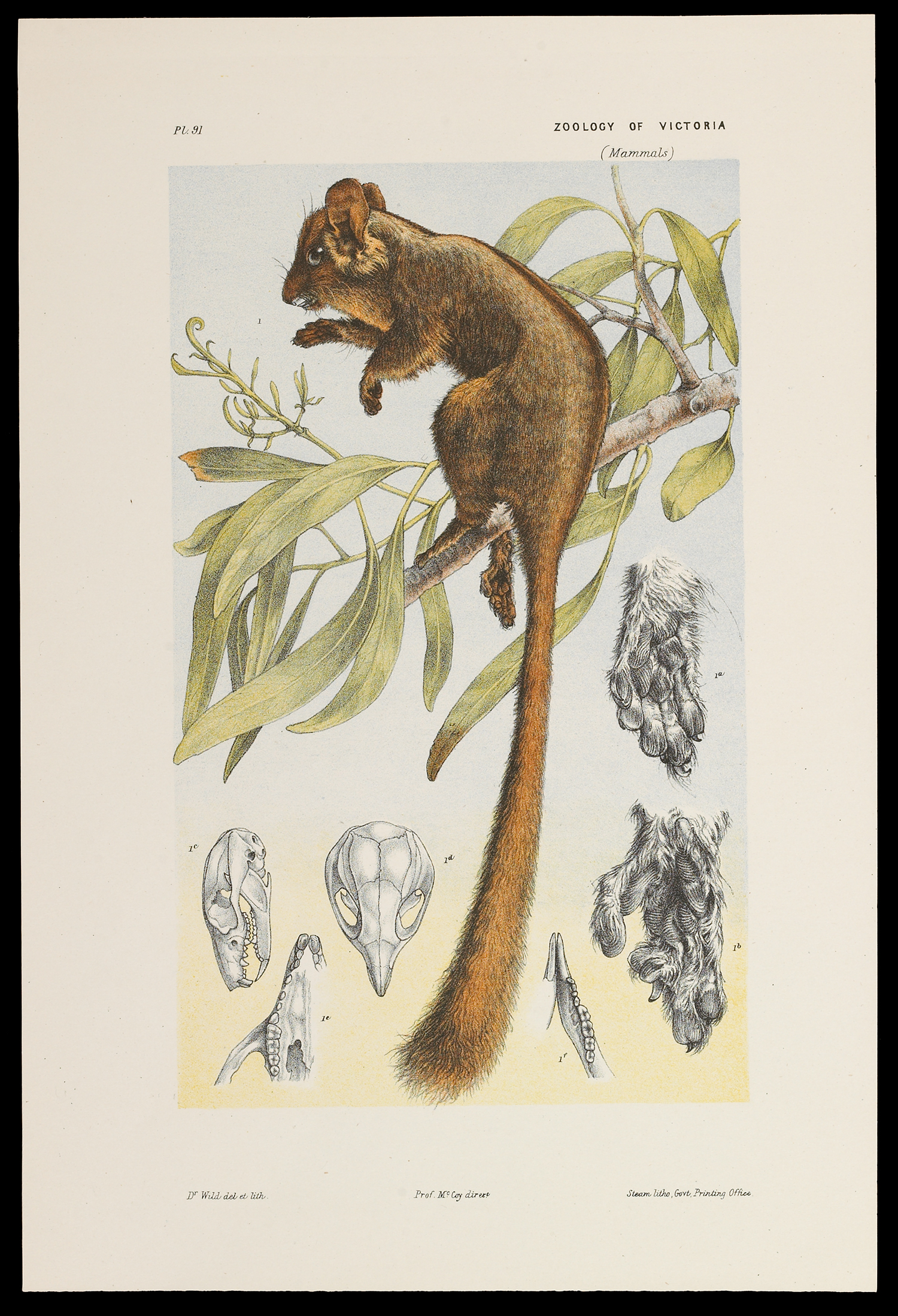
Plate 91. Gymnobelideus leadbeateri (now known as Leadbeater's Possum, Gymnobelideus leadbeateri) found at Bass River
In general appearance this curious animal is intermediate between Belideus and Phascogale; but its nearest affinity is with the former, from which the absence of the flank-membrane and the different form of the feet distinguish it. There is only one species known, which occurs in the scrub on the banks of the Bass River, in Victoria. I name it after the skilled taxidermist of our Public Museum, in which specimens of both sexes are preserved.
Leopard Seal
Hydrurga leptonyx

Public Domain (Licensed as Public Domain Mark 1.0)
Plate 21. Sea-Leopard Seal, Stenorhynchus leptonyx (now known as Leopard Seal, Hydrurga leptonyx), found along the Victorian Coast
This, the largest of the Seals frequenting our coasts, is a most voracious devourer of fish and occasionally of marine birds. It is a good example of the group of genera termed "Earless Seals," from their having no external ear-conch visible. Unlike the Eared Seals, the hind limbs are directed backwards when at rest, nearly in a line with the body, and closely approximated to the tail with only a moderate, obliquely lateral, power of motion; so that, on the land, instead of raising the body clear of the ground and walking on the four legs like the eared seals, it can only progress painfully on the land by the action of the abdominal muscles and singularly flexible pine. Dr. Ludwig Becker (who died in the Burke and Wills Expedition across the Australian Continent), when making our plate from a living specimen, wrote thus to me on this point :- "The specimen while alive was able to open its mouth so much that the upper and lower jaw formed an angle of nearly eighty degrees. Palate and tongue pale flesh-color. The flexibility of the spine was seen while the poor animal was crying either from pain or for food; it could rise the head two feet and a half from the floor while still the sternum was level with the belly, and the head when raised was bent backwards. At the same time the spine from above the pelvis to the tail moved right to left. The sound was somewhat between a roaring and a grunting noise, not very strong."
This species abounds in countless myriads on the packed ice of the Antarctic Ocean, and only occurs on our shores as an occasional visitant strayed from its usual haunts.
Fine specimens from the Victorian coasts are in the National Museum.