Australia's predominantly arid landscape created an ideal environment for lizards to evolve into diverse forms. Twenty-one species of the more common Victorian lizards were illustrated in the Prodromus, representing all Australian lizard families.
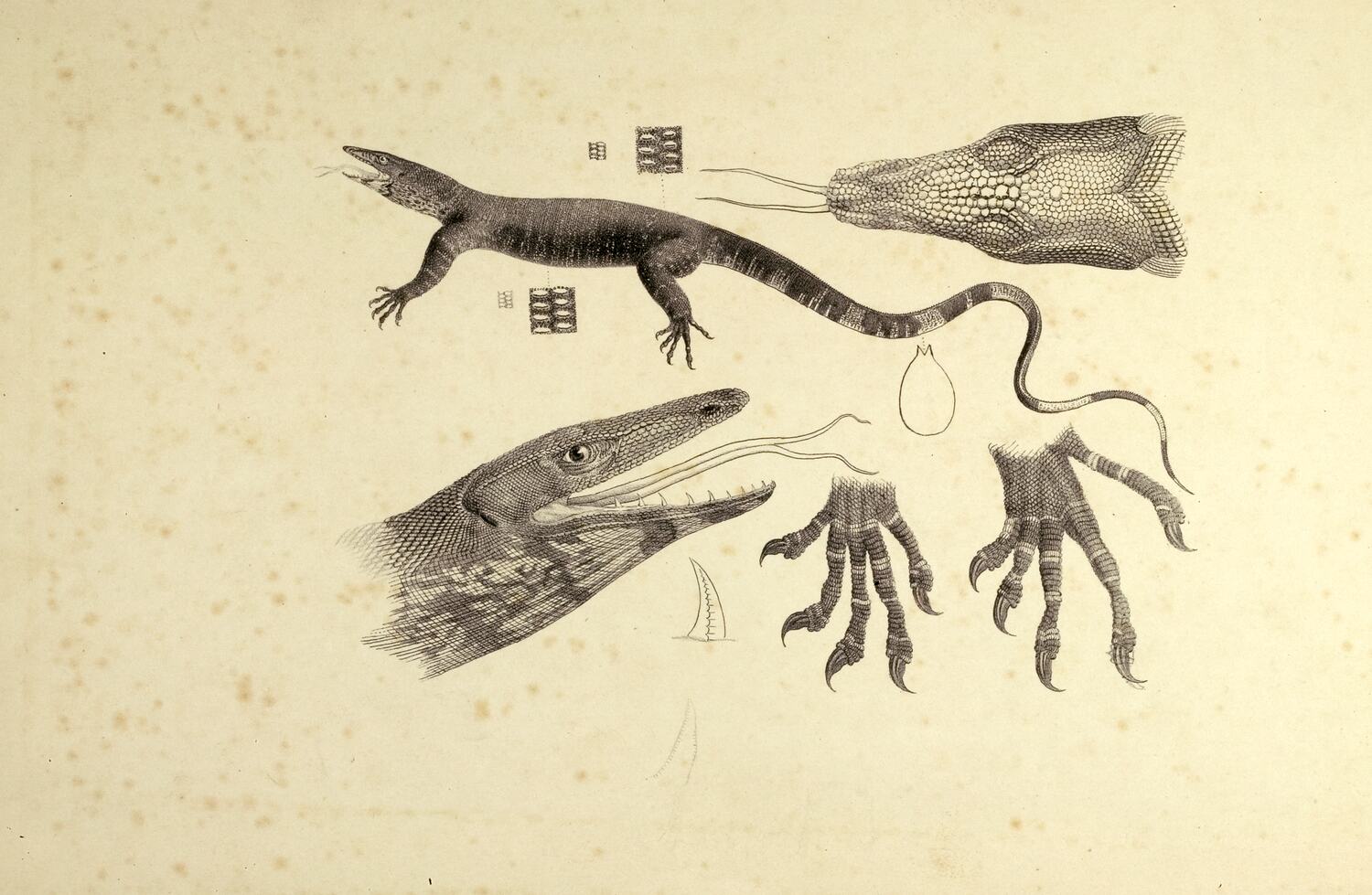
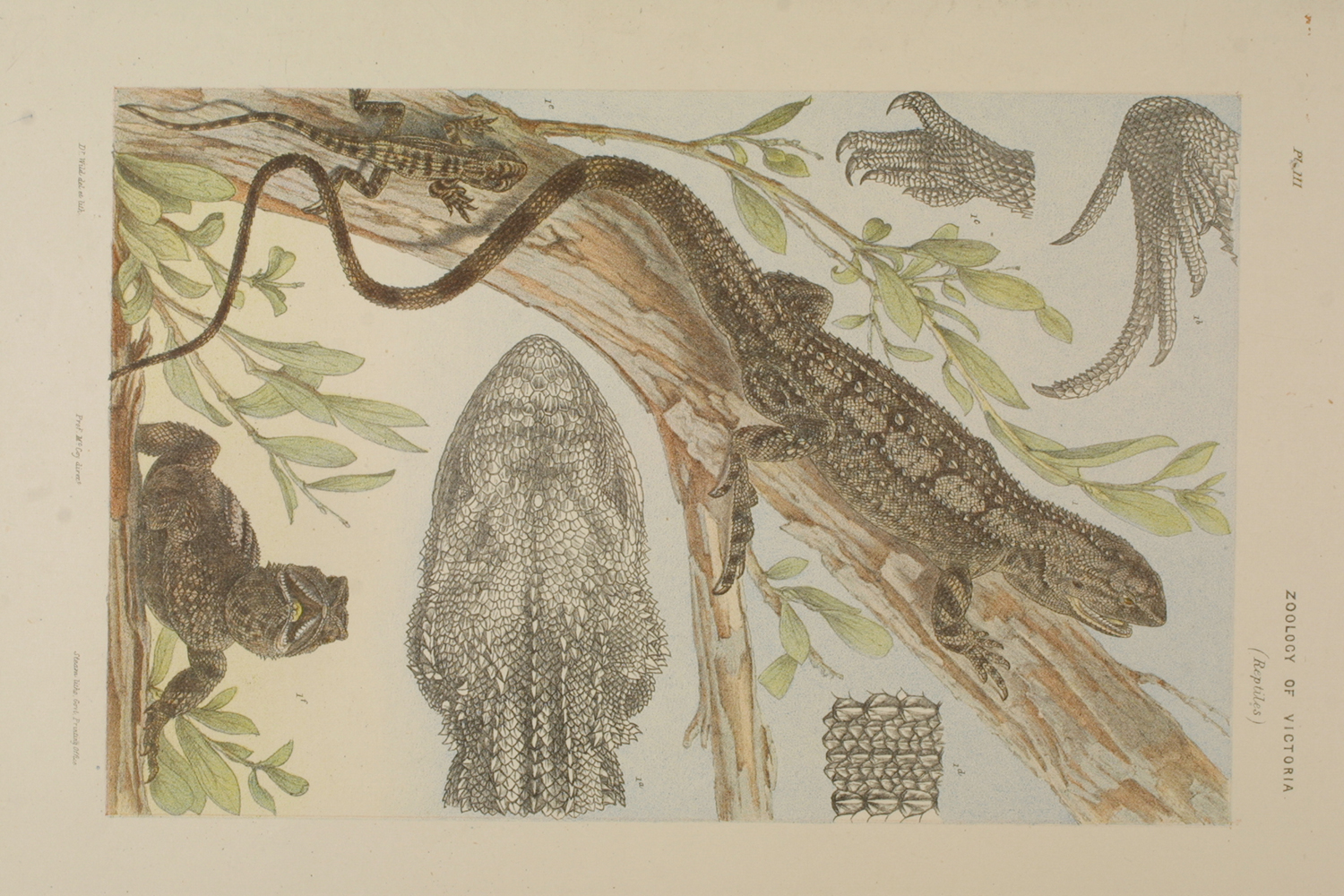
The goanna family includes Australia's largest lizards. First illustrated was the Lace Monitor, shown characteristically gripping a tree. Also depicted was the Sand Goanna, which occurs only in the state's far north-west. Similarly, geckoes are more diverse in the north, with just two species represented: the Marbled Gecko and the Thick-tailed Gecko.
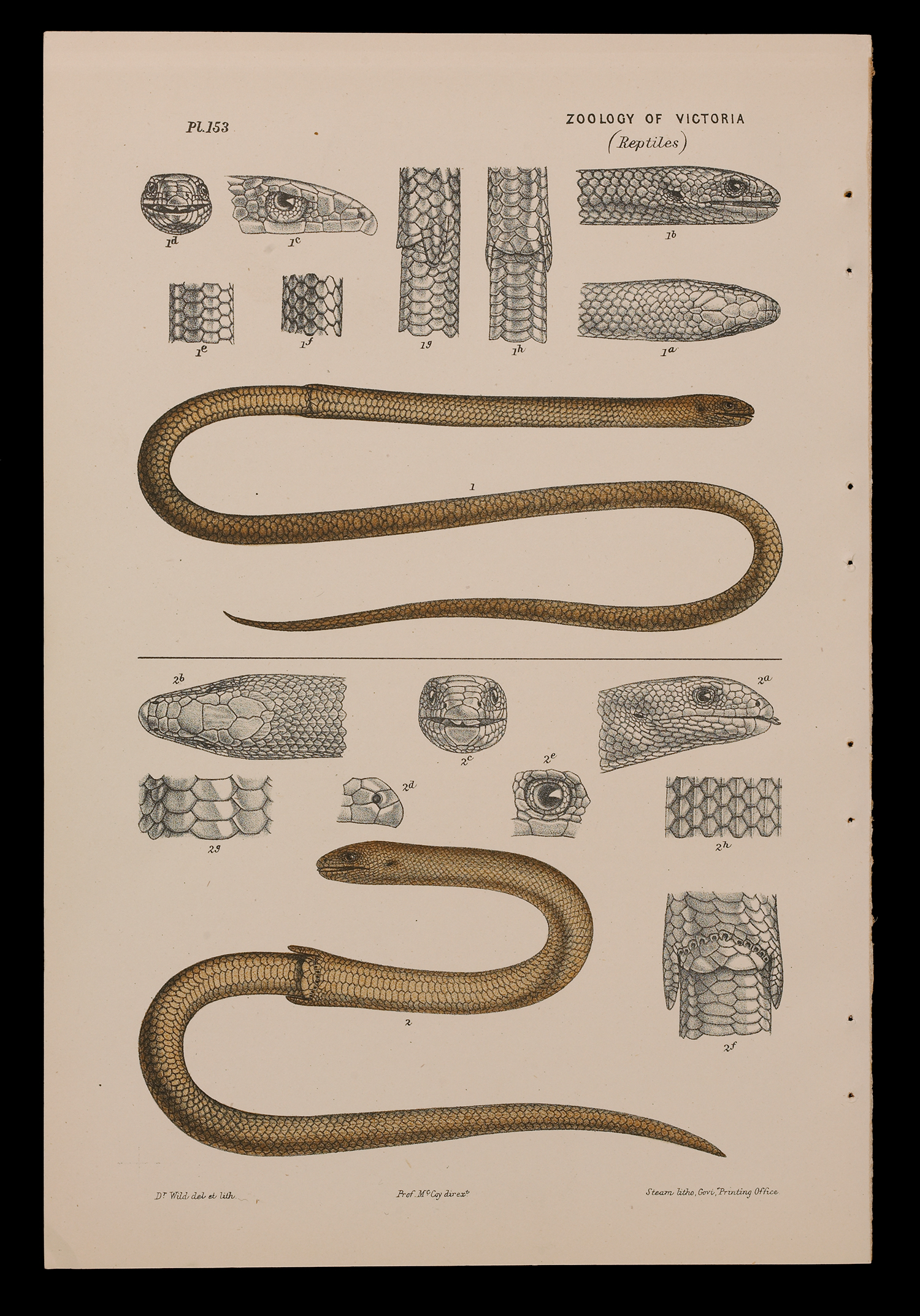
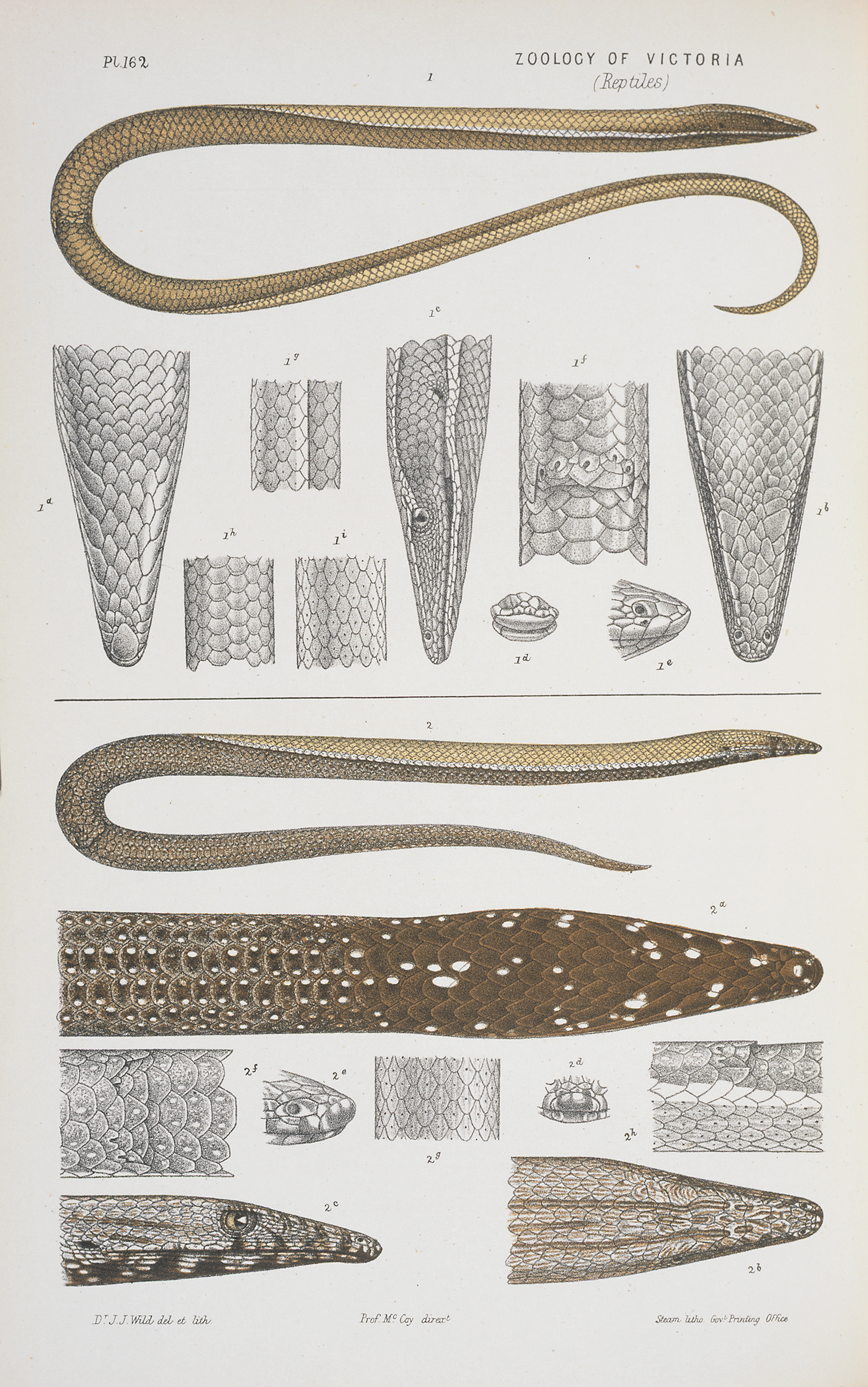
Several species of flap-footed lizards, such as the Burton's Legless Lizard and the Striped Legless Lizard, were also included, along with a number of dragon species. The Eastern Water Dragon was described by McCoy as being collected from:
... a country so rugged and overgrown with forests and almost impenetrable scrub that it is an extremely rare occurrence for a white man to reach the habitat in which the Physignathus is found, in the upper reaches of the Buchan River. — Frederick McCoy
Closer to home, McCoy described the Blood Sucker as 'the commonest lizard about Melbourne, especially in the sandy districts on the south coast'. Now familiar as the Jacky Lizard, it was portrayed as making an 'elegant little pet'.
Presently considered threatened, the Earless Dragon has not been recorded in Victoria since 1967, standing as a reminder of species which have not fared well since European settlement.
Skinks, the most abundant of Australia's lizards, were well represented. Largest are the blue-tongues, of which three species were illustrated, while a specimen of Cunningham's Skink collected from Essendon was also depicted.
Having covered most of the larger species, McCoy turned to the smaller, more cryptic skinks. Numerous unpublished plates indicated his intention to provide more thorough classification of the family, but unfortunately his notes for these have not been located.
Blotched Blue-tongue Lizard
Tiliqua nigrolutea

Public Domain (Licensed as Public Domain Mark 1.0)
Plate 131. The Southern, or Blotched, Blue-tongued Lizard, Cyclodus nigroluteus (now known as the Blotched Blue-tongue Lizard, Tiliqua nigrolutea) found about Melbourne
Not uncommon about Melbourne, where it is generally called "Blue-tongued Lizard," or "Sleepy Lizard." When kept in confinement it feeds on bread and milk, lapping the milk readily.
Gippsland Water Dragon
Physignathus lesueurii howittii
Public Domain (Licensed as Public Domain Mark 1.0)
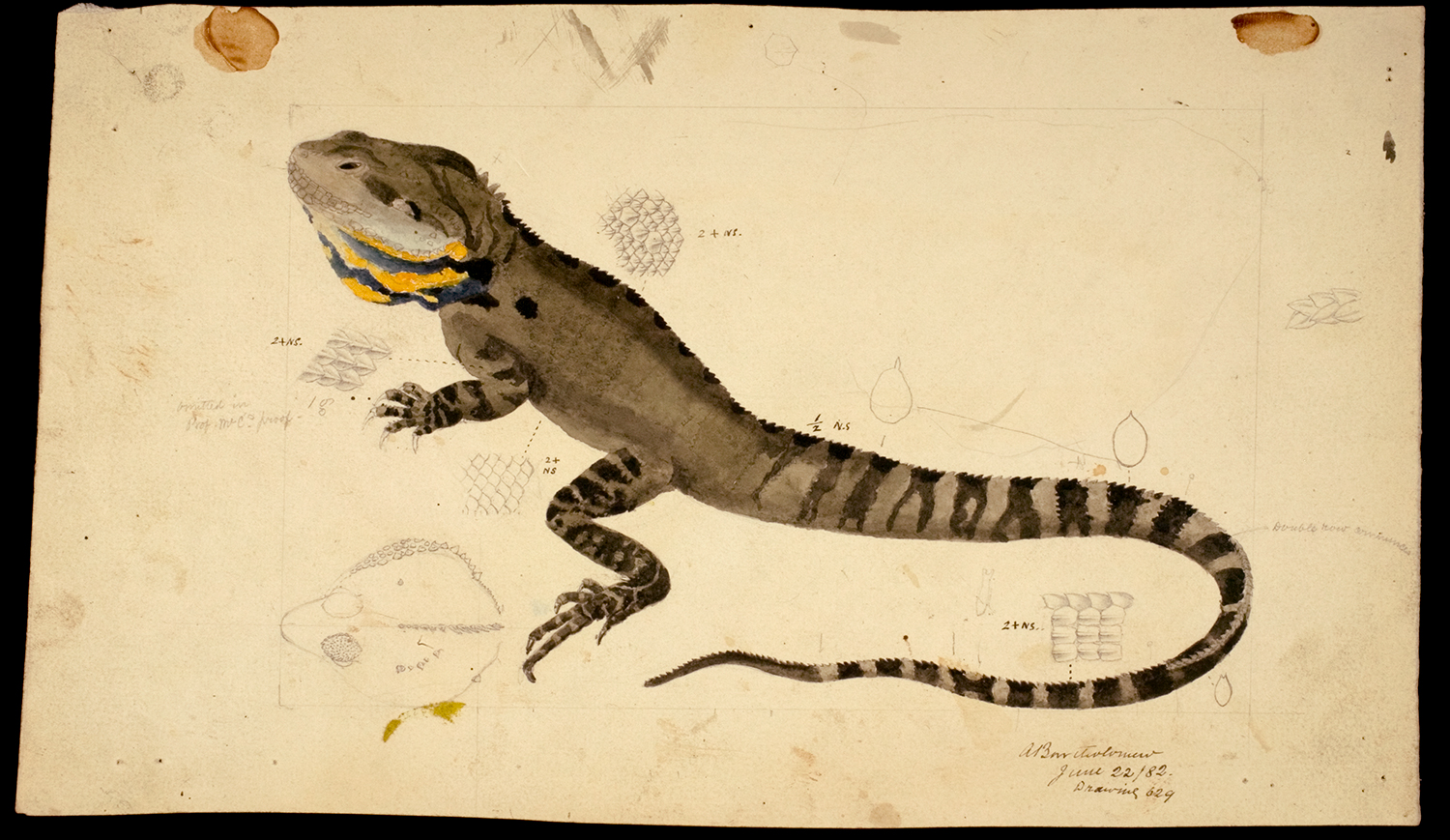
Plate 81. Gippsland Water Lizard, Physignathus lesueri var howitti (now known as Gippsland Water Dragon, Physignathus lesuerii howittii)
The only difference I observe between this and the typical P. Lesueri of Queensland is the greater width in proportion to the height of the rostral plate in the Queensland one...As it is improbable such creatures would have so great a geographical range as to be common to Gippsland and Queensland, with such an enormous space between the rivers, I name the variety or probable species after that excellent geologist, magistrate, and bushman, my accomplished friend Mr. A. Howitt, who, with his multifarious and laborious duties, in so difficult a country to traverse, is always ready and willing to aid in any scientific investigation of the natural products of Gippsland, and who with infinite difficulty succeeded in procuring three specimens for me of this River-Lizard.
The proverb that "Cows far off have long horns" is ludicrously exemplified in the case of this Lizard, which has apparently given rise to the rumors of Crocodiles having been seen in Gippsland; a country so rugged and overgrown with forests and almost impenetrable scrub that it is an extremely rare occurrence for a white man to reach the habitat in which the Physignathus is found, in the upper reaches of the Buchan River.
Discover more lizards
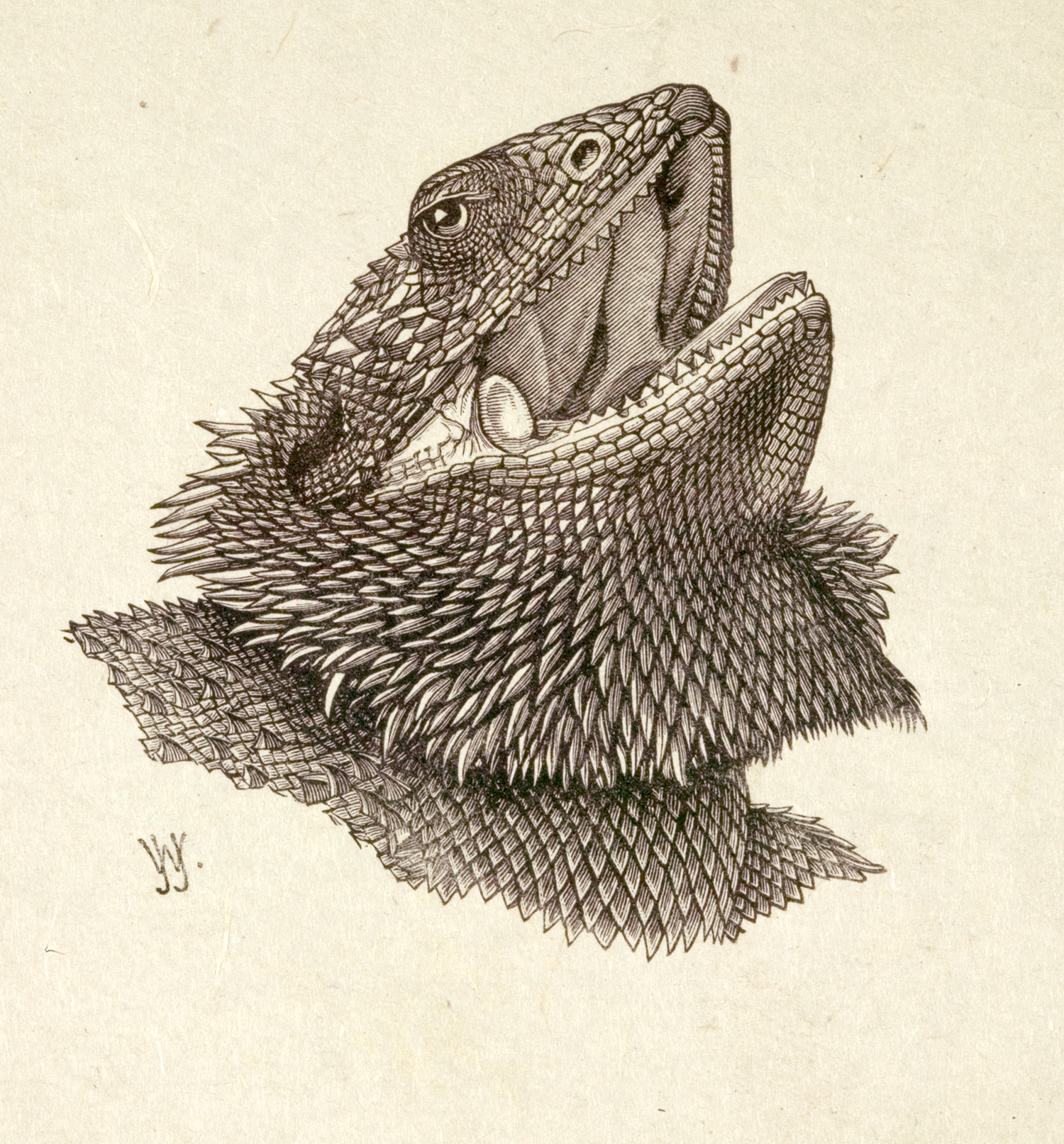
Plate 121. Bearded Lizard, Grammatophora barbata (now known as the Bearded Dragon, Pogona barbata). Rare in Melbourne/abundant-Murray boundary
Public Domain (Licensed as Public Domain Mark 1.0)
This is commonly called the Jew Lizard by colonists, and is easily distinguished by the beard-like growth of long slender spines round the throat and parotoids, the form of which below, in the adult, is shown in the woodcut, and the similar band along the sides, as well as by the absence of any median keel along the back. Some species have the throat black.
When irritated, it inflates the body to a considerably increased size, and hisses like a snake, exciting alarm; but rarely biting. The eggs are usually 8 or 10, connected by membrane in a row.
The species is rare near Melbourne, but becomes gradually more abundant in all the more northern warm localities up to the Murray boundary.
Plate 162. Burton's Lialis, Lialis burtoni (now known as Burton's Legless Lizard, Lialis burtonis) found in the Mallee Scrub
Public Domain (Licensed as Public Domain Mark 1.0)
These lizards are even more like snakes than the Pygopus, from the almost imperceptible smallness of the rudiments of the hind limbs, scarcely larger or longer than an ordinary adjacent scale, and the immovable eyelids. The external open ear, however, and fleshy tongue indicate at a glance the true affinity to be with lizards and not the snakes.
Our figure 2 shows the colouring half-way between that species and L. Burtoni from Trinity Bay, having longitudinal dark streaks on top of head and the large conspicuous white spots on dark greyish-brown under side, and vertical dark patches on side of cheeks and lower jaws, as in L. Burtoni, but with lighter, plain, unstreaked upper side, with a small dot in centre of each scale, as in L. punctulata. Other specimens in the Museum Collection have the five longitudinal brown streaks and rows of dark and light spots on whole of upper surface, as in the typical L. Burtoni, with rows of conspicuous white spots on darker under surface. All the varieties have the curious and most unusual colouring of the darker surface being below, instead of above, as usual.
The specimens found in Victoria, measured above are smaller than those generally of warmer latitudes; but I have a specimen in the Museum from Duke of York Island, of the size, shape, and colouring of our figure 1.
Not very uncommon in the Mallee Scrub and other warmer parts of Victoria.
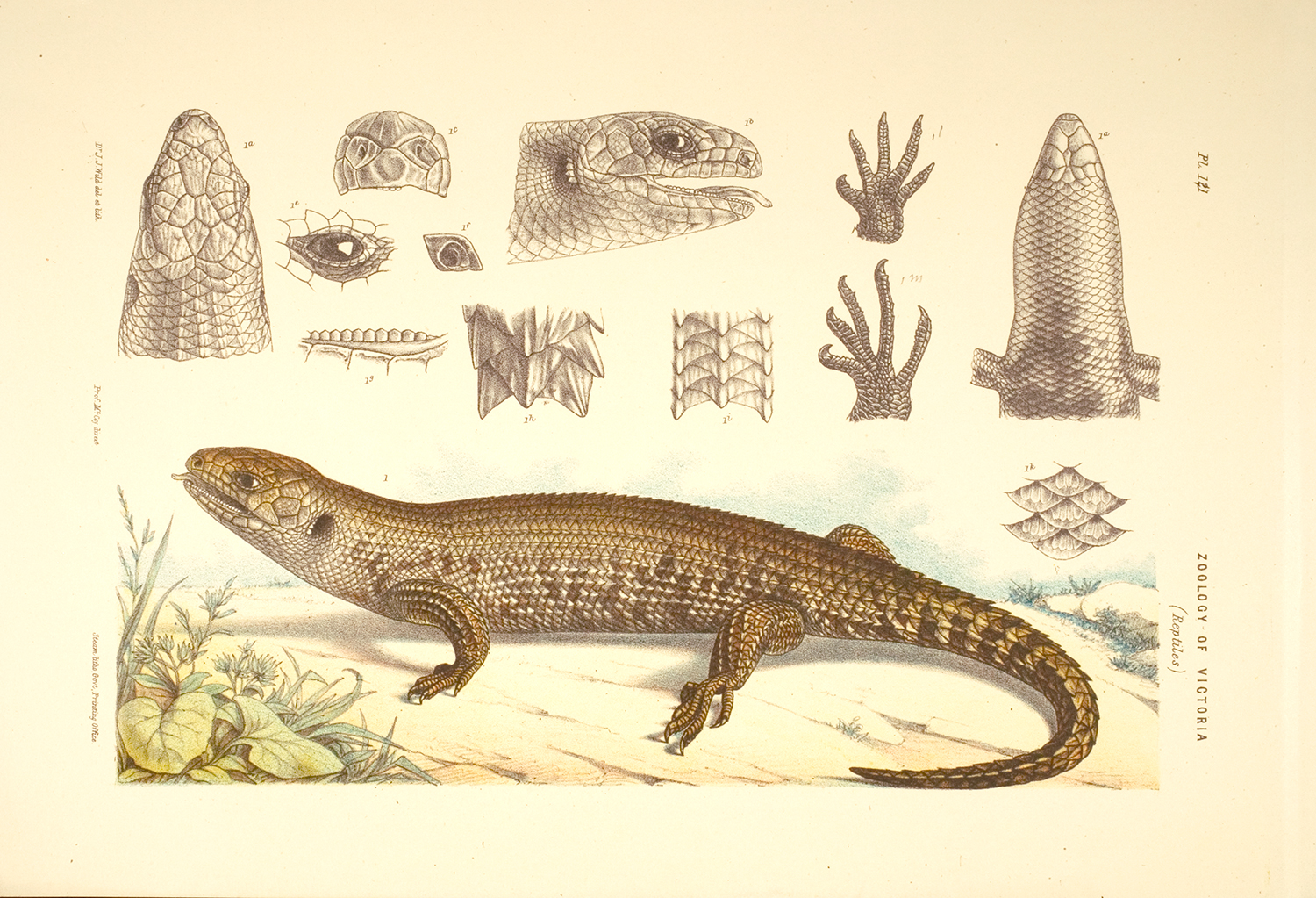
Plate 141. The Spiny-ridged Lizard, Egernia cunninghami (now known as Cunningham's Skink, Egernia cunninghami) found in Brighton. Mentions Merri Creek and Sunbury (formerly not known)
Public Domain (Licensed as Public Domain Mark 1.0)
This rare Lizard was formerly not uncommon at Merri Creek and similar rocky places near Melbourne, and at Sunbury.
The indigo-blue colour of the tongue is so striking as to suggest the popular name of Blue-Tongue for both the banded and the blotched species of Cyclodus (C. gigas and C. nigroluteus), and this Egernia; but the latter, which has the tongue of the same colour, but paler, is easily distinguished by its long slender toes and ridged and strongly spined scales.
The species figured is from Brighton.
Not figured of the colours of life before.
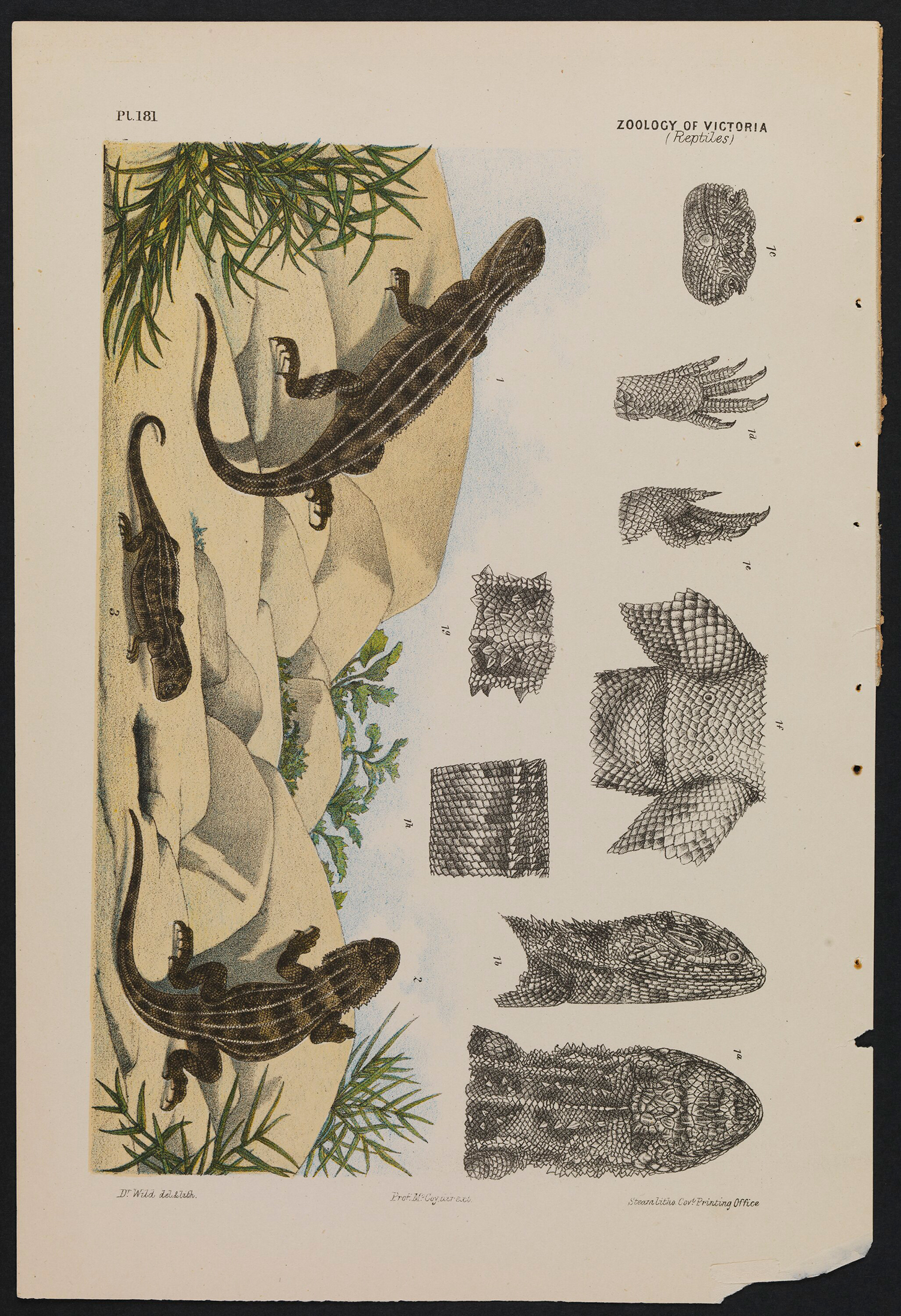
Plate 181. The White-streaked Earless Lizard, Tympanocryptis lineata (now known as the Earless Dragon, Tympanocryptis lineata pinguicolla), found at Essendon and plains of Sunbury
Source: Museums Victoria
Public Domain (Licensed as Public Domain Mark 1.0)
The species of Tympanocryptis are remarkably distinguished from all of the genus Grammatophora or Amphibolurus by the ear openings being absent or entirely concealed by being covered over by the ordinary scales of the adjacent parts of the head. The present species, at first glance, resembles the young of the G. muricata or "Blood-sucker" of colonists, figured on our plate 111, so much as to be easily mistaken for it.
The habits of this little Lizard are entirely different from those of the G. muricata, never ascending trees of bushes like that creature, but inhabiting stony plains and retreating into small holes, like those of the "Trap-door Spider," on the ground when alarmed.
Not very uncommon at Essendon and the plains near Sunbury, &c., to the north of Melbourne.
This interesting reptile has not been figured before.
Plate 41. The Lace Lizard, Hydrosaurus varius (now known as the Lace Monitor, Varanus varius)
Source: Museums Victoria
Public Domain (Licensed as Public Domain Mark 1.0)
This is by far the largest of the Victorian Lizards, sometimes reaching 6 feet in length, and from its fierce, bloodthirsty disposition is a most unwelcome visitor to the poultry yards, from which it occasionally carries off the chickens. Its usual food is the common Opossum, and various smaller mammals and birds. It is often popularly called Iguana by the settlers, but the English name originally given by Shaw is more desirable, as there is no near affinity with the herbivorous true Iguana, in which the body has a dorsal crest, a dilatable throat, a thick, wide, slightly notched tongue, imbricated body scales, and different maxillaries and dentition.
The color varies greatly, being different in every individual in the relative proportion of the yellow and the black. Our figure and description indicate the commonest marking, but in some even the usual strong, transverse, black bands on the throat are absent.
Although the present Lace Lizard is generally arboreal, climbing the forest trees with ease, and running well on the ground, it can swim nearly as well as a crocodile; and, from being thus seen in some of the Gippsland rivers, the idea had arisen that there are Crocodiles in that part of the colony. None of the family Crocodilidœ, however occur in Victoria; the large claws on all the toes, and absence of webs between the toes of the hind feet, as well as the slender tongue, and the absence of large, bony plates on the back, easily distinguish the Lizards of the present family from those of the Crocodilidæ, or true Crocodiles.
Plate 153, Figure 1. Frazer's Delma, Delma frazeri (now known as the Legless Lizard, Delma inornata) found near Melbourne
Public Domain (Licensed as Public Domain Mark 1.0)
The greater number of the species found near Melbourne are of the plain uniform coloring of our figure, but I have a few with dark markings on the head and sides of the neck depicted by Gray and Smith, differing in no other respect from the plain ones. One specimen in the Museum, from Newington station, in the Wimmera district, presented by Mr. Foster, of Stawell, has grown two tails, forking out from the place of previous fracture.
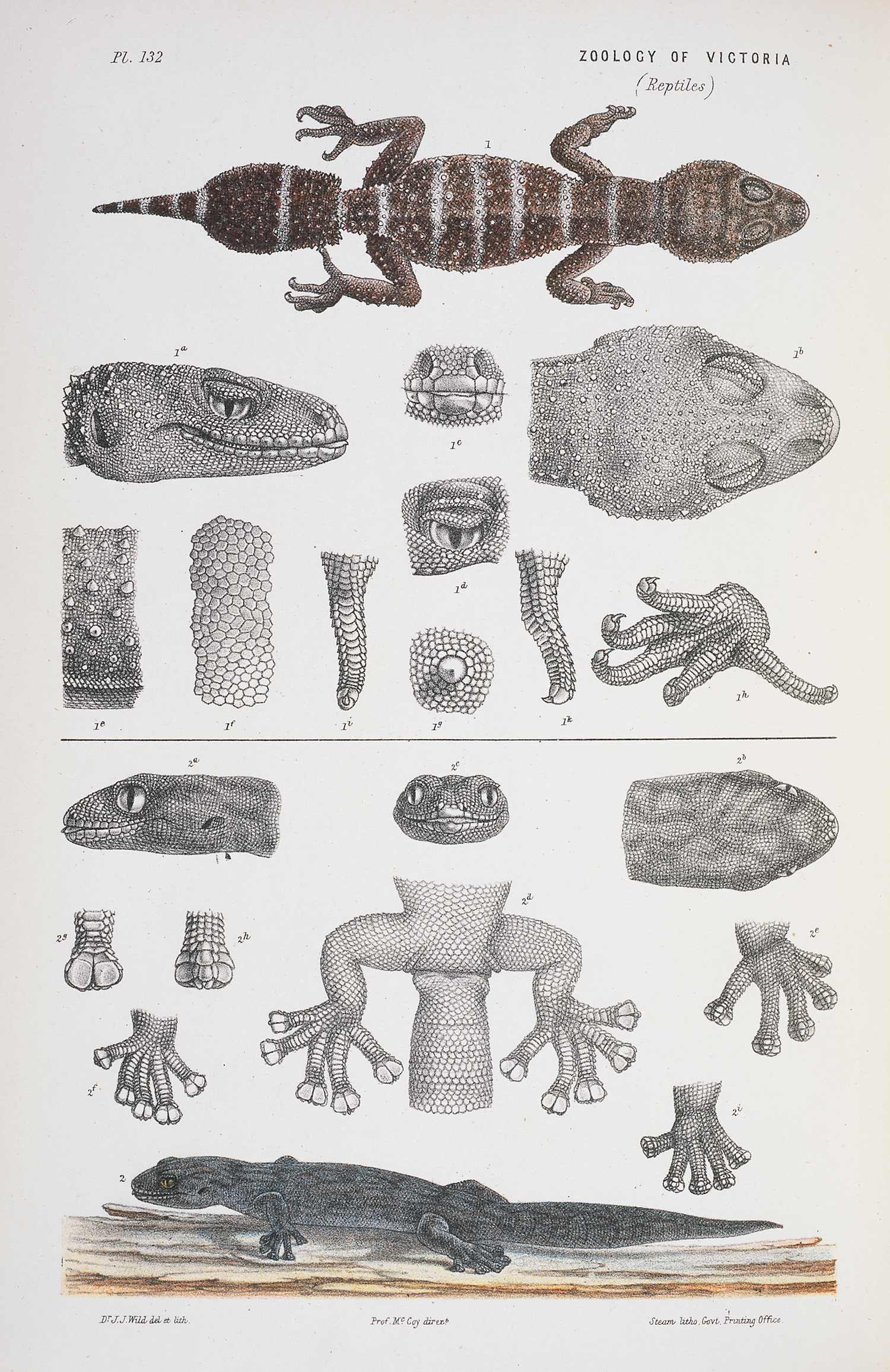
Plate 132, Figure 1. The Thick-tailed Gecko, Phyllurus miliusii (now known as the Thick-tailed Gecko, Underwoodisaurus milii)
Plate 132, Figure 2. The Marbled Gecko, Diplodactylus marmoratus (now known as the Marbled Gecko, Christinus marmoratus) found in Echuca
Public Domain (Licensed as Public Domain Mark 1.0)
Figure 1
The Geckoes form one of the most peculiar divisions of the saurian reptiles. They are all small disagreeable-looking Lizards inhabiting warm countries, and are nocturnal in their habits, catching insects, especially caterpillars and other larvæ, and worms, on which they feed by night; and hiding under the bark of trees and in other crevices by day, and especially shunning the glare of the sun, in which the other kinds of Lizards delight.
The legs are strong, the feet short, with the toes rather short and nearly equal in length, usually furnished with sharp, retractile claws, like those of a cat, for climbing the bark of trees, and generally furnished with transverse membranous plates below, recalling the structure of the foot of a fly, and enabling them to run up smooth surfaces, such as a perpendicular wall of a house, or on the ceiling of a room, with great swiftness, darting on the flies and other insects, which it can only catch with its jaws, by pouncing on them and swallowing them whole, the oesophagus or gullet being unusually large, to allow of this more of feeding, and the articulation of the lower jaw being far behind the head, as in the crocodiles, to form a large gape.
Like most nocturnal animals, the eyes are very large, and the pupil usually vertical and elliptical, with fringed edge; the eye-lids are continuous, like those of the chameleon, the under one very small, and the upper very large; and a transverse winking one moving transversely between them.
They are remarkable for uttering a sharp, loud cry or click, in some species like the word "Geck-o," from which their name arises.
The skin seems soft and almost naked, from the minuteness and granular character of the scales, the head being destitute of conspicuous plates, unlike most Lizards. The tail is less than the body in length, and so brittle that it falls off even from a slight jar or sudden awkward movement from fright; the new tail, which soon replaces the lost one, is generally slightly different in size, color, and scaling from the original, and must not be mistaken for a new specific character; it is generally depressed, often fusiform, and sometimes flattened and dilated.
The males are smaller, more slender, and more agile, and more brightly colored than the females.
The brown and grey mottled colors of most of the species vary a good deal at will, to assimilate to the tint and style of coloring of the bark, &c., on which they rest, and from which only the brilliancy of their eyes distinguishes them. Their movements are sudden, and surprisingly swift and noiseless.
The present species, P. Miliusii, is one of the most striking Geckoes of the slender-toed group, having the toes bent nearly at right angles with each joint, giving them the appearance of having been broken or deformed. The broad, thick, heart-shaped tail, and beautiful, transverse, dark and light banding of the color of the upper surface, render this one of the most striking Lizards of the northern warm parts of the colony. It is rarely found south of Sandhurst.
Figure 2
Like all the Geckoes, these Diplodactyli are small, nocturnal Lizards, with the tips of the toes generally more or less dilated. This species is a good example of those having an apparent doubling of the greatly swollen distal ends of the toes, with the terminal joint and claw so minute as to seem hid in the notch between the two large pads.
They live on insects and worms, which they swallow whole, the oesophagus being very large. The males are smaller than the females. The tails are very brittle and easily list, reproduced with some slight differences, from the original in the form of the scales, &c.
The species is abundant in the northern parts of the colony, found lurking under the deciduous bark of trees in the day time, the brownish of purplish-ashy mottlings almost exactly coinciding in appearance with the bark, rendering them very difficult of detection except for the brightness of the beautiful bronze eye. Some specimens have the transverse, dark marbling more distinct, and with the light color less broken, while others have the pattern more complex. The under-side is destitute of markings in all the species. The specimen figured is from Echuca.
Not figured of the color of life before.
Plate 111. The Blood-Sucker, Grammatophora muricata (now known as the Tree Dragon, Amphibolurus muricatus) found in the Goulbourn district
Public Domain (Licensed as Public Domain Mark 1.0)
This is the commonest lizard about Melbourne, especially in the sandy districts on the south coast, where it may often be seen, as represented in our plate, on a stump of Tee-tree, which it resembles in color and marking so nearly that it is almost impossible to distinguish it, unless the sun happens to glance from its bright eyes. When seen it will remain so immovable as almost to induce a belief that it is a withered stump; if your eye should leave it for an instant, it is gone like a flash. It is fond also of basking in the sun on shady paths, &c. The eggs are laid in the sand.
Why the popular name of "Blood-sucker" should be so universally given to this harmless creature by the colonists, I cannot conceive. In confinement it feeds readily on flies, and makes an elegant little pet in a Wardian Fern-case.
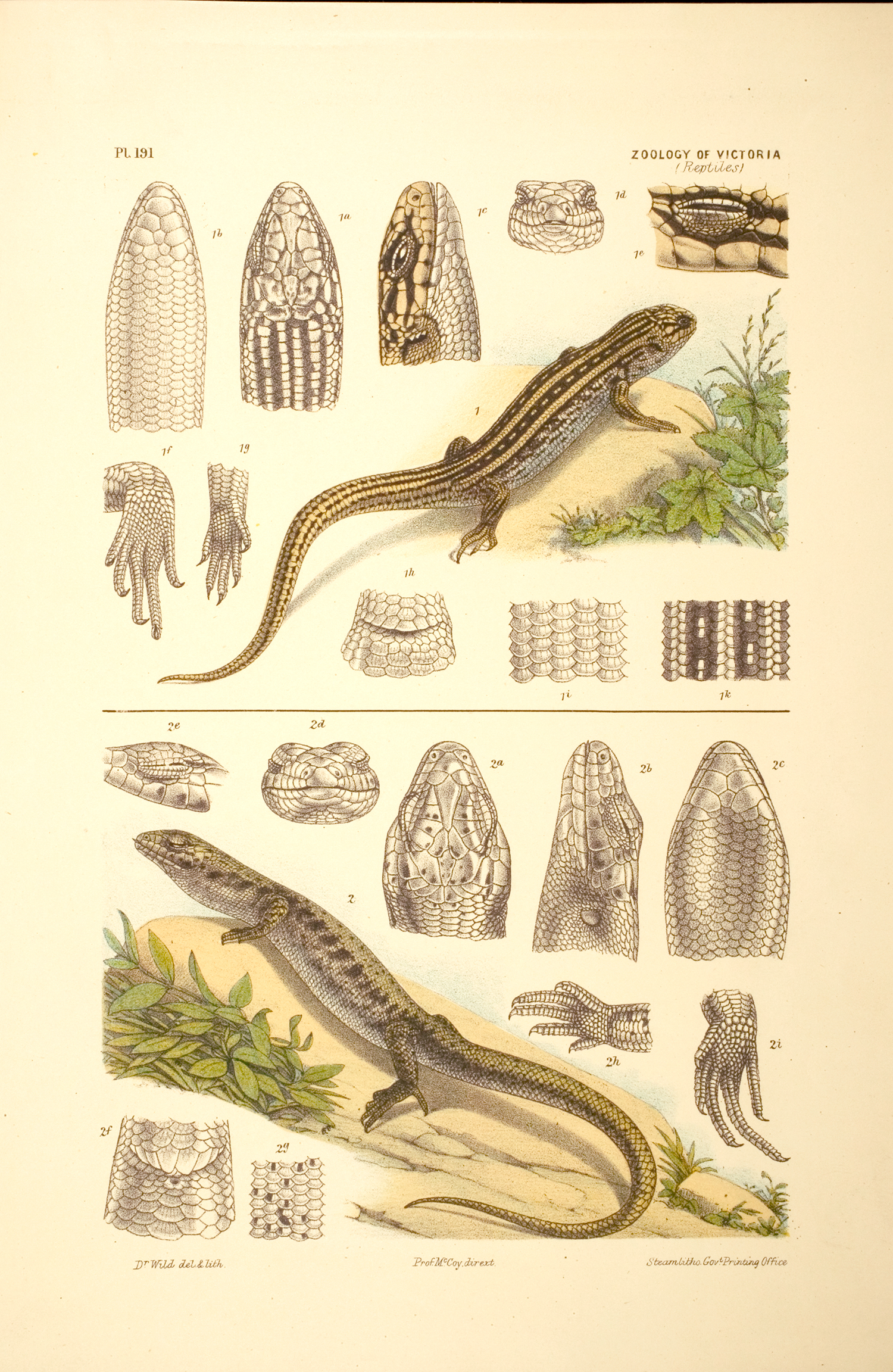
Plate 191, Figure 1. White's Hinulia Lizard, Hinulia whitei (now known as White's Skink, Egernia whitii), found at Prahran
Public Domain (Licensed as Public Domain Mark 1.0)
This is one of the most elegantly marked, but most variable of the small Lizards common in Victoria. The two white spotted broad, black, longitudinal stripes on the back are the most constant of the markings, but the markings of the sides vary greatly, sometimes presenting two or three rows of round whitish spots, margined irregularly with black; more commonly the sides show only a number of black spots of very irregular size and shape.
This Lizard, like other species of Hinulia, does not climb trees or bushes like the so-called Blooksucker (Grammatophora), but keeps on the ground under logs and stones, darting rapidly through the herbage when disturbed.
The specimen figured is rather less than the average size. From Prahran, near Melbourne. It occasionally reaches a length of 1 ft. 2 in.