Crabs, lobsters, slaters, shrimps, barnacles and woodlice are all Crustacea. Together they comprise a diverse sub phylum of Arthropoda. Most Crustacea are found in marine habitats, while others live in freshwater. A relatively small number have adapted to terrestrial environments.
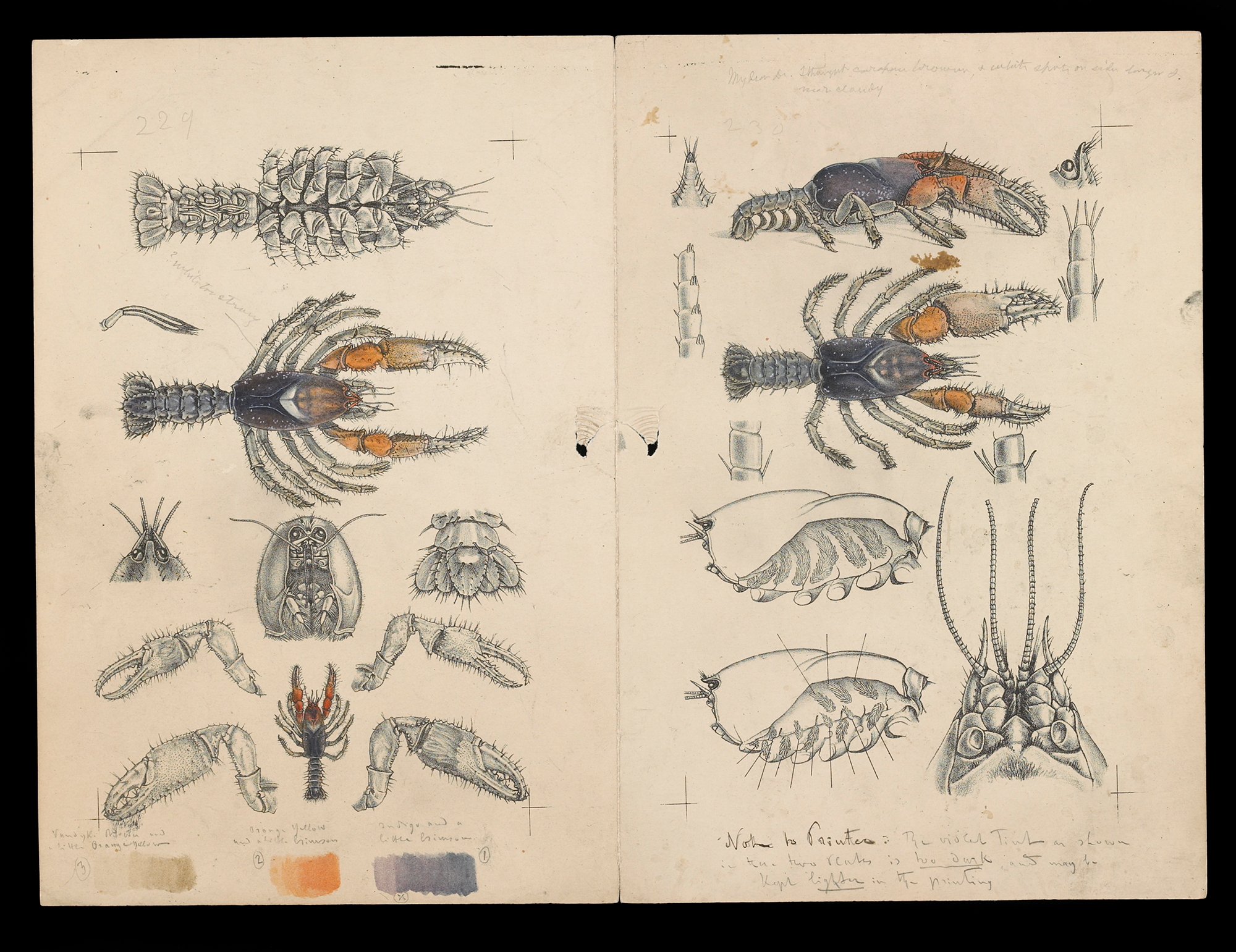
A total of seven species of Crustacea were included in the Prodromus. They include the largest and most commercially important species, such as the Murray Spiny Crayfish, Southern Rock Lobster and Tasmanian Giant Crab.
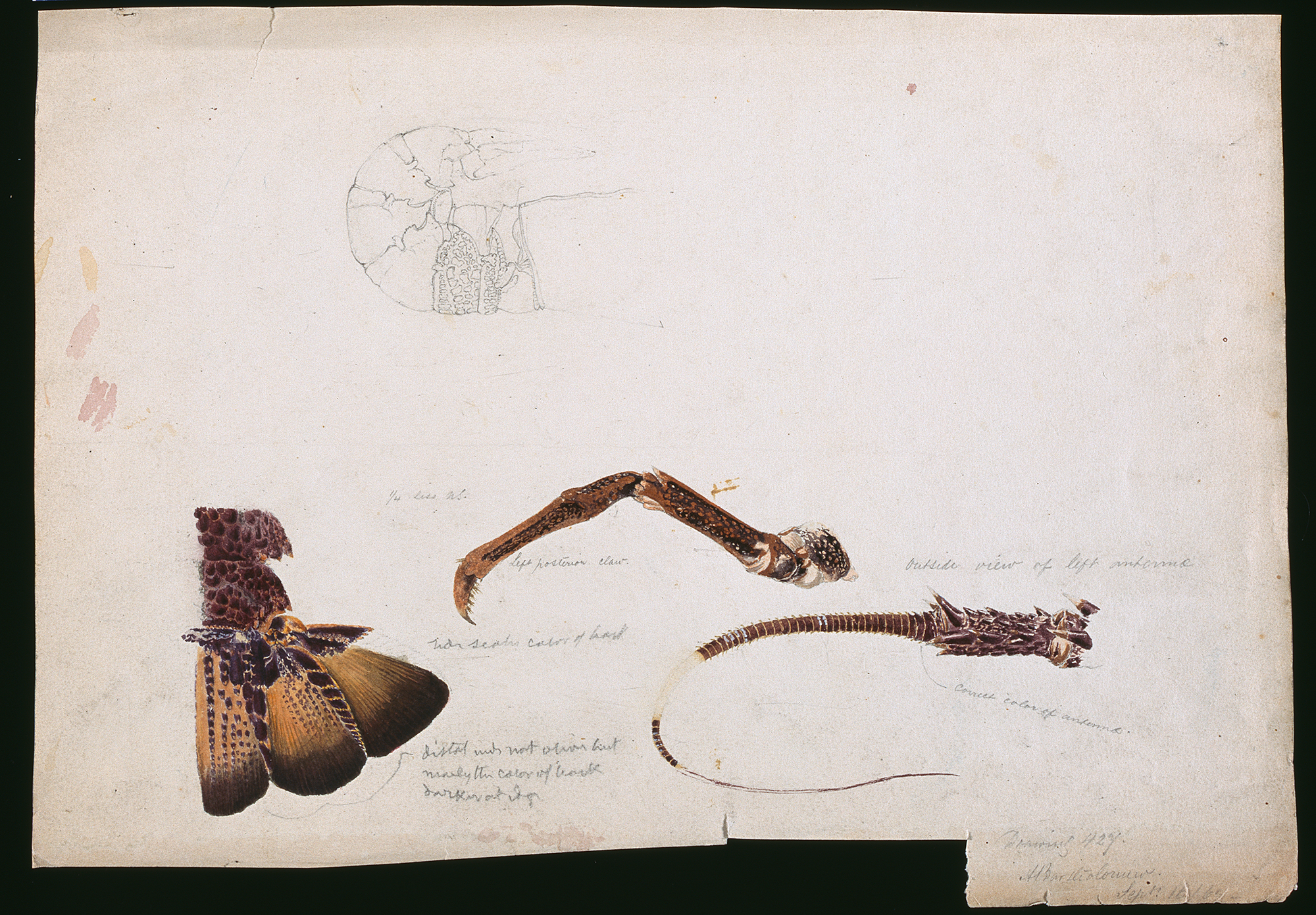
Several other species were illustrated in unpublished plates, including highly detailed studies of a burrowing crayfish prepared by John James Wild and two intriguing illustrations of spiny crayfish. It is clear from McCoy's earlier descriptions of the Yarra Spiny Crayfish that he was becoming increasingly aware that each major Victorian watershed had its own variety of crayfish; unfortunately he never provided descriptions of the unpublished plates.
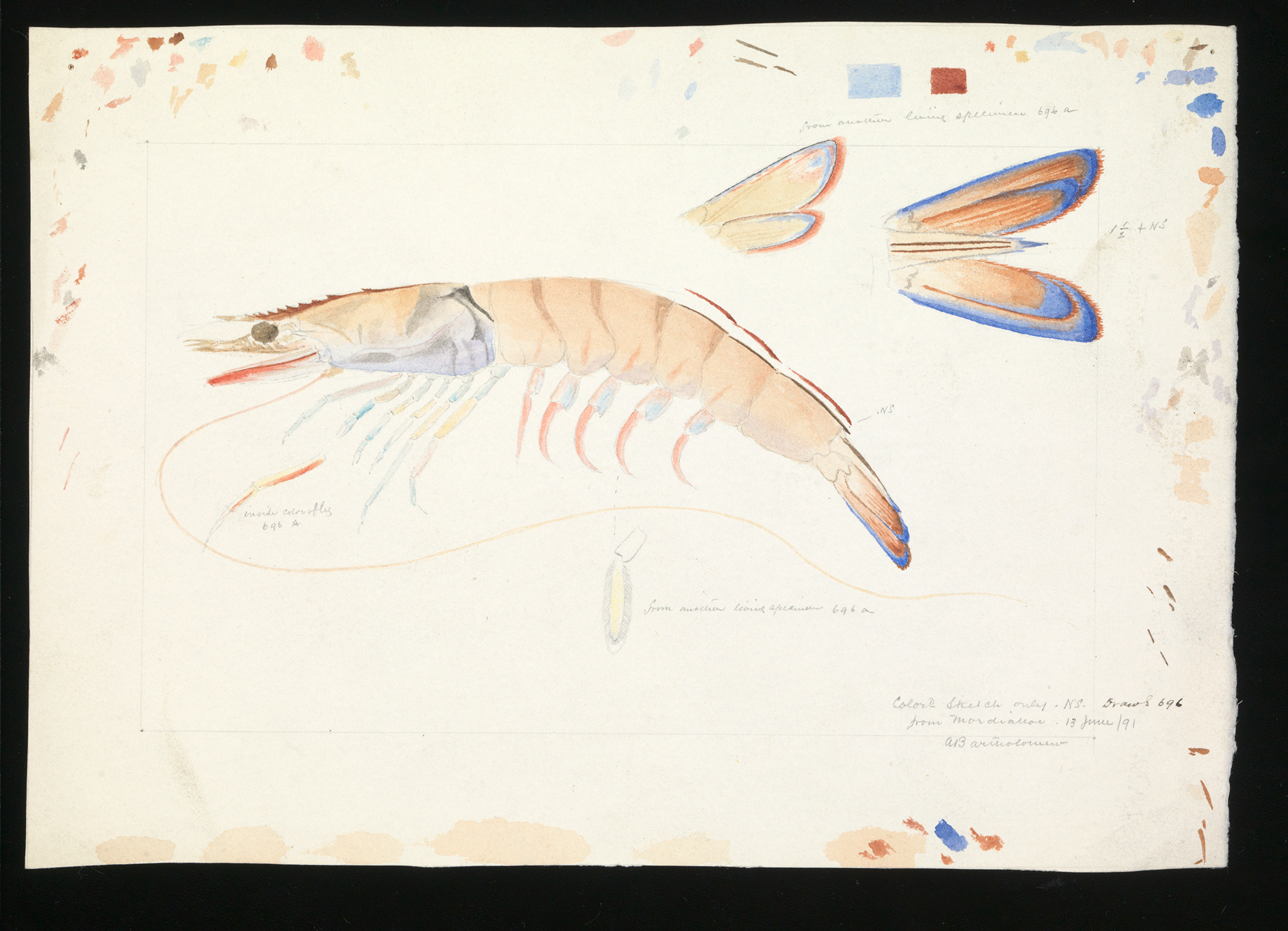
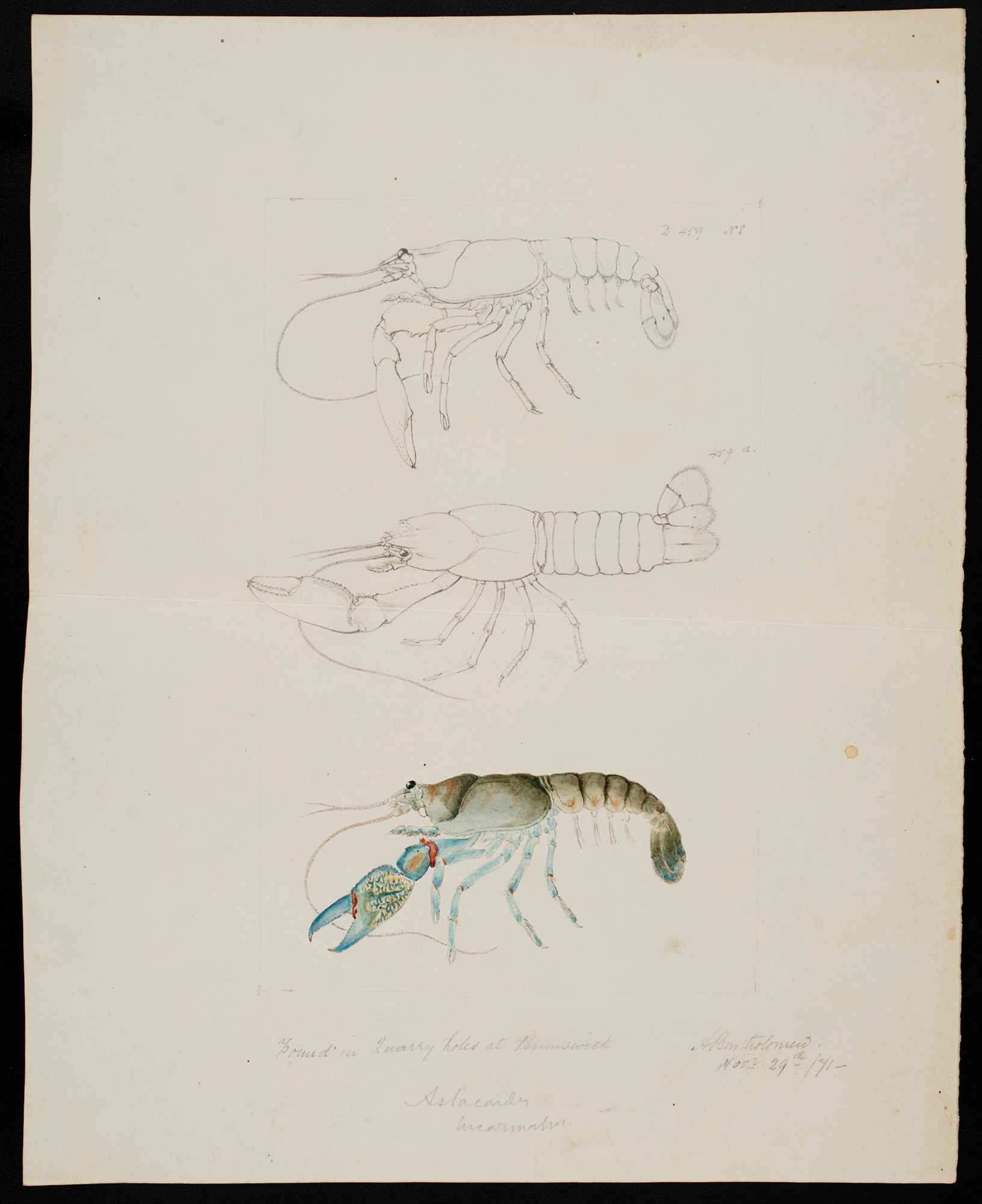
Studies by Arthur Bartholomew highlight other specimens from an area that is now suburban Melbourne. The yabby from a quarry in Brunswick and an impressive prawn from Mordialloc are examples of familiar fauna from locations that have changed profoundly in the last 150 years.
Balmain Bug
Ibacus peronii
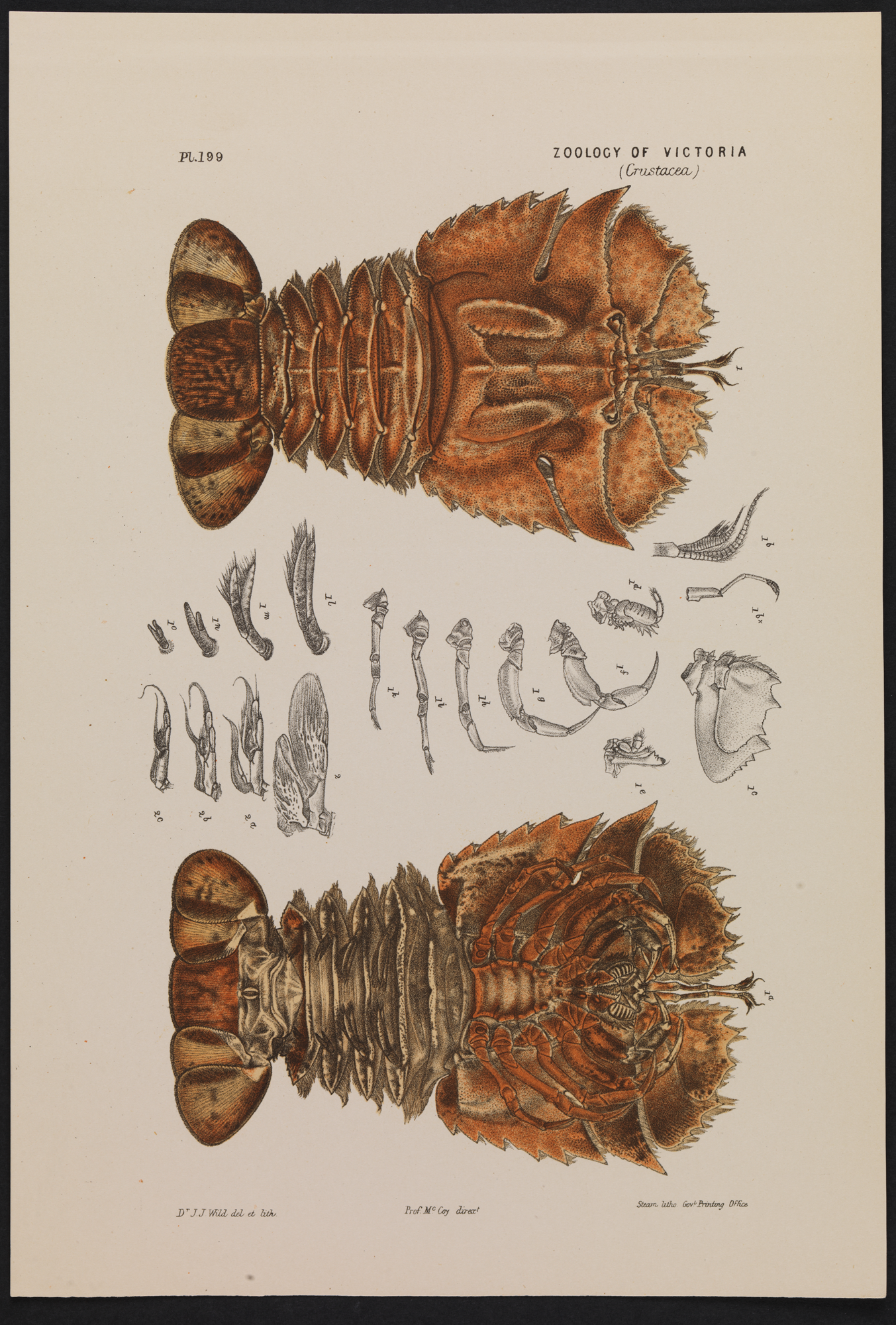
Plate 199. Péron's Ibacus Crab, Ibacus peronii (now known as the Balmain Bug, Ibacus peronii), found in Port Phillip Bay
One enormous specimen, 9 inches long and 5 in. 3 lines wide at front of carapace, presented by D. Best, Esq., from Phillip Island, is more roughly granular than usual and has seven distinct, large, angular teeth behind sinus. Not very uncommon in Hobson's Bay and on the shores outside Port Phillip.
Tasmanian Giant Crab
Pseudocarcinus gigas
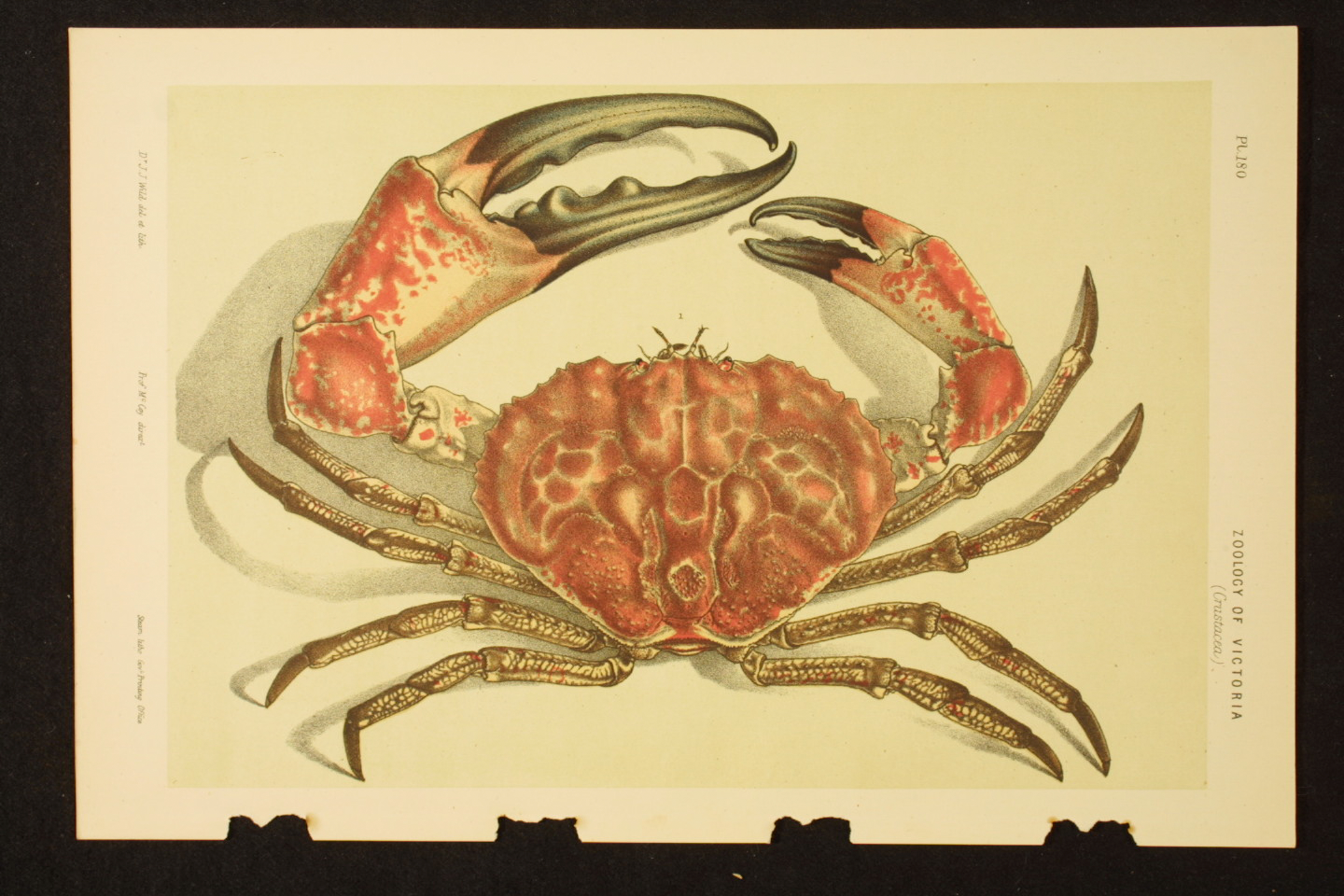
Plates 179-180. The Great Red King-Crab, Pseudocarcinus gigas (now known as the Tasmanian Giant Crab, Pseudocarcinus gigas), found at Portland
This gigantic and beautifully coloured crab is now figured in the colours of life for the first time. It is not uncommon at the western extremity of the coast-line of the colony, particularly about Portland, from whence examples are often brought to the fish-market. The small female with the much smaller claws seems more common than the great male with its immense powerful pincers.
Discover more crustaceans
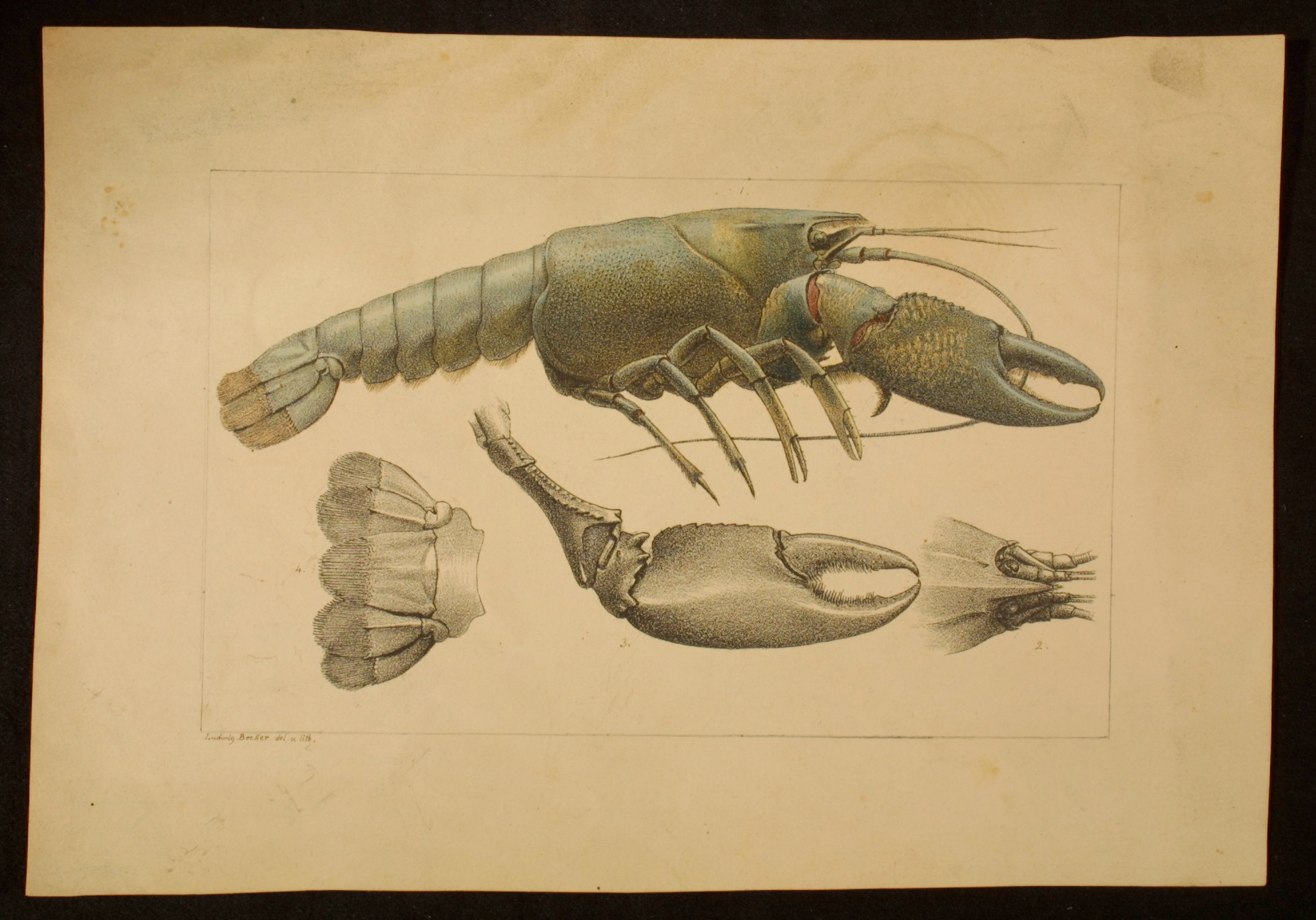
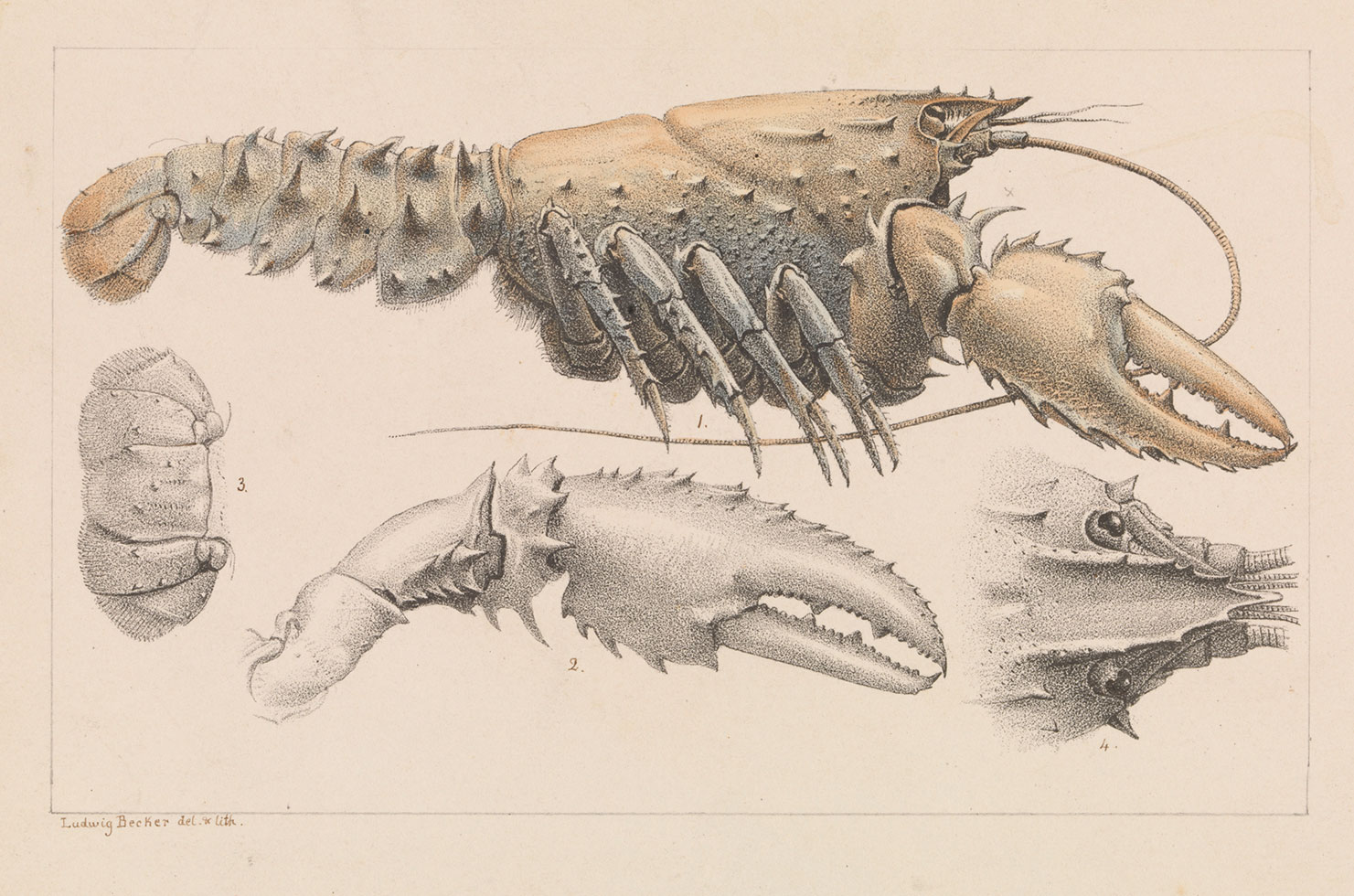
Plate 15. Murray Lobster, Astacopsis serratus (now known as Murray Spiny Crayfish, Euastacus armatus), found in the Murray River
This gigantic species is now sent to the Melbourne market in considerable quantity from the Murray by railway for the table instead of lobsters, and is by far the most delicious of the few Victorian crustacea good for food.
All of the spines vary in size and number, not only in different individuals, but on the two sides of the same one. The blue color is very much stronger in some individuals than in others, and I notice (Bibl. Univ. 15 Mars, 1870) that some of the reddish Crayfish in the rivers of Switzerland are said by local observers to be blue when recently moulted. Some specimens are olive-green where the blue appears in others.
Very common in the Murray River, where it is caught by lowering a piece of bagging, with cords and floats to the four corners, with some flesh in the middle; this being pulled up every now and then shows three or four of the "Lobsters" feeding; a bit of meat at the end of a string suffices to catch them.
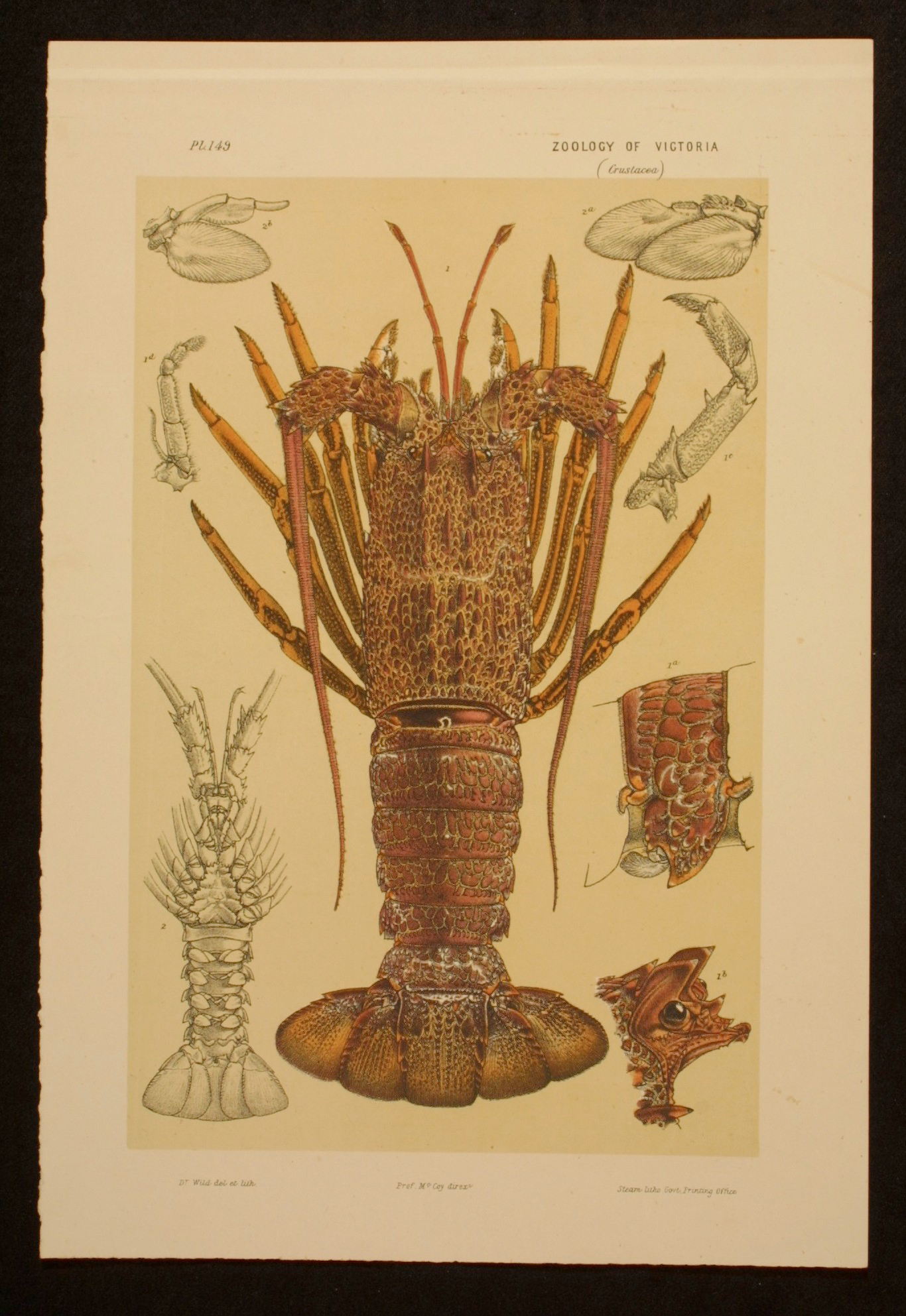
Plates 149-150. Southern Spiny Lobster (Melbourne Crawfish), Palinurus lalandi (now known as the Southern Rock Lobster, Jasus edwardsii novaehollandiae) found on the rocky coasts of Victoria
This fine and very interesting species has not been properly figured before, and is consequently a source of some perplexity to naturalists. It was first described from the Cape of Good Hope by Prof. Milne Edwards, from the specimens in the Paris Museum named in manuscript P. Lalandi by Lamarck.
I suggest the trivial name of Southern Rock Lobster for this species, which, abounding in Victoria, Tasmania, and New Zealand, as well as the Cape of Good Hope, (and St. Paul's according to Heller,) does not appear to have been noticed as far north as Sydney, where it is replaced by a totally different species, the Common Sydney Crawfish P. Hügelli, of which I have one specimen from our coast and one from Tasmania, as excessively rare occurrences as stragglers.
Very abundant in pools on the rocky coasts of Victoria, and is the common Melbourne Crawfish of the fishmongers.
Plate 29. Yabber Crayfish, Astacopsis bicarinatus (now known as Yabby, Cherax destructor)
This species grows to six inches in length, from snout to end of tail, and varies considerably in color, some having the body and abdomen dark-olive, others paler or with a yellow tinge, and some are of a dull pale-brown or horn color; the large anterior pair of claws are always blue with red joints, and the flexible part of the five tail-fins dull-brown. The smaller pairs of legs are blue, or greenish, or whitish in different living individuals. These are eaten in great numbers by the aborigines, and by some other people who like them. They are commonly known about Melbourne by the native name of Yabber or Yabbie.
This species does not seem to inhabit the flowing rivers or streams, but is abundant in the quarry -holes and swamps round Melbourne, and in most waterholes in the colony, doing great damage to dams and reservoirs from burrowing holes through the banks. The individuals live for a long time underground in their burrows after the pools of water on the surface have dried up. I can find no difference between the specimens from the swamps of the Murray district on our northern boundary and those near Melbourne.
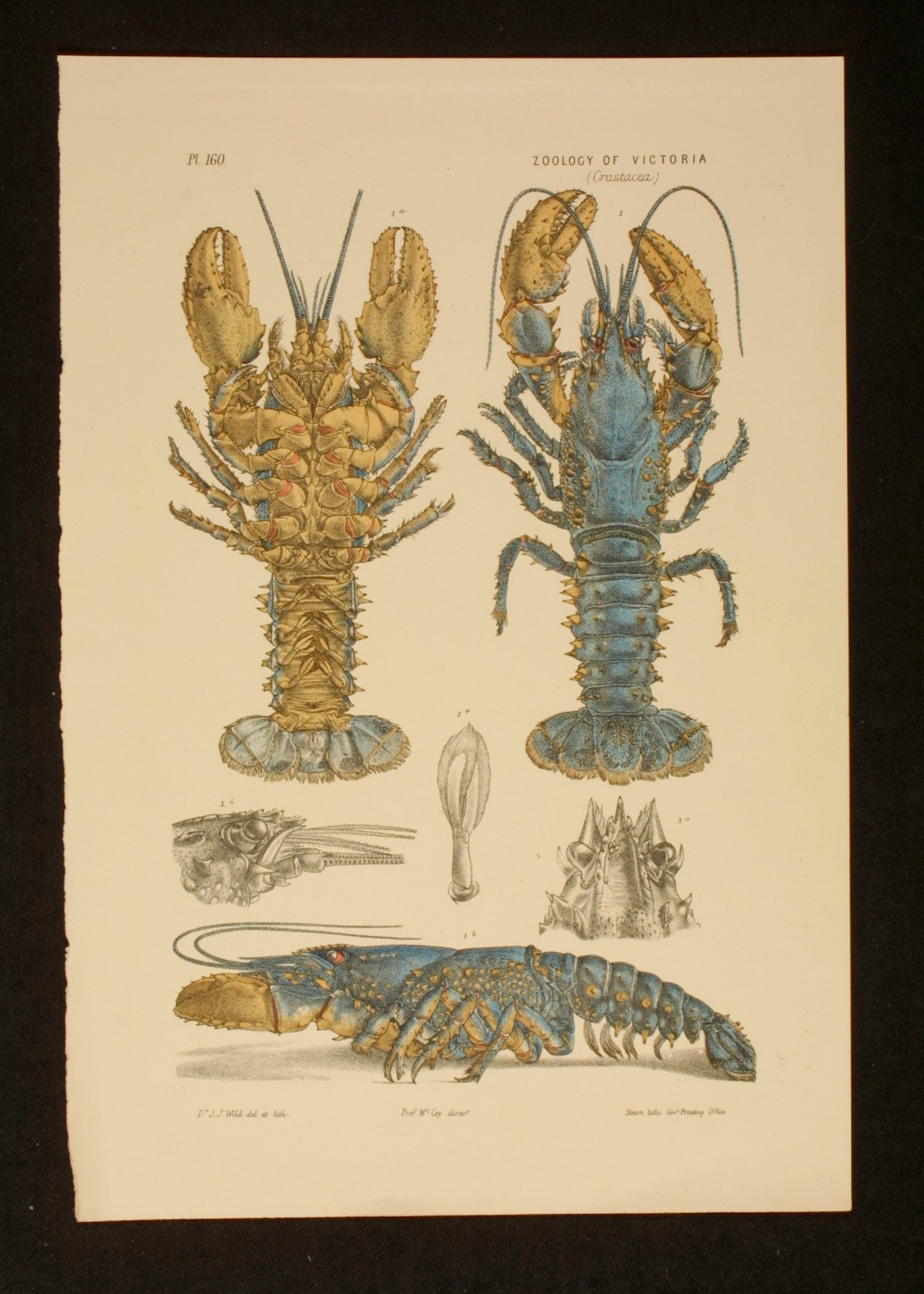
Plate 160. The Yarra Spiny Cray-fish, Astocopsis Serratus var. yarraensis (now known as the Yarra Spiny Crayfish, Euastacus yarraensis) found in the Yarra River
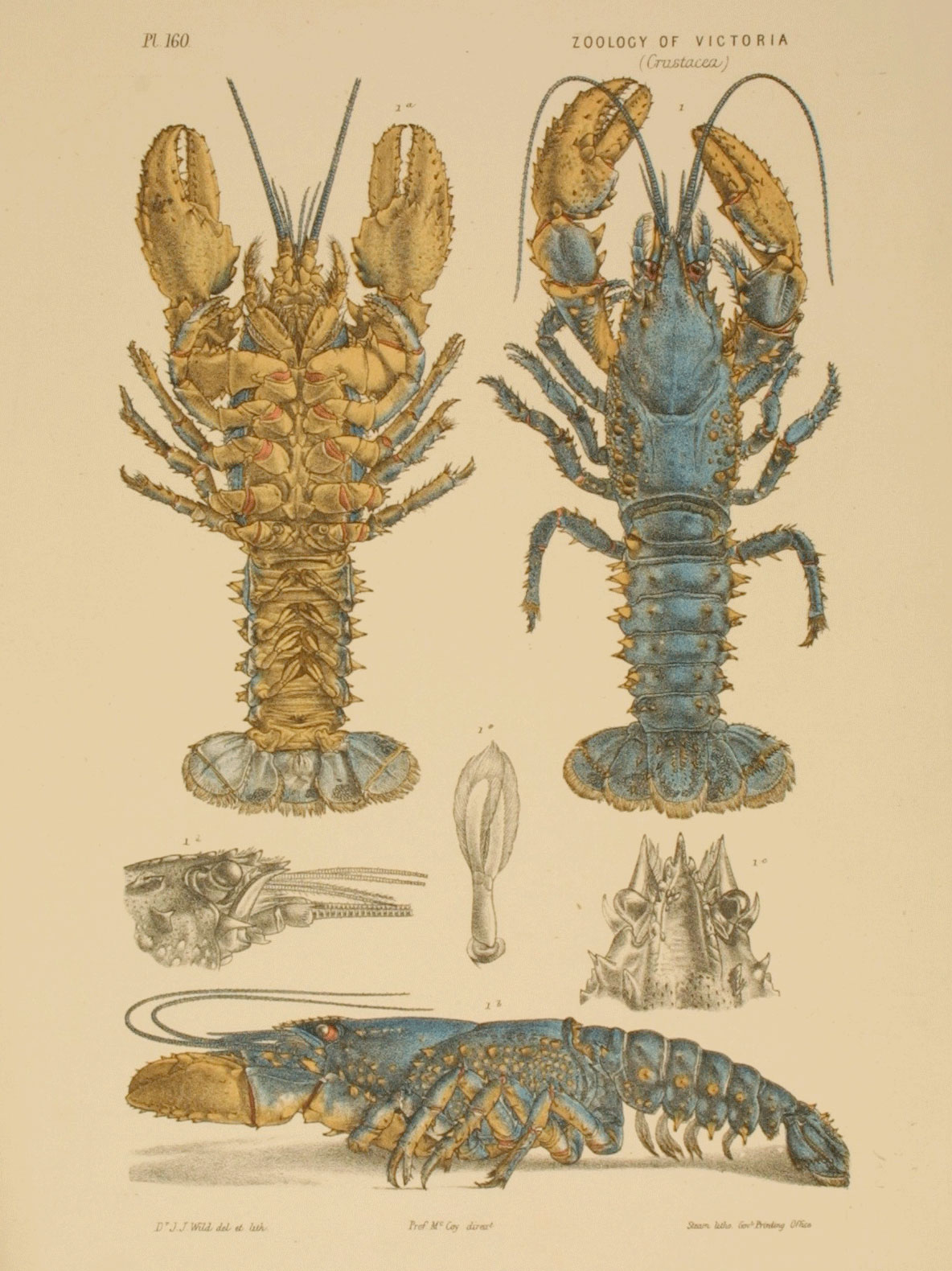
Six months after I published in the Second Decade the illustration of the Murray Cray-fish (A. serratus), and about a month after I published in the Third Decade the account of the Yabber Cray-fish (A. bicarinatus), there was published the number of the Proceedings of the Zoological Society of London containing Professor Huxley's remarkable paper on the classification and distribution of the Cray-fish, and I gladly recognize the internal anatomical peculiarity of the Australian Cray-fishes which he has pointed out, characterising his family ParastacidS, peculiar to the Southern Hemisphere, and differing from those of the other half of the world in the podobranchiæ having no lamina, and in the first joint of the abdomen being destitute of appendages in both sexes.
Our plate 160 illustrates a remarkable variety of the typical A. serratus of the Murray, common in the Yarra and its numerous effluents flowing southwards into the sea of the south coast of the colony; and as very few of the inhabitants of these river systems are identical (most of the species and many of the genera being dissimilar), this form is worthy of special note. It is usually less than half the size of the Murray individuals, being usually only five inches and rarely six inches long; it further differs in the whole thorax and abdomen above being of an intense Prussian-blue color, the spines, chelæ, and under surface ivory-white, with the membrane of the joints red. All the proportions and the number and disposition of the spines seem to me to agree so closely with the large pale Murray form, that, although so unlike at first glance, I have no doubt the southern race is merely a variety, which, for convenience of reference, may be distinguished by the name of the river in which it is chiefly found, from its mouth at Melbourne to its highest branches. The colors of those from the Watts River are particularly intense.