The phylum Annelida includes earthworms, sandworms and leeches. Characterised by elongated, segmented bodies, they have well developed respiratory, vascular and nervous systems.
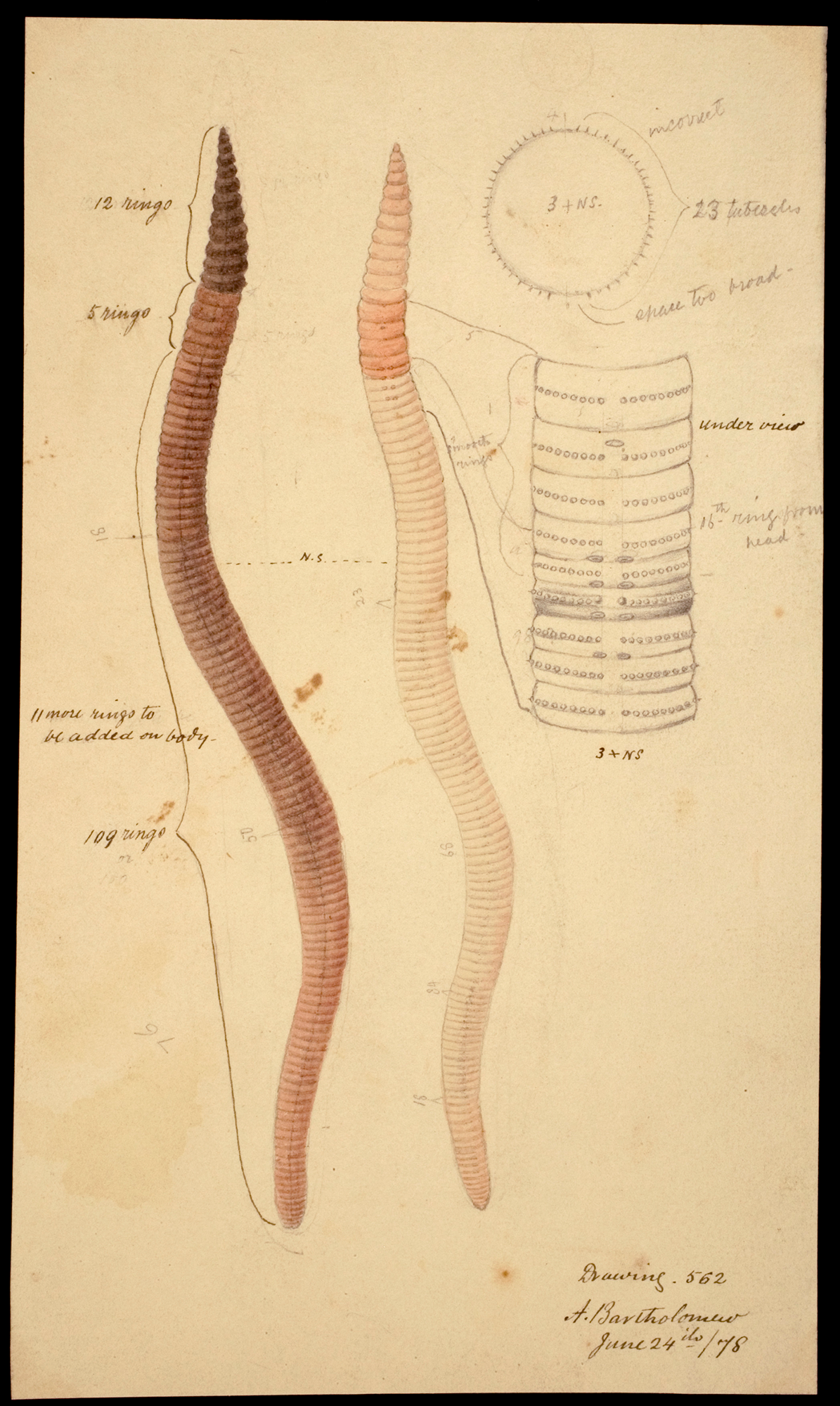
Only one species of earthworm was included in the Prodromus: McCoy's original description of Megascolides australis, the Giant Gippsland Earthworm. The longest earthworm in the world, this was a significant and surprising discovery.
Other earthworms, along with several species of leech, were drawn in the laboratory by Arthur Bartholomew, McCoy's lecture room assistant. Unlike the fragile Giant Gippsland Earthworm, these smaller animals could be kept alive in an aquarium within the lab for much closer observation. This allowed Bartholomew to capture the sinuous contraction and expansion of the leech's movement over several images.
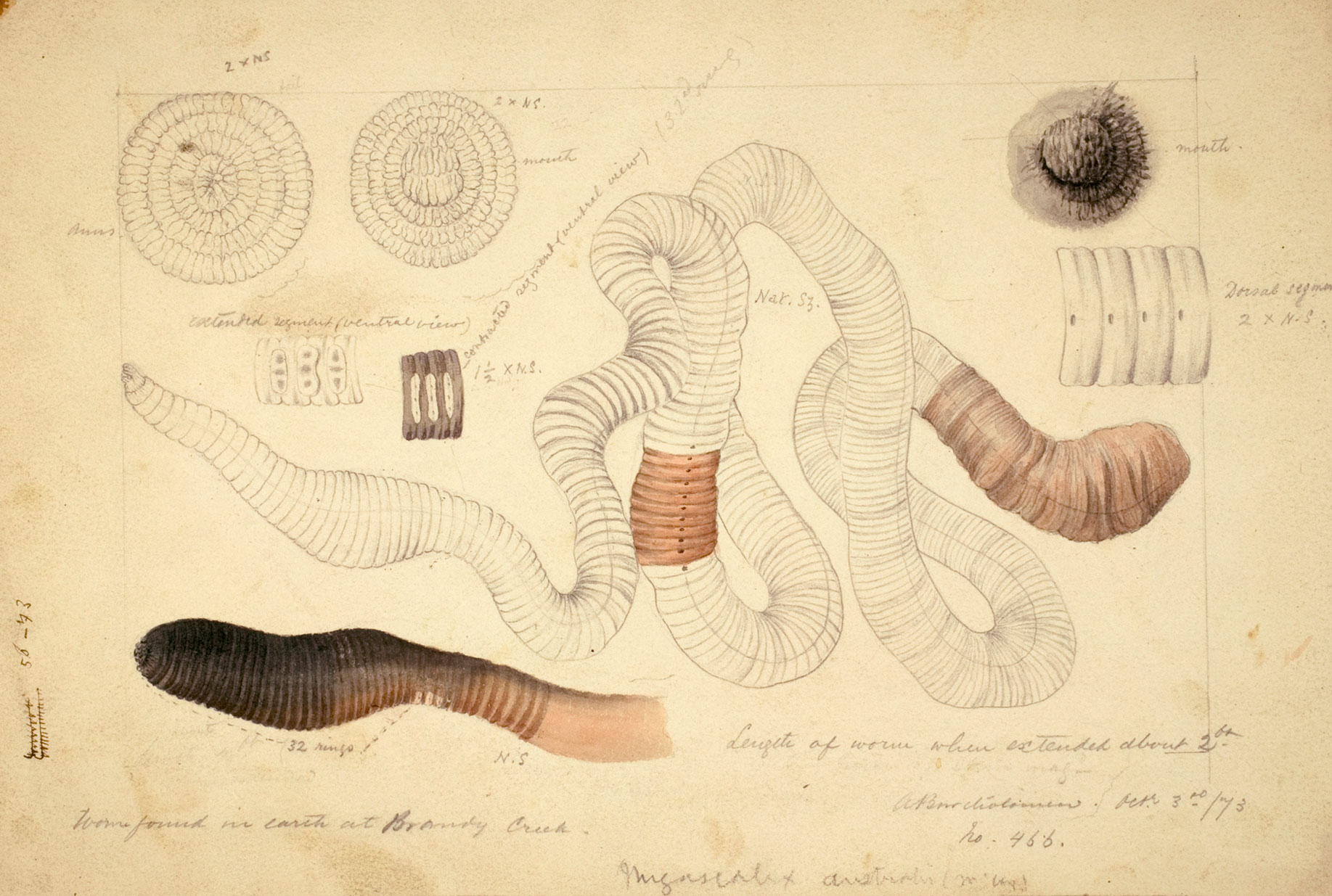
Giant Gippsland Earthworm
Megascolides australis
Dr. Templeton, of the Royal Artillery, was the first to draw attention to the existence of enormous earth-worms, 20-40 inches in length, and 1-1/2 inches in thickness, in the alpine region of Ceylon during the rainy season, in a letter sent to the Zoological Society of London, and published in their proceedings of 1845,* for which he proposed the name of Megascolex caeruleus, from their size and color.
I am constrained to use a special generic title Megascolides for the present form, and make it the type of a distant genus, which only differs as far as I know now from Lumbricus in its great size, very much more numerous rings, and the clitellæ formed of three separate short bands, not going round the body, but being confined to the ventral side.
On the first entry of the surveyors into that paradise of land selectors, the Brandy Creek district, on the new Gippsland line of railway, I received from them numerous specimens of this gigantic Earth-worm, with queries as to whether it were a snake or a worm, &c. All of them, from the great diameter of the digestive tube, were almost like small membranous sausage skins filled with earth, and from their great brittleness each individual was usually received divided into several pieces, the broken ends of which contracted so strongly as almost to close the would, and decomposition setting in so rapidly that very little of the essential characters could be made out. Although I have more recently examined perfect examples, both living and in spirit, I cannot find any male or female genital pores, such as are so conspicuous in Perichaeta, the former between some rings on the ventral surface in front of the "cingulum," and the latter behind it.
The living worms emit an odour resembling that of creosote. Like the ordinary earth-worms they burrow in the earth, swallowing the portion in front as they bore downwards, casting the portions from which they have abstracted the nutrient particles on the surface of the ground, renewing the surface by a kind of natural trenching which tends to bury the surface beneath a continual top-dressing of fresh soil from below.
A specimen of the thickness of that in the plate [15mm] will stretch itself along the ground to a length of 6 feet in its exertions to escape, and one of that thickness held up measured 5 foot 10 inches.