New research reveals Australian reptiles challenge established evolutionary theory
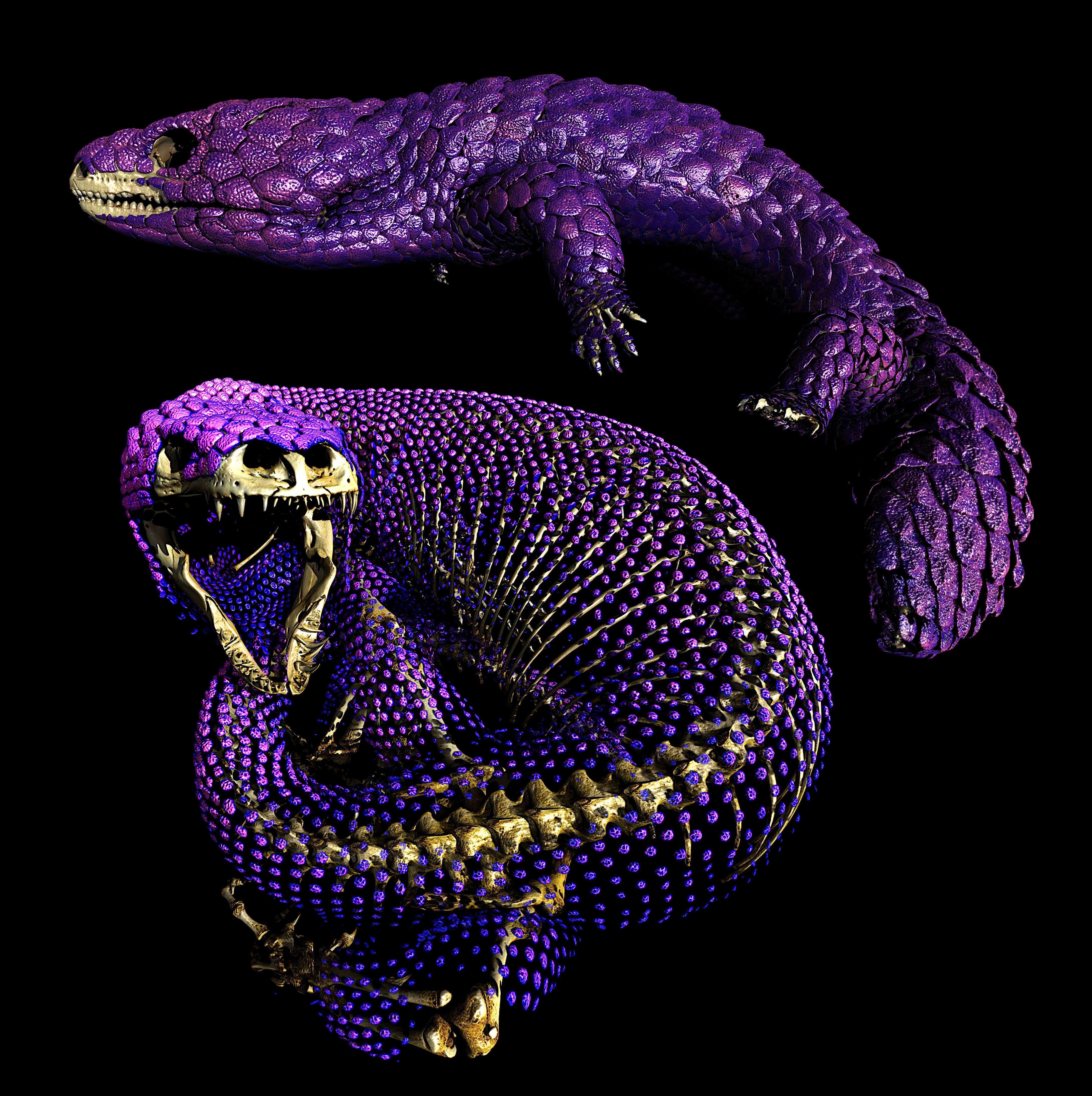
Groundbreaking new research showing the re-evolution of goannas’ skin bone plates, akin to chain mail armour, presents a direct challenge to a well-established 19th century evolutionary theory.
Dollo’s Law of irreversibility – proposed by Belgian palaeontologist Louis Dollo in 1893 – states that ‘an organism never returns exactly to a former state, even if it finds itself placed in conditions of existence identical to those in which it has previously lived’.
However, a new paper published today in the Biological Journal of the Linnean Society shows that monitor lizards (or the commonly known goanna) lost their skin bone plates (or osteoderms), most likely because their active lifestyle and efficient bodies worked better without the extra weight. When their descendants reached Australia 20 million years ago, something remarkable happened: they grew them back, in a direct challenge to Dollo’s Law.
‘This discovery also underscores Australia’s role as a hot spot for evolutionary oddities: a place where marsupials dominate, where mammals lay eggs, and now, where the only known ‘comeback’ of reptile osteoderms has occurred,’ said Roy Ebel, lead author and researcher at Museums Victoria Research Institute and the Australian National University.
This re-evolution can be traced back to the Miocene period, when Australia’s climate was becoming drier. The osteoderms’ bony protection barrier may have helped reduce water loss and likely offered protection in open, arid landscapes. Goannas are the only known case of a lizard lineage re-acquiring osteoderms after losing them.
To finally understand the origin of skin bone plates, scientists reconstructed 320 million years of osteoderm evolution across all reptiles, marking unparallelled taxon sampling.
As well as the re-evolution of goannas, the new research also resolves a century old debate. Earlier in the 20th century, researchers assumed that lizards inherited osteoderms from a common ancestor. The new study debunks this theory, showing that lizard osteoderms have several independent evolutionary origins dating back to the Jurassic and Cretaceous periods.
Despite their striking resemblance, species such as the gila monster and the shingleback lizard did not inherit their osteoderms from a common ancestor: they evolved them independently – just as powered flight arose in birds, bats, and pterosaurs.
Knowing when and how armour evolved gives scientists a solid base for exploring the genetic and developmental processes behind it. The next step is to test whether water-loss prevention really drove the re-evolution of armour in Australian goannas.
For now, the landmark study shows how modern tools can solve ancient mysteries, and how, in evolution, the more we look, the stranger and more fascinating the story becomes.
About Museums Victoria Research Institute
Established in 2022, the Museums Victoria Research Institute mobilises world-class collections and scientific expertise to address today’s most urgent and complex global challenges.
From climate change and biodiversity loss to migration, inequality and conflict, the Museums Victoria Research Institute utilises more than 170 years of museum-based research to better understand our rapidly changing world. The Institute redefines how research can inform and inspire change - connecting science, culture and community, to turn knowledge into action. Its work not only deepens public understanding but also helps shape a sustainable and equitable future through research.